







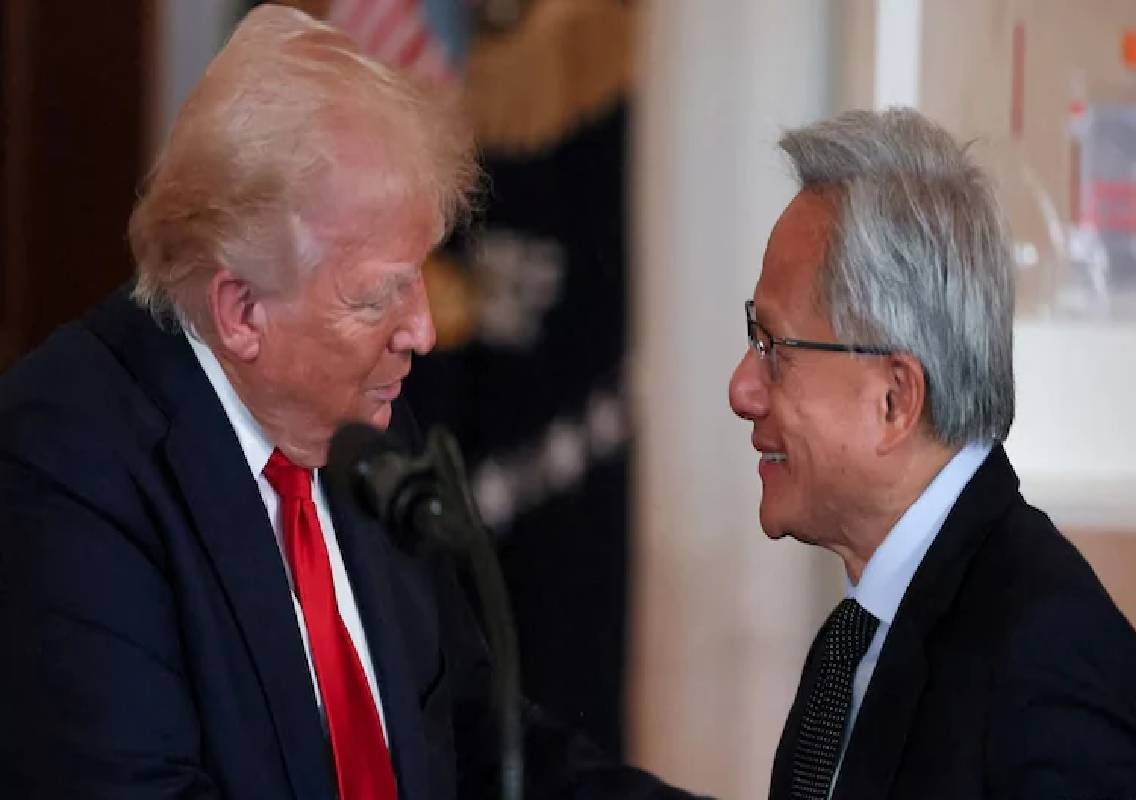


Washington: US President Donald Trump has defended his role in bringing Jensen Huang back as chief executive of Nvidia, assuring the company’s board that the technology executive poses no national security threat. However, Trump’s remarks about Huang’s expertise potentially benefiting China have raised questions amid continuing investigations into alleged links between a Singapore-based businesswoman and Chinese intelligence.
Huang, Nvidia’s co-founder, returned as the company’s president and CEO after an 11-day period of uncertainty that included his resignation and subsequent reinstatement. Nvidia’s 10-member board unanimously approved his return following discussions with Huang and assurances from senior US government officials that his leadership did not pose a security risk.
Trump says US government gave security assurances
Speaking to CNBC about his intervention, Trump said Nvidia’s board had sought assurances regarding the national security implications of Huang’s return.
“We gave them assurance, at least with everything we know, and we know a lot,” Trump said, explaining that the government had provided the requested assurance.
Trump has publicly taken credit for helping secure Huang’s reinstatement, arguing that his leadership is important to maintaining America’s position in artificial intelligence and advanced semiconductor technology.
However, the President also highlighted the possibility that the United States could lose Huang’s expertise to China if relations between the executive and the country deteriorated.
He suggested that Huang could take his knowledge of Nvidia’s advanced Blackwell AI chip technology to China if he became dissatisfied with the United States. Trump also speculated that Chinese President Xi Jinping might seek to recruit Huang rather than rely on espionage to obtain advanced semiconductor technology.
There has been no indication that Huang intends to move to China.
Controversy over alleged Chinese intelligence links
The controversy surrounding Huang intensified following reports about his relationship with Alice Huang, an executive at Singapore-based company Megaspeed.
US intelligence agencies reportedly suspect Alice Huang of having links to Chinese intelligence. The US Department of Justice is investigating her alleged connections with Beijing and Megaspeed.
The company has also come under scrutiny over allegations that it purchased Nvidia processors and routed them to Chinese customers, potentially circumventing US export restrictions.
These allegations have raised questions about whether sensitive technology or confidential company information could have reached China. However, the allegations remain under investigation and should not be treated as established findings.
Trump dismissed concerns about Alice Huang’s alleged links to Chinese intelligence during his CNBC interview, making remarks about the scrutiny faced by Chinese women in business.
The President also said the Justice Department had conducted an investigation and that Huang himself had been cleared of personal wrongdoing.
Congressional hearings and investigations ahead
Despite Trump’s assurances, Huang is expected to face questions from US lawmakers over the controversy.
According to the report, he is scheduled to appear at a closed-door hearing on December 1 before three House committees. He is also due to testify before a Senate committee on December 3, with the latter hearing set to be livestreamed.
The investigations are not limited to Huang’s personal connections. California’s attorney general has opened an investigation into Nvidia’s chip exports and disclosures to shareholders.
The California Department of Justice is seeking information on whether advanced Nvidia chips or confidential company information reached China and whether the company misled investors or the public.
The Securities and Exchange Commission has also reportedly launched an investigation into Nvidia’s accounting practices and communications with shareholders. Nvidia is continuing its own internal investigation despite Huang’s return to the leadership position.
Nvidia’s leadership and US-China technology competition
Nvidia occupies a central position in the global artificial intelligence industry, with its advanced processors widely used to develop and operate AI systems. Its technology has also become a major factor in the competition between the United States and China for leadership in advanced computing.
Huang’s return has therefore attracted attention beyond the company’s boardroom. The Trump administration has argued that retaining his leadership is important to America’s technological position, while the ongoing investigations reflect concerns about export controls and the protection of sensitive technology.
Trump’s latest comments underline the challenge facing the administration: supporting a major American technology company and its leadership while addressing national security concerns surrounding advanced chip exports and possible links to China.
Although the President has expressed confidence in Huang’s return, the upcoming congressional hearings and investigations are likely to keep the controversy in focus. Their findings could provide greater clarity on the allegations involving Megaspeed, the movement of Nvidia technology and the company’s compliance with US regulations.