







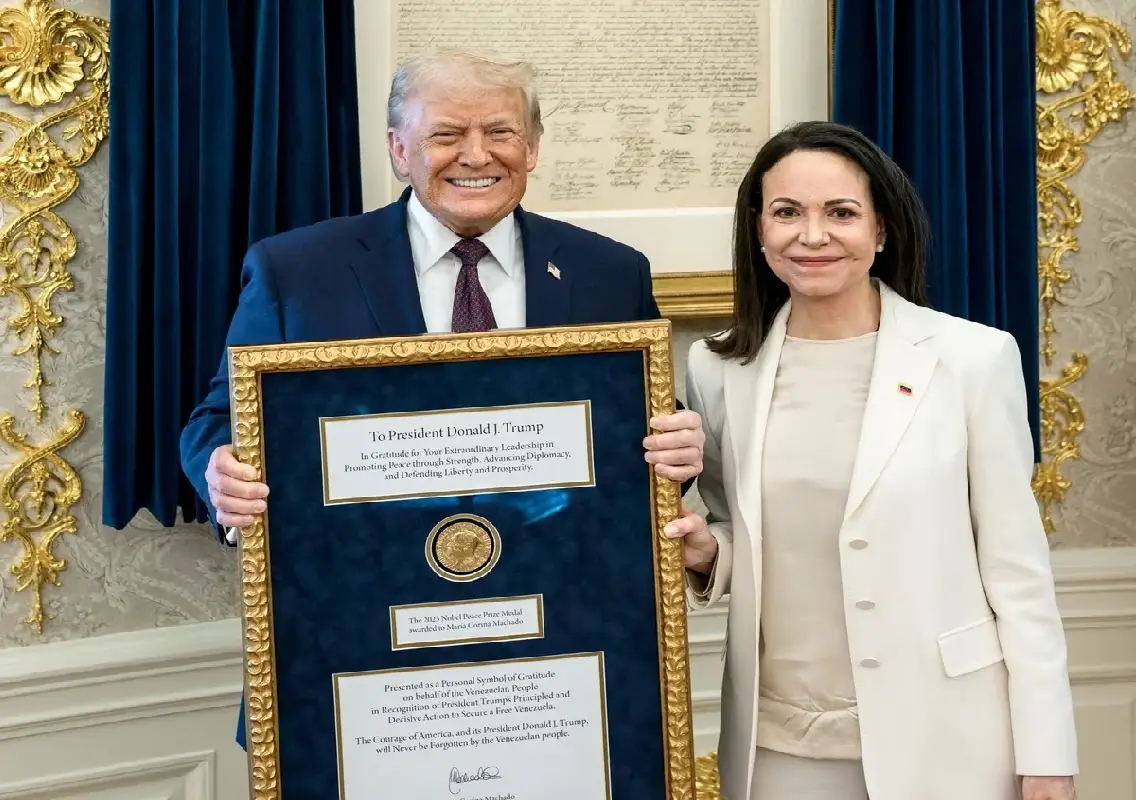


Washington: US President Donald Trump on Thursday publicly thanked Venezuelan opposition leader María Corina Machado after she presented him with her Nobel Peace Prize medal during a meeting at the White House — a symbolic and politically charged gesture that has drawn international attention.
The unusual event took place at the White House, where Machado, who won the 2025 Nobel Peace Prize for her long-standing efforts to advance democracy and oppose the authoritarian regime of Nicolás Maduro in Venezuela, offered Trump her Nobel medal as a sign of appreciation for what she described as his “unique commitment to our freedom.” Trump shared a post on his social platform Truth Social, calling Machado a “wonderful woman” and expressing gratitude for the gesture of “mutual respect.”
Symbolic presentation at White House
During the meeting, which was attended by officials from both sides, Machado presented the Nobel Peace Prize award — the physical medal — to Trump in a framed display. White House photos from the event showed the medal alongside an inscription praising Trump’s “extraordinary leadership in promoting peace through strength, advancing diplomacy, and defending liberty and prosperity,” a message attributed to Machado’s symbolic presentation.
While the physical medal was given to Trump, the Norwegian Nobel Institute and Nobel Committee have been clear that a Nobel Peace Prize cannot be formally transferred, revoked, shared or otherwise reassigned once it has been awarded. The Nobel laureate status remains exclusively Machado’s, even if the medal itself is in Trump’s possession.
Reactions and political context
Trump’s praise of Machado’s gesture comes amid continuing complexity in US-Venezuela relations. Earlier in January, the US conducted a major military operation in Venezuela that resulted in the capture of former President Maduro, who was taken into US custody to face charges. Machado and other opposition figures had hoped greater US support would bolster her position, but Trump has publicly questioned Machado’s political viability and has engaged with Venezuela’s interim leadership, including Delcy Rodríguez, who had served as Maduro’s vice president.
Machado described her meeting with Trump as positive and reaffirmed that Venezuelans “can count on” American support, although she has not secured a clear US commitment on democratic transition or elections. Her gesture of presenting the Nobel medal is widely seen as both a personal sign of gratitude and a strategic appeal for continued backing in Venezuela’s transition.
Nobel Prize traditions and limitations
The Nobel Peace Prize is conferred annually by the Norwegian Nobel Committee, and its statutes are strict: while the physical medal may change hands after it is awarded, the status of Nobel laureate is non-transferable and cannot be shared or revoked once officially granted. This clarification was issued by the Nobel Committee in recent days amid speculation that Machado might attempt to gift the prize to Trump.
The symbolic nature of the presentation does not alter the official record: Machado remains the 2025 Nobel Peace Prize winner, and Trump is not recognised as a laureate. This distinction has been emphasised by Nobel officials who reiterated the finality of the award and its rules regarding ownership and title.
Broader implications
Political analysts say the gesture highlights the fraught dynamics of Venezuelan politics and the role of international support in the country’s future. Machado, who has been sidelined in formal leadership roles despite her Nobel recognition, appears to be using the symbolic act to strengthen her political relevance and appeal to the US for backing against Maduro’s hold on power.
For Trump, accepting the medal (even if only symbolically) reinforces his narrative of global influence and leadership, a point he has often emphasised in both foreign and domestic political arenas. However, the Nobel Committee’s firm stance ensures that formal Nobel recognition remains solely with Machado.