







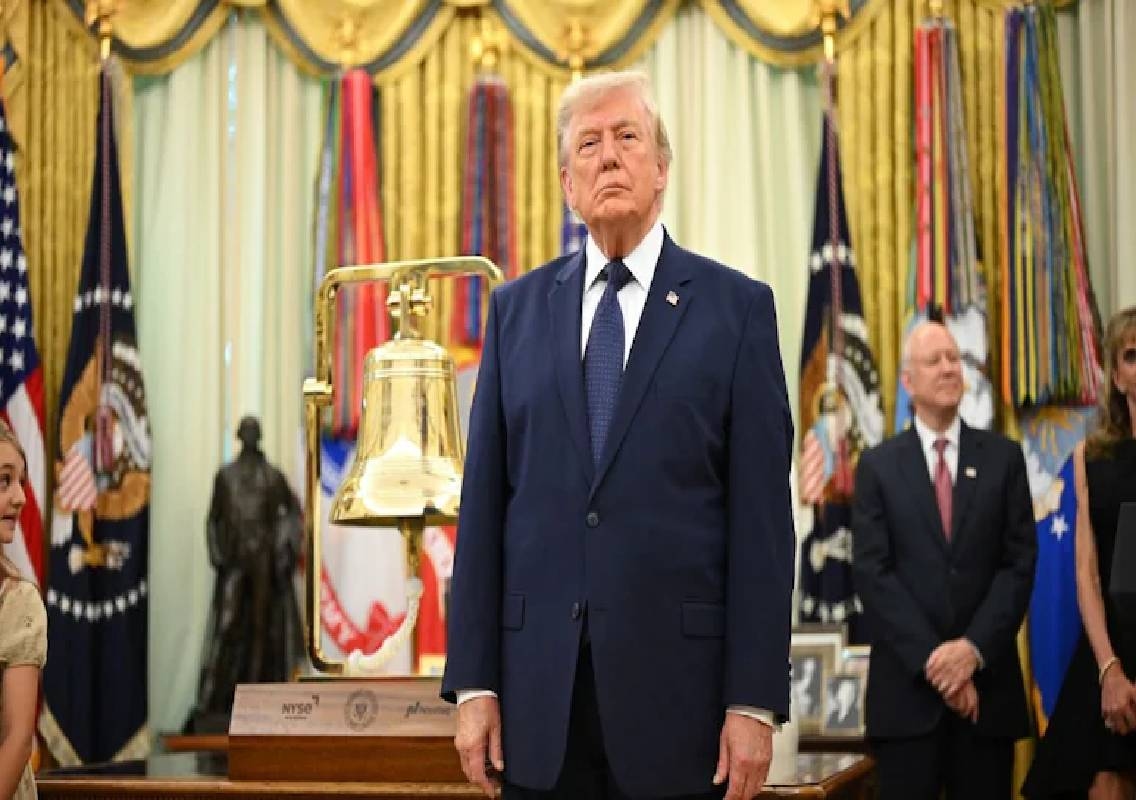


Washington: US President Donald Trump on Monday symbolically rang the opening bells of the New York Stock Exchange (NYSE) and the Nasdaq from the Oval Office, reinforcing his administration’s focus on stock market performance as a measure of economic success. The event also marked the launch of the new Trump Accounts, an investment programme designed to encourage long-term stock market participation among American children.
The ceremony comes as Trump seeks to highlight strong market performance despite facing declining public approval over inflation and the rising cost of living ahead of the November midterm elections.
Trump highlights stock market performance
During the ceremony, Trump expressed confidence in the future of the US economy and predicted further gains for investors.
“It’s going to go up – I think the market’s going to go through the roof,” Trump said after officially signalling the start of trading on both major stock exchanges.
The symbolic bell-ringing reflected Trump’s long-standing effort to associate his presidency with Wall Street’s performance, frequently pointing to rising stock prices as evidence of his administration’s economic policies.
However, public opinion remains divided on his handling of the economy.
According to a June survey by The Associated Press-NORC Center for Public Affairs Research, only 33 per cent of American adults approve of Trump’s economic leadership.
Trump Accounts launched to encourage investing
The Oval Office event also celebrated the rollout of Trump Accounts, introduced under the Republican administration’s 2025 tax and spending legislation.
The programme aims to help children build long-term wealth by investing in stock market index funds from an early age.
Each eligible account will receive an initial government contribution of 1,000 US dollars, with additional private donations encouraged from companies and philanthropists.
Treasury Secretary Scott Bessent said the initiative is intended to expand financial participation among Americans who currently have little or no exposure to equity markets.
He noted that approximately 38 per cent of American families do not own stocks or have investments linked to the equity market.
Billionaires pledge billions to the programme
The investment initiative has already attracted support from several prominent business leaders and philanthropists.
Michael Dell, founder of Dell Technologies, and his wife Susan Dell announced a commitment of 6.25 billion US dollars towards the programme.
Additional pledges have also come from billionaire investor Ray Dalio and Gwynne Shotwell, President of SpaceX, who announced plans to donate company stock to support the initiative.
The administration hopes such contributions will significantly increase participation and encourage long-term financial planning among younger generations.
Inflation continues to challenge administration
Despite strong gains in US stock markets, inflation remains a key concern for many American households.
The S&P 500 index has delivered impressive returns in recent years, rising 17.9 per cent in 2025 after recording gains of 25 per cent in 2024 and 26.3 per cent in 2023. The benchmark index has already gained roughly 10 per cent so far this year.
However, rising consumer prices have continued to weigh on Trump’s popularity.
The Consumer Price Index has increased 4.2 per cent over the past year, compared with 3 per cent when Trump began his second presidential term in January 2025.
Economists have attributed part of the inflationary pressure to higher tariffs and the economic impact of the conflict involving Iran.
White House hopes programme builds long-term wealth
The administration argues that expanding stock market ownership can help more Americans benefit from economic growth over the long term.
Treasury Secretary Bessent said increasing equity participation would allow more households to build financial security while strengthening the country’s investment culture.
Trump also joked that the programme should have been launched sooner, suggesting children had already missed out on recent market gains.
“We should have acted faster,” the President remarked during the event.
Focus shifts to economic messaging
As the United States moves closer to the November midterm elections, the Trump administration is expected to continue highlighting economic growth, stock market performance and investment initiatives as key achievements.
While Wall Street has responded positively in recent months, polling indicates many voters remain more concerned about everyday expenses than investment returns.
The success of programmes such as Trump Accounts may ultimately depend on whether they can broaden stock market participation beyond wealthier households and deliver meaningful long-term financial benefits.