


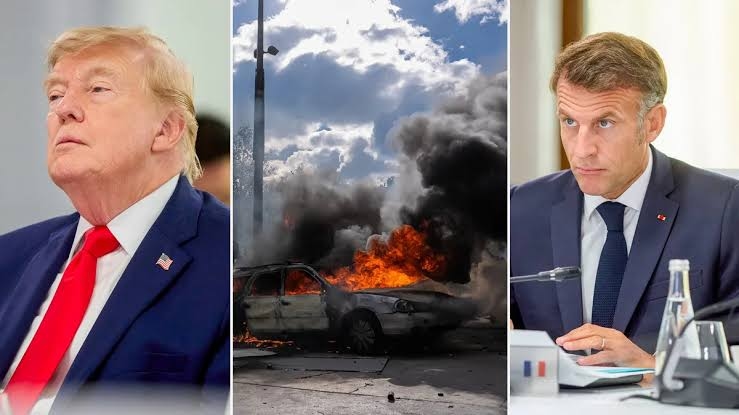


Washington: US President Donald Trump has blamed French President Emmanuel Macron’s immigration policies for the riots sweeping France, claiming the unrest could have been avoided if the French government had followed his advice on immigration.
“Paris is going to be a Muslim city very soon, and that wasn’t the deal,” Trump said on Monday, alleging that immigration had significantly changed the French capital’s demographic composition.
Speaking to reporters outside the White House, Trump said he had warned Macron years ago against allowing large numbers of immigrants to enter France. He described the French president as a friend but argued that his immigration policies had been a mistake.
“He’s a friend of mine. I told him a long time ago, you’re making a big mistake in France. You’re letting everybody from the world come in,” Trump said.
“The whole world was coming in. And as you know, Paris is going to be a Muslim city very soon, and that wasn’t the deal. That wasn’t the deal,” he added.
Trump’s remarks came as French authorities introduced localised curfews and restrictions on public gatherings following a weekend of riots, looting and clashes between protesters and police. The unrest has intensified pressure on Macron’s government to restore order, protect businesses and address concerns about public safety.
According to figures cited by France’s Interior Ministry, around 2,400 people were arrested and nearly 1,000 officers were injured during the violence. The unrest has also caused extensive damage to commercial establishments across several cities.
France imposes localised curfews after weekend violence
French authorities opted for targeted restrictions rather than imposing a blanket curfew across Paris. Prime Minister Sébastien Lecornu said localised measures were more appropriate at this stage, although the government had not ruled out declaring a state of emergency.
“My determination to restore order is absolute,” Lecornu told reporters.
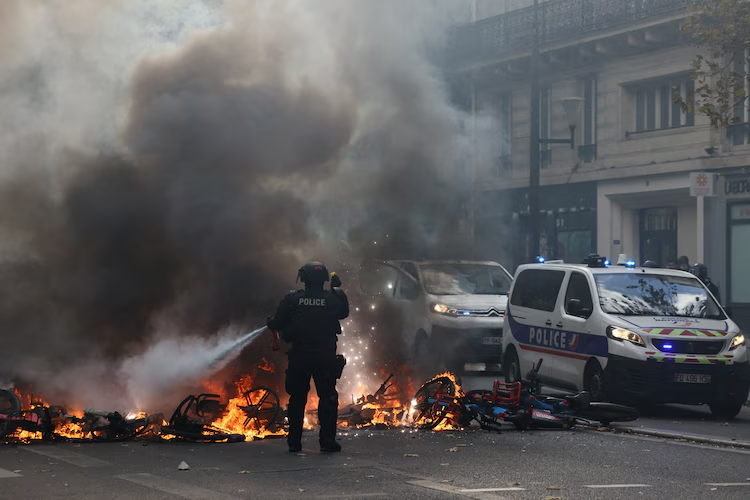
Paris police prohibited demonstrations in certain areas of the capital from 8 pm on Monday. A curfew was also imposed around Place de la République and Les Halles, running from 11 pm until 6 am on Tuesday, according to reports.
Additional police personnel were deployed to enforce the restrictions and prevent further clashes, looting and damage to property.
The measures reflected the government’s attempt to contain the unrest without immediately resorting to emergency powers across the country. Authorities have faced pressure to ensure public safety while distinguishing between peaceful demonstrators and those involved in violence.
The reported death of a protester who suffered a cardiac arrest on Saturday added to concerns surrounding the unrest. The available information does not establish that the death was directly caused by police action or violence.
The Federation of Trade and Retail said nearly 3,000 shops had been affected by the weekend’s violence. The scale of the reported damage prompted calls for government assistance to businesses facing losses from looting and destruction.
The unrest has therefore become both a security challenge and an economic concern, with retailers and other commercial establishments seeking protection and support.
Macron condemns destruction and urges restraint
Macron earlier condemned the destruction in a televised address, expressing anger and shame over the scenes of violence.
“Nothing justifies it, nothing explains it, nothing excuses it,” the French president said, questioning how citizens could engage in acts that damaged their own country.
At the same time, Macron acknowledged that people participating in peaceful demonstrations could have legitimate grievances. He stressed that those concerns should not be conflated with the actions of individuals involved in looting, assaults or destruction of property.
The president stopped short of declaring a state of emergency but indicated that local authorities would be empowered to prohibit demonstrations when necessary to protect public buildings, businesses and residents.
His response sought to balance the need to restore public order with the recognition that peaceful protest and violent unrest are not the same.
The government’s approach has also faced scrutiny over whether existing security arrangements were sufficient to prevent the scale of destruction reported over the weekend.
Immigration becomes central to political debate
Trump used the unrest to renew his criticism of Macron’s immigration policies, presenting the violence as evidence of what he considers the consequences of allowing large numbers of immigrants into France.
His claim that Paris would soon become a Muslim city was a political assertion, not an established demographic forecast. The remarks also linked the unrest to immigration without evidence in the supplied account establishing that immigration or the religious identity of immigrants caused the riots.
France has a diverse population, including Muslim communities with varied national origins and backgrounds. The presence of these communities should not be treated as evidence that they are responsible for violence or disorder.
Trump’s comments reflect a broader political debate in the United States and Europe over immigration, integration, national identity and security. Immigration has become a prominent issue for right-wing political movements, which frequently argue for stricter border controls and tougher enforcement.
However, the causes of riots can be complex and may involve different political, social and economic factors. Establishing why the latest unrest occurred would require evidence about the events that triggered the protests, the participants involved and the circumstances surrounding the violence.
Trump’s intervention has added an international dimension to the debate, turning the French government’s handling of the unrest into another point of disagreement over immigration policy.
French government faces pressure to restore order
The riots have placed Lecornu’s government under mounting pressure to protect public spaces, prevent further attacks on businesses and reassure residents in affected areas.
The reported arrests and injuries highlight the scale of the security operation required to respond to the unrest. Meanwhile, the damage to thousands of shops has raised concerns about the financial consequences for retailers and workers.
Localised curfews and restrictions on demonstrations are intended to give police greater control over areas considered vulnerable to further violence. The effectiveness of these measures will depend on whether authorities can prevent new incidents while maintaining public confidence.
The government may also face questions about its preparedness, the handling of demonstrations and the support available to businesses affected by looting.
For Macron, the immediate challenge is to restore order while responding to public concerns without treating peaceful protest as equivalent to criminal violence.
Trump’s comments have sharpened the political dispute by framing the unrest as a consequence of immigration. But his claims about Paris’s future demographic composition remain his own assertions, separate from the French government’s response to the riots.
As authorities continue enforcing restrictions, the focus remains on preventing further violence, protecting residents and businesses, and determining the circumstances behind the unrest.