







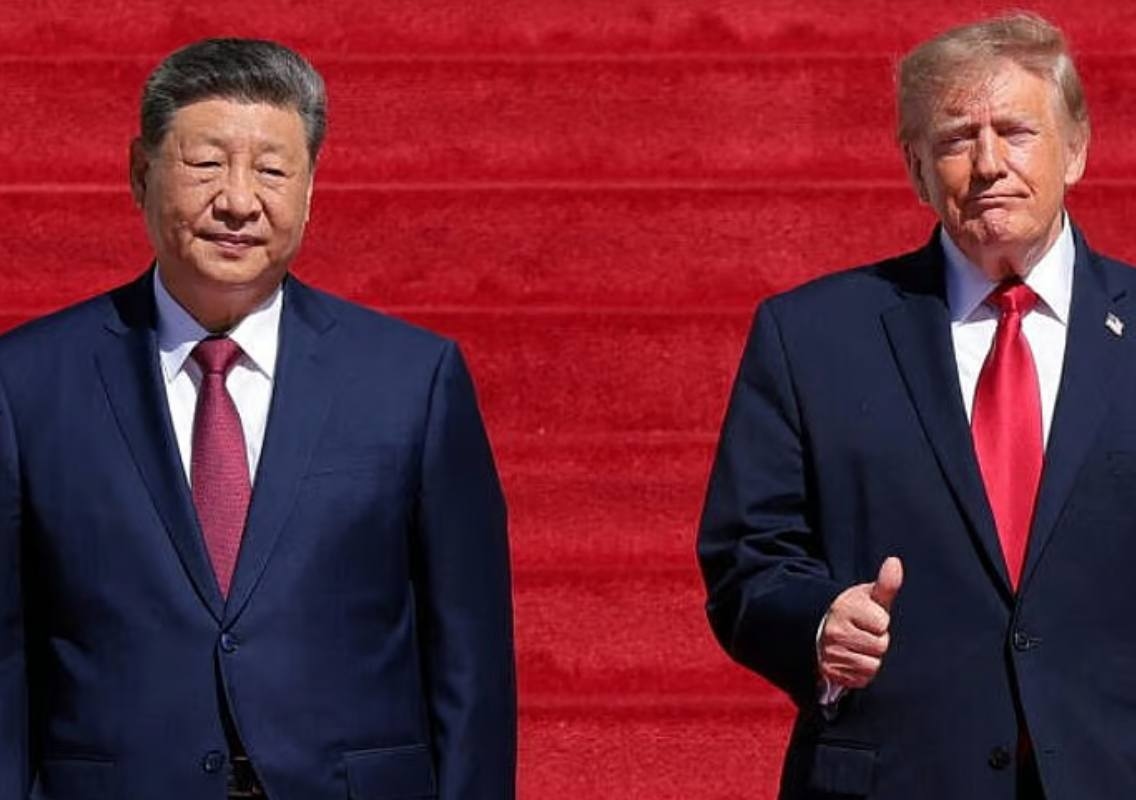


Washington: US President Donald Trump and Chinese President Xi Jinping’s high-profile summit in Washington produced a series of limited economic agreements but did not resolve major differences between the world’s two largest economies, according to analysts and official statements.
The three-day visit, which concluded on Friday, September 25, focused on stabilising the US-China relationship amid disputes over trade, technology, artificial intelligence, Taiwan, critical minerals and the conflict involving Iran.
The two countries subsequently announced recommendations for more favourable tariff treatment covering $60 billion worth of two-way trade, with each side identifying $30 billion of non-sensitive goods. However, the agreement remains subject to further discussions rather than representing a comprehensive settlement of the broader trade dispute.
Analysts cited by Reuters described the outcome as a continuation of what they see as a managed period of competition rather than a major breakthrough. Some argued that the summit’s elaborate ceremony provided Beijing with diplomatic advantages, while others pointed to the economic measures and continued high-level dialogue as evidence that both governments are trying to prevent relations from deteriorating further.
Tariff agreement covers $60 billion in goods
The clearest economic outcome was the agreement to recommend lower tariffs on $30 billion of goods moving in each direction.
The US list includes agricultural products, fish and seafood, wood products, cosmetics and medical devices. China’s list includes a range of US agricultural products and other goods.
The White House said the arrangement could improve market access for roughly 30% of US exports to China. China said the proposed reciprocal tariff reductions could create better conditions for trade in agriculture, energy, manufactured goods and consumer products.
On Monday, the two governments released more details of the products covered. China’s list included items such as corn, dairy products and other agricultural goods, while US tariff reductions were expected to cover products including small appliances, toys and holiday decorations.
However, analysts cautioned that the lists largely concern non-sensitive products and may not fundamentally change the overall structure of US-China trade.
Deborah Elms of the Hinrich Foundation told Al Jazeera that the products covered were unlikely to significantly alter overall trade flows, although some tariff reductions could benefit consumers and businesses.
Trade truce extended, but wider disputes remain
The two sides also agreed to extend their existing trade truce, providing additional time for negotiations.
The broader US-China economic relationship, however, remains unsettled. The two countries continue to have differences over technology controls, rare earths and critical minerals, investment, market access and industrial policy.
The US and China have also been working through previously announced mechanisms, including the US-China Board of Trade and Board of Investment. The White House said the two leaders operationalised both mechanisms during Xi’s visit.
The Board of Trade has been tasked with addressing market access issues and tariff arrangements, while the investment mechanism is intended to facilitate greater two-way investment.
The progress on investment remains more uncertain because security concerns and political mistrust continue to restrict major Chinese investment in the US.
Lack of major business delegation draws attention
Another point highlighted by analysts was the absence of a large delegation of Chinese corporate executives accompanying Xi for the Washington visit.
Earlier expectations had included the possibility of significant business announcements and investment commitments. The absence of a major Chinese CEO delegation, however, underscored the difficulties involved in expanding two-way investment while Washington and Beijing continue to scrutinise each other’s companies and technologies on national security grounds.
The issue is significant because the two governments had previously discussed creating mechanisms to encourage investment between their economies.
While the Board of Investment has now been operationalised, analysts say the existence of the mechanism does not automatically mean that major investment flows will follow.
China retains leverage through critical minerals
China’s position in global supply chains for rare earths and other critical minerals remains one of Beijing’s important sources of leverage.
These materials are used across industries including electronics, electric vehicles, renewable energy, aerospace and defence.
The US has sought greater reliability in supplies of rare earths and other critical minerals, while China has used export controls as part of its broader economic policy.
The White House said the two countries continued discussions over US concerns about rare earth supplies, with the stated goal of restoring shipments to appropriate levels.
This issue remains separate from the newly announced tariff arrangements and could continue to feature prominently in future US-China negotiations.
US farmers get some tariff relief
The tariff discussions could provide some benefits to American agricultural exporters.
China’s list of products for potential tariff reductions includes several agricultural commodities, including corn, wheat, meat and dairy products.
However, soybeans — one of the most important US agricultural exports to China — were notably absent from the list reported on Monday. That has led analysts to question how much the latest agricultural arrangement will change the broader trade picture.
The agricultural issue is politically significant in the US because farmers represent an important constituency for the Trump administration.
The agreement could therefore provide some relief to exporters, although the extent of the benefit will depend on implementation, purchase volumes and the final tariff arrangements.
Taiwan remains a major unresolved issue
The summit also did not eliminate differences over Taiwan.
China considers Taiwan part of its territory, while the US maintains unofficial relations with the island and has long provided it with defensive military equipment.
Trump did not make Taiwan a central feature of his public comments following the summit, in contrast with earlier discussions in which US arms sales to Taiwan had been described as part of negotiations with Beijing.
Analysts said the absence of a major public confrontation on Taiwan may help preserve diplomatic stability, but it does not resolve the underlying disagreement.
Taiwan remains one of the most sensitive issues in the US-China relationship and could become a source of tension again if Washington announces additional military support for Taipei or Beijing responds with stronger military or economic measures.
Iran also exposed differences
The summit did not produce a major joint initiative on the conflict involving Iran.
China has maintained its own diplomatic position on the conflict, while the Trump administration has sought international support for its approach.
Following Xi’s departure from Washington, Chinese Vice President Han Zheng reiterated Beijing’s positions at the United Nations General Assembly, illustrating that the summit did not result in a broad alignment between the two governments on geopolitical issues beyond their bilateral economic relationship.
The disagreement is significant because the conflict has wider consequences for energy markets and global trade.
AI cooperation provides another opening
Artificial intelligence was another area where the two countries agreed to continue dialogue.
The White House said the leaders agreed to establish mechanisms for communication on AI-related incidents. The move is intended to create channels for discussions around risks associated with increasingly advanced AI systems.
The agreement does not remove the much deeper technology rivalry between Washington and Beijing.
The US continues to impose restrictions on access to some advanced technologies, while China is seeking to strengthen its domestic capabilities in AI and semiconductor manufacturing.
Nevertheless, the creation of a communication channel could provide a mechanism for the two governments to discuss potential risks even while competition continues.
More meetings planned before year-end
Trump and Xi are expected to meet again at the Asia-Pacific Economic Cooperation (APEC) summit in Shenzhen in November and later at the G20 gathering in Miami in December.
The frequency of meetings means that the Washington summit is unlikely to be viewed as a final settlement of US-China differences.
Instead, the two governments appear to be maintaining direct communication while attempting to prevent trade and geopolitical disputes from escalating into a broader confrontation.
The challenge will be to translate the agreements announced during the summit into concrete changes in trade, investment and technology relations.
What the summit achieved
The summit produced several tangible outcomes:
- Recommendations for lower tariffs covering $30 billion of non-sensitive goods in each direction.
- An extension of the existing US-China trade truce.
- Further work through the Boards of Trade and Investment.
- Continued discussions over rare earths and critical minerals.
- An AI communication mechanism.
- Continued high-level engagement between Trump and Xi.
- Plans for further meetings at APEC and the G20.
At the same time, major disagreements over Taiwan, advanced technology, critical minerals, investment and broader geopolitical issues remain unresolved.
Why analysts call it a limited breakthrough
The differing assessments of the summit reflect the gap between the agreements announced and the larger disputes that remain.
Some analysts cited by Reuters viewed the ceremony and diplomatic attention surrounding Xi’s visit as advantageous to Beijing, particularly because the summit did not result in major Chinese concessions on several contentious issues. Others argued that the value of the meeting lies in keeping communication open and creating mechanisms that can prevent disputes from escalating.
The latest tariff agreement itself is meaningful for the affected products, but its broader economic impact is limited by its focus on non-sensitive goods.
The summit therefore appears to have produced incremental progress rather than a comprehensive reset in US-China relations.
Conclusion
Trump and Xi’s Washington summit produced concrete but limited economic agreements while leaving many of the most difficult US-China disputes unresolved.
The $60 billion tariff arrangement, extension of the trade truce, AI dialogue and continued work on investment provide channels for cooperation. However, disagreements over Taiwan, technology, rare earths, investment and geopolitical issues remain significant.
For Washington and Beijing, the immediate objective appears to be maintaining stability while continuing negotiations on areas where their interests overlap. Whether the latest agreements develop into a broader improvement in relations will depend on their implementation and the outcome of negotiations ahead of the leaders’ planned meetings later this year.