





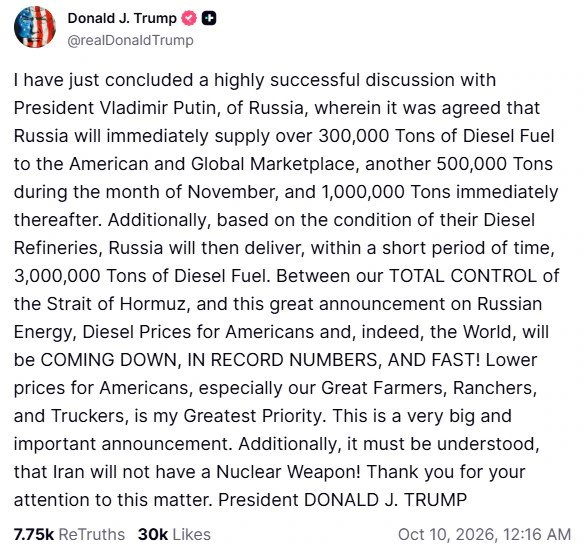
Washington: US President Donald Trump has announced plans to bring large quantities of Russian diesel into American and global markets in a sharp reversal of Washington’s policy of restricting Moscow’s energy revenues over its war against Ukraine. The move has drawn strong criticism from Ukrainian President Volodymyr Zelenskyy, who warned that the arrangement would provide Russia with additional resources to continue the conflict.
Trump said Russia had agreed to supply more than 300,000 metric tonnes of diesel immediately, followed by another 500,000 tonnes in November and 1 million tonnes thereafter. He also indicated that a further 3 million tonnes could be delivered within a relatively short period, depending on the condition of Russian refineries.
The announcement followed what Trump described as a “highly successful” conversation with Russian President Vladimir Putin on Friday, October 9. It comes as American diesel prices remain elevated and the November 3 midterm elections approach, with rising living costs emerging as a concern for voters.
The decision is particularly contentious because Trump signed a sweeping Russia sanctions law last month intended to restrict revenue streams that help Moscow finance its war against Ukraine.
Zelenskyy calls Russian diesel deal an investment in war
Zelenskyy criticised the arrangement, arguing that allowing Russia to sell petroleum products would undermine efforts to end the war.
“Gifts to Putin will not bring peace or any benefit to the civilised world,” the Ukrainian president wrote on X.
He also described the arrangement as “an investment in a war that must be ended, not prolonged” and called for genuine de-escalation based on reciprocal action.
Speaking about the broader negotiations, Zelenskyy expressed concern that Ukraine was being used as a cover for an agreement reached between Washington and Moscow. He characterised the decision as a weak move by otherwise strong partners.
His criticism reflects Kyiv’s concern that easing restrictions on Russian energy exports could strengthen Moscow financially even as Ukraine continues to face Russian military attacks.
The announcement also came while US envoys Steve Witkoff and Jared Kushner were meeting Ukrainian representatives in Miami to discuss proposals for ending the war. The timing raised questions in Kyiv about Washington’s negotiating priorities and whether the diesel arrangement would affect the broader peace effort.
Ukraine offered to halt refinery strikes, report says
According to Axios, US representatives told Ukrainian negotiators that Trump was expected to speak with Putin and ease restrictions on Russian diesel exports.
The discussions reportedly took place during eight hours of talks in Miami. The negotiations came amid continued Ukrainian attacks on Russian oil infrastructure, which Washington has linked to pressure on international fuel supplies and prices.
Zelenskyy reportedly offered to halt strikes on Russian oil refineries if Moscow stopped attacking Ukrainian power plants. Such a proposal would require reciprocal commitments from both sides, and the available reporting does not establish that an agreement on those terms was reached.
The dispute illustrates the difficulty of reconciling Washington’s immediate concerns about fuel costs with its stated objective of ending Russia’s war against Ukraine.
For Kyiv, attacks on Russian energy infrastructure are part of its effort to weaken Moscow’s ability to finance military operations. For Washington, disruptions to refining capacity and fuel supplies have become an additional concern as prices rise.
Trump says lowering fuel costs is his priority
Trump defended the decision by pointing to the impact of diesel prices on American households and businesses.
“Lower prices for Americans, especially our Great Farmers, Ranchers, and Truckers, is my Greatest Priority,” he wrote on social media.
Diesel is essential to freight transport, agriculture, construction and some home-heating systems. Higher prices can increase the cost of moving goods and producing food, potentially feeding into wider inflation.
The administration is under pressure to improve fuel availability as global energy markets face disruptions linked to the war involving Iran, damage to refining infrastructure and constraints on shipping.
The Group of Seven countries had also agreed to release 100 million barrels of oil and diesel from reserves amid concerns over supply and prices.
The US Treasury Department issued a temporary licence easing sanctions on certain Russian diesel shipments. The measure represents a significant departure from the policy of limiting Russian energy revenues following Moscow’s invasion of Ukraine.
Russian presidential envoy Kirill Dmitriev welcomed the announcement, saying cooperation between Russia and the United States on diesel and energy could benefit global markets.
Diesel prices remain a major concern in the US
According to the American Automobile Association, the average US diesel price reached approximately $6.28 per gallon on Thursday, October 8. Although prices had eased slightly from earlier levels, they remained sharply higher than a month before.
Diesel prices have risen substantially since the US and Israel began their war against Iran on February 28, adding to pressure on businesses that rely on fuel-intensive transport and operations.
The conflict has contributed to disruptions in global energy supply chains, while the war in Ukraine and damage to Russian refineries have further tightened the market.
After Trump announced the Russian supply arrangement, US diesel futures fell sharply, reflecting expectations that additional fuel could improve near-term availability. However, a fall in futures prices does not guarantee that consumers will see a comparable or lasting reduction at the pump.
The administration has also considered other measures to contain domestic fuel costs, including expanding access to tax-exempt red-dyed diesel, which is commonly used in agricultural equipment.
Analysts question whether Russian supplies will lower prices significantly
Energy analysts have warned that the proposed Russian deliveries may not be enough to produce a substantial or sustained reduction in diesel prices.
Oil-market researcher Rory Johnston, founder of CommodityContext.com, described the announcement as a “nothing burger” in a post on X. He argued that Russia typically exports considerably more diesel when its refineries are operating without major disruptions.
Jim Mitchell, an analyst at Wood Mackenzie, said the additional supplies could offer some relief to a market already facing tight conditions.
“It’s clearly not a fix, but another stream to aid a very tight diesel market,” Mitchell said.
The initial 300,000 tonnes of diesel would amount to approximately 2.25 million barrels. Although that is a substantial shipment, it is small relative to the scale of the global fuel market and the supply disruptions that have pushed prices higher.
The actual impact will depend on how much fuel is delivered, when it reaches buyers and whether other disruptions continue. Analysts have also questioned whether the announced volumes will materialise as quickly as suggested.
The deal could therefore provide additional supply without resolving the structural constraints affecting the market.
US considers further measures to expand fuel production
The Trump administration is also examining domestic measures to contain diesel costs.
Reuters reported that the president was expected to direct government departments to explore ways of increasing fuel output and addressing regulations that constrain energy production.
One option under consideration involves the Defense Production Act, a Cold War-era law that allows the federal government to support and prioritise the production of goods considered essential to national security.
The law can provide tools such as government-backed loans and loan guarantees, as well as the prioritisation of certain contracts. Its use to expand oil and fuel production would depend on the specific measures adopted by the administration.
The White House has also been examining ways to expand refining capacity. Industry executives have reportedly argued that upgrading existing facilities would be more practical in the short term than constructing new refineries, which can take years to complete.
These domestic initiatives reflect the administration’s attempt to address fuel prices through a combination of additional imports, regulatory changes and increased production.
A difficult balance between energy prices and sanctions
Trump’s announcement exposes a central challenge in US policy: reducing fuel costs for American consumers while maintaining economic pressure on Russia over its war against Ukraine.
For the White House, additional diesel supplies could offer some relief to a market under pressure. However, the scale and timing of the proposed deliveries remain uncertain, and analysts caution that the deal is unlikely to solve the wider supply shortage on its own.
For Ukraine, the decision risks weakening the economic pressure on Moscow and complicating negotiations to end the war. Zelenskyy’s response reflects concern that Russia could gain financially from the arrangement without making equivalent concessions on the battlefield.
The temporary easing of sanctions also raises questions about how Washington will implement its recently enacted restrictions on Russian energy revenues.
Ultimately, the success of the arrangement will depend on whether the promised supplies reach the market and whether they meaningfully reduce fuel costs. Its broader diplomatic consequences may prove equally significant, particularly if Kyiv concludes that Washington is prioritising short-term energy relief over pressure on Moscow to end the war.