







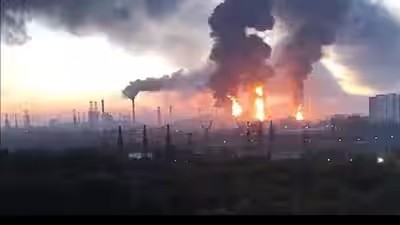


Moscow: Ukraine launched a massive overnight drone attack on Russia, with Russian officials saying more than 1,000 drones were intercepted across the country and 450 were heading towards Moscow, in what the capital’s mayor described as the largest drone attack on Moscow so far.
The strikes hit several locations around the Russian capital, including the Moscow Oil Refinery and a residential building. At least two people were killed in the Moscow region, while 20 others were injured, according to Russian authorities. A third person later died in hospital, Reuters reported.
The attack came on the third and final day of Russia’s parliamentary elections, with Moscow Mayor Sergei Sobyanin accusing Ukraine of attempting to disrupt the voting. He said the attack did not prevent the elections from continuing.
More than 1,600 drones reported intercepted
Sobyanin said Russian air defences had intercepted more than 1,600 drones since Saturday, including 450 that were heading towards Moscow.
Russia’s Defence Ministry separately said it had destroyed or intercepted 1,110 Ukrainian drones overnight across Russia, occupied Crimea and the Black Sea, according to reports. The differing figures reflect separate reporting periods and locations.
Several drones reached the grounds of the Moscow Oil Refinery, while another struck a residential building, according to Russian officials.
The attack caused damage in the Moscow region and led to the evacuation of around 400 people, including 70 children, from a damaged apartment building, regional Governor Andrei Vorobyov said.
Moscow refinery damaged
The Moscow Oil Refinery, a major facility operated by Gazprom Neft, was among the sites affected.
Smoke and fire were reported at the refinery after the drone strikes. The facility, located in Moscow’s Kapotnya district, has previously been targeted during the war. Reuters reported that the refinery processed around 11.6 million tonnes of oil in 2024.
Ukrainian President Volodymyr Zelenskyy said the attack targeted Russian oil and logistics infrastructure that helps finance the war.
Zelenskyy said domestically developed weapons, including drones and missiles, were used against the facilities. He described the targets as sources of revenue supporting Russia’s military campaign.
Russia accuses Ukraine of election disruption
The drone assault coincided with the final day of Russia’s parliamentary elections.
Sobyanin described it as an “unprecedented attack” and said it had been planned to disrupt the voting. He said Russian authorities had prevented the attack from achieving that objective.
Russia was also conducting voting in the four Ukrainian regions it claims to have annexed — Donetsk, Luhansk, Kherson and Zaporizhzhia — as well as Crimea, which Russia annexed in 2014.
Ukraine considers the voting in territories under Russian occupation illegal.
The Russian authorities’ claim that the drone operation was specifically intended to disrupt the elections has not been independently established.
Deadly Russian strikes reported in Ukraine
While the drone assault was taking place in Russia, Ukraine also reported deadly Russian attacks.
Ukrainian emergency authorities said a Russian drone attack near Kyiv killed a mother and her children. Other Russian strikes were reported in different parts of Ukraine, including an attack on a monastery in Kherson.
The continuing attacks underline the increasingly intense use of long-range drones by both sides more than four years after Russia launched its full-scale invasion of Ukraine.
Ukraine expands long-range drone campaign
Ukraine has increasingly relied on domestically produced long-range drones to strike targets deep inside Russian territory.
Energy infrastructure has become a particular focus, with Kyiv seeking to put pressure on facilities connected to Russia’s fuel production and logistics network.
Russia has likewise continued to launch large-scale drone and missile attacks against Ukrainian cities and infrastructure.
The latest escalation comes despite recent statements about efforts to limit attacks on energy infrastructure. Both sides have continued to accuse each other of violating understandings aimed at reducing such strikes.
The Moscow attack is among the largest reported drone operations of the war and demonstrates the growing range and scale of Ukraine’s unmanned aerial capabilities. At the same time, the resulting civilian deaths and damage show the risks posed by the expanding long-range air war.