







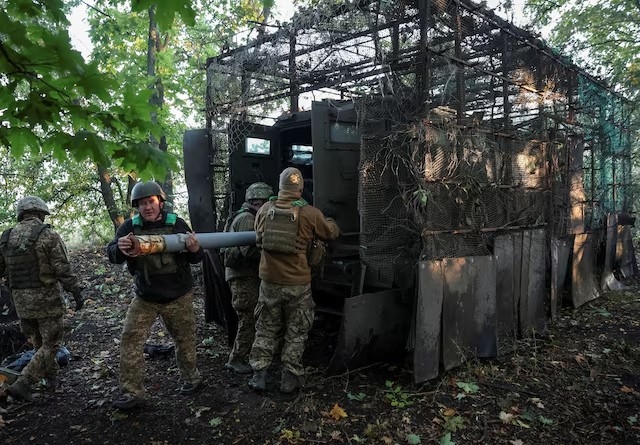


Kyiv: Ukrainian forces have recaptured another 51 square kilometres of territory in northern Donetsk as part of Operation Vivaldi, a senior Ukrainian military commander said on Monday, in a counteroffensive aimed at disrupting Russia’s attempts to advance towards key cities in the region.
Brigadier-General Andrii Biletskyi, commander of Ukraine’s Third Army Corps, said the latest phase of the operation had brought the total territory claimed as retaken during Vivaldi to 176 square kilometres. Ukrainian forces also reported taking or restoring control over five settlements during the latest phase.
The battlefield claims could not be independently verified. Reuters reported the latest developments as Ukrainian forces sought to complicate Russia’s efforts to put pressure on the eastern Ukrainian cities that form part of the country’s defensive strongholds.
Ukraine reports fresh gains in Donetsk
Biletskyi said Ukrainian forces had liberated three settlements — Nove, Ridkodub and Katerynivka — while restoring Ukrainian control over Karpivka and Novomykhailivka.
The 51-square-kilometre gain represents the third phase of Operation Vivaldi, which has been under way in northern Donetsk. Ukrainian authorities previously reported that the first two phases had resulted in a combined 125 square kilometres being regained.
The latest announcement therefore takes the total area claimed by Ukraine during the operation to 176 square kilometres.
Nove has been described by Ukrainian commanders as a particularly important objective because Russian forces had used the settlement as a hub in the area. Ukrainian military reporting said the operation was designed to disrupt Russian positions and prevent Moscow from concentrating forces for a wider advance.
Operation Vivaldi targets Russia’s eastern advance
The operation is taking place in the northern part of Donetsk, where Russian and Ukrainian forces have been engaged in some of the most intense fighting of the war.
The Institute for the Study of War, a Washington-based research organisation, has assessed that Ukrainian counteroffensive operations in the area have disrupted Russia’s effort to carry out a broad encirclement of Ukrainian cities in what has been described as the country’s eastern “fortress belt”.
Reuters reported that Russia’s overall rate of frontline advances has slowed this year, although Russian forces continue to apply pressure from the south and have increased their infiltration into Kostiantynivka, an important city in the Donetsk region.
The developments around northern Donetsk therefore form part of a broader contest over the approaches to Ukraine’s remaining major urban centres in the region.
Donetsk remains central to the war
Donetsk has been one of the principal battlefields since Russia launched its full-scale invasion of Ukraine in February 2022.
Russia has sought to seize the entire region, while Ukraine continues to hold part of it. Moscow’s demand for control of all of Donetsk has also remained one of the major territorial issues in stalled peace negotiations.
Reuters reported that Ukraine still controls about 20% of the Donetsk region, while Russia continues to seek full control. The United States has sought to revive negotiations between Moscow and Kyiv, but talks have so far failed to produce a settlement.
Control of territory in Donetsk is strategically important because several Ukrainian cities form a defensive line that has slowed Russia’s attempts to capture the region.
Ukraine claims earlier gains in the southeast
The latest reported gains in Donetsk follow a separate Ukrainian counteroffensive in the southeast earlier this year.
Kyiv said that operation resulted in more than 700 square kilometres of territory being recovered over several months. As with the latest Donetsk claims, battlefield developments can be difficult to verify independently while fighting continues.
Operation Vivaldi was publicly acknowledged by Ukraine earlier in September after military analysts and open-source researchers had reported Ukrainian advances around the Lyman area.
During the first stage, Ukraine’s Third Army Corps said it had regained control of 75 square kilometres and liberated an additional 10 square kilometres. During the second stage, it reported another 40 square kilometres of territory regained, taking the claimed total after two stages to 125 square kilometres.
Ukrainian and Russian losses remain difficult to verify
The Ukrainian military has also released figures for Russian casualties during the latest phase of the operation.
The Third Army Corps said Russian forces suffered around 2,000 personnel losses and that more than 250 Russian servicemen were captured. These figures have not been independently verified.
Independent verification of battlefield casualty figures is particularly difficult because both sides have strong incentives to emphasise their own successes and the opposing side’s losses.
The focus of the latest Ukrainian announcement, however, remains the reported territorial gains and the disruption of Russian operations in northern Donetsk.
What the gains mean for the wider battlefield
The reported advance does not represent a reversal of the overall war, but it demonstrates that Ukraine continues to conduct local counteroffensive operations even as Russian forces maintain pressure elsewhere along the front.
For Kyiv, disrupting Russian efforts around northern Donetsk could help reduce pressure on important urban centres and complicate attempts to establish a wider encirclement.
For Moscow, maintaining pressure on the Donetsk front remains important to its stated objective of taking the entire region and strengthening its position in any future negotiations.
The coming weeks will show whether the Ukrainian gains reported under Operation Vivaldi can be consolidated and whether Russia responds by shifting additional forces to the area.
For now, the 51-square-kilometre advance reported by Ukraine marks another significant development in the continuing battle for northern Donetsk, although the precise extent of territorial control remains subject to verification as fighting continues.