







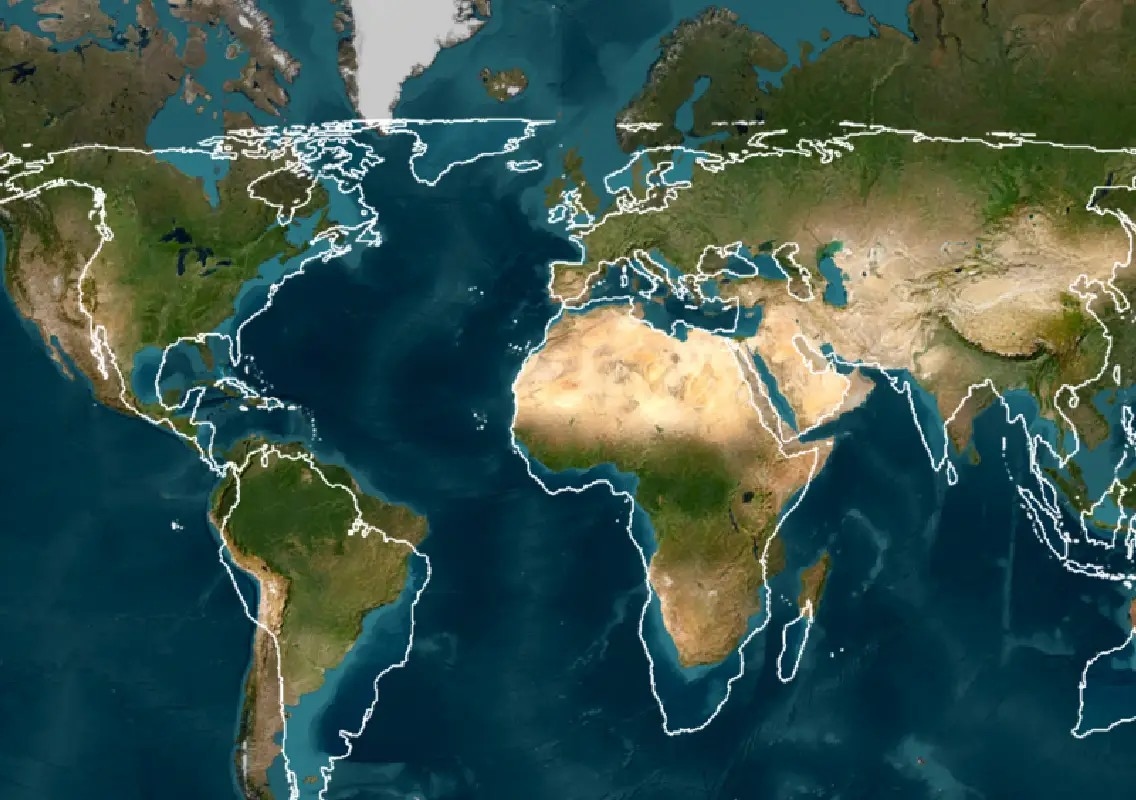


The United Nations General Assembly has voted overwhelmingly to support a new approach to world maps, aiming to give a more accurate representation of the relative sizes of countries and regions.
The “Correct the Map” resolution, introduced by African Union member states and the Bahamas, received support from 164 member states. Six abstained, while the United States voted against the resolution.
Why the Mercator map is being challenged
The campaign focuses on the widely used Mercator projection, developed by European cartographer Gerardus Mercator in 1569. While the projection remains useful for navigation, it significantly distorts the apparent size of countries as they move further from the equator.
Greenland, for instance, can appear similar in size to Africa on a Mercator map, despite Africa being about 14 times larger than Greenland.
The UN resolution says such distortions can contribute to an unbalanced perception of Africa, Latin America and South Asia and may reinforce misconceptions about their geographical and developmental significance.
Equal Earth projection gains support
The resolution proposes the Equal Earth projection as a more equitable alternative because it represents the surface areas of different regions more accurately.
The Equal Earth map, introduced in 2018, makes Africa appear considerably larger while reducing the visual size of Europe and Greenland.
France has also announced plans to move away from the Mercator projection in favour of maps that better represent countries’ actual surface areas.
A call for a fairer picture of the world
The African Union adopted the Equal Earth Map in March and subsequently urged UN member states to support its wider adoption.
The resolution also calls on digital map platforms to engage with UN member states and regional organisations and consider adopting more accurate representations.
The move marks a significant effort to challenge long-standing geographical perceptions and present the world in a way that better reflects its true proportions.