







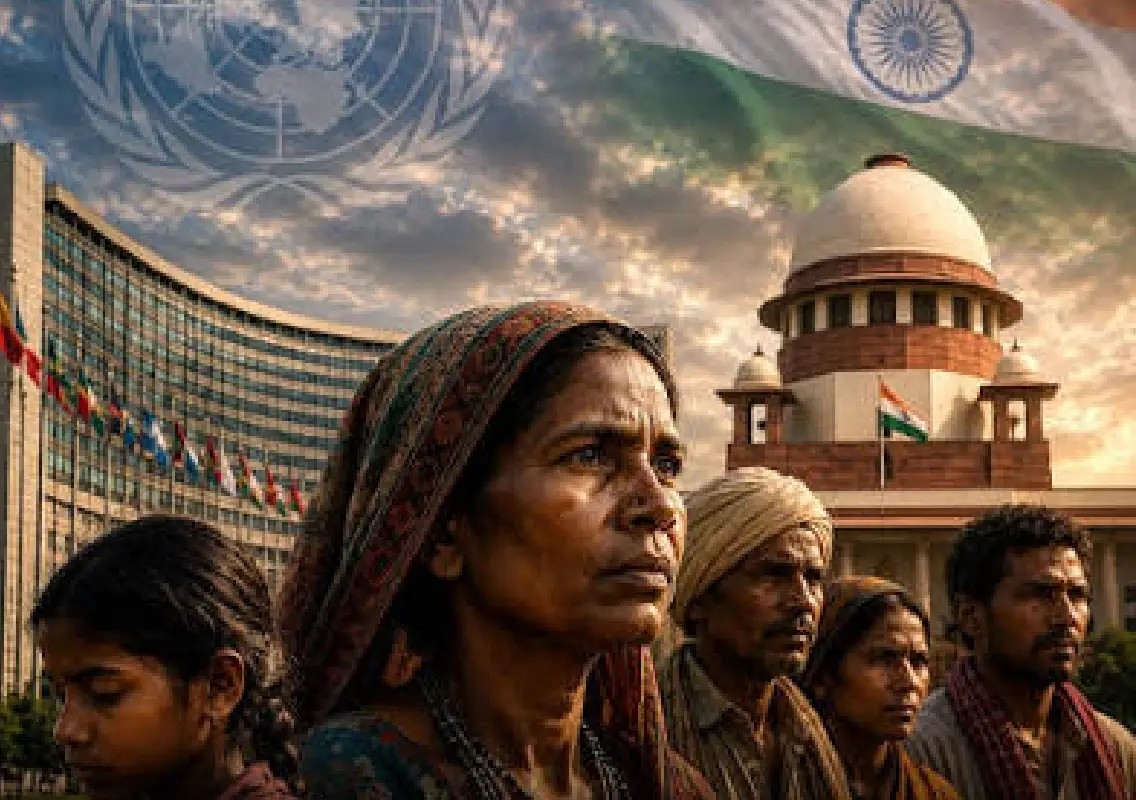


Geneva/New Delhi: A United Nations human rights watchdog has called on India to strengthen protections for vulnerable communities, including Scheduled Castes, Scheduled Tribes and other disadvantaged groups, while urgently addressing reported hate crimes targeting Bengali-speaking Muslims.
The concerns were raised by the UN Committee on the Elimination of Racial Discrimination (CERD), which concluded its review of India after considering the country’s reports and information from other stakeholders during its 118th session in Geneva. The committee’s concluding observations were published on August 25, following a review held from August 10 to 25.
The committee’s findings highlight concerns over alleged violations by law enforcement officials, including excessive use of force, extrajudicial killings, arbitrary detention, torture, ill-treatment and sexual violence involving ethnic and ethno-religious groups, Indigenous and Tribal Peoples, Scheduled Tribes and Scheduled Castes, particularly Dalits.
It has urged the Indian authorities to investigate allegations, ensure accountability and strengthen safeguards for communities considered vulnerable to discrimination and violence.
UN committee raises concerns over law enforcement
CERD expressed concern over reports of large-scale violations allegedly committed by law enforcement officials against several groups.
The committee’s concerns cover not only racial or ethnic discrimination but also discrimination affecting Indigenous and Tribal Peoples, Scheduled Tribes, Scheduled Castes and other vulnerable communities.
The findings point to allegations of excessive use of force, extrajudicial killings, arbitrary and prolonged detention without due process, torture, ill-treatment and sexual violence.
The committee has called for such allegations to be investigated and for those found responsible to be brought to justice.
The findings place particular emphasis on the need for effective legal protection and accountability. The objective, according to the committee’s mandate, is to ensure that people belonging to communities vulnerable to discrimination can enjoy their rights without unequal treatment.
Bengali-speaking Muslims among groups highlighted
One of the most significant concerns raised by CERD relates to Bengali-speaking Muslims.
The committee has called on India to urgently address hate crimes against Bengali-speaking Muslims and strengthen protections for members of the community.
The issue has previously been raised by the UN committee in connection with developments in Assam. In a January 2026 communication, CERD referred to concerns about alleged racial discrimination against members of the Bengali-speaking Muslim community during the updating of the National Register of Citizens (NRC).
That communication raised concerns about the exclusion of Bengali-speaking Muslims from the final NRC list, difficulties in obtaining required documents and what the committee described as disproportionate effects on people classified as “non-original inhabitants”. It also questioned differences in verification standards and the suspension of Foreigners Tribunal processes that could prevent people classified as “doubtful voters” from challenging their status.
The latest findings therefore come against the backdrop of concerns that the committee has already communicated to India.
Dalits and tribal communities face discrimination concerns
The UN committee has also highlighted concerns affecting Scheduled Castes, Scheduled Tribes and Dalits.
Caste remains a significant factor influencing social and economic opportunities in India, with historically disadvantaged communities continuing to face barriers in areas such as education, employment, access to resources and social participation.
CERD’s concerns are particularly focused on situations in which discrimination is accompanied by violence or alleged violations by state authorities.
The committee has called for stronger protection mechanisms and effective investigations into allegations of abuse. Such measures are intended to ensure that members of disadvantaged communities have access to justice and that perpetrators cannot act with impunity.
The findings also underscore the importance of protecting Indigenous and Tribal Peoples, who may face particular vulnerabilities because of social, economic and geographical marginalisation.
What is the UN discrimination committee?
The Committee on the Elimination of Racial Discrimination is a body of independent experts responsible for monitoring how countries implement the International Convention on the Elimination of All Forms of Racial Discrimination.
CERD consists of 18 independent experts. Its role includes examining reports submitted by countries that are party to the convention and assessing whether they are taking appropriate steps to prevent and eliminate racial discrimination.
India’s latest review is significant because the country was considered during CERD’s 118th session, alongside Finland, Honduras and Kuwait. The UN treaty body database records India’s concluding observations under document CERD/C/IND/CO/20-21, published on August 25, 2026.
The committee’s observations are recommendations and findings arising from its treaty-monitoring role. They are not equivalent to a domestic court judgment against India.
India had not been reviewed by CERD for years
The latest review also marks an important point in India’s engagement with the committee.
The UN human rights office described the 2026 proceedings as CERD’s first dialogue with India since 2007. During the review, committee experts raised questions concerning anti-Muslim hate speech and freedom of religion for Dalits, among other issues.
The extended gap between reviews makes the latest observations particularly significant for assessing developments since India’s previous examination.
India’s participation in the review provided an opportunity for the government to present its position and explain the measures it has taken to address discrimination and protect vulnerable communities.
The wider debate over discrimination
The committee’s observations come amid continuing debate in India over discrimination based on caste, ethnicity, religion, tribal identity and other social characteristics.
India’s Constitution provides safeguards against discrimination and establishes affirmative measures for historically disadvantaged communities. Several constitutional and statutory institutions also have mandates related to the protection of Scheduled Castes, Scheduled Tribes and minorities.
However, the UN findings indicate that legal protections alone may not be sufficient if affected communities continue to report violence, discrimination or difficulties in accessing justice.
The committee has therefore stressed the importance of effective implementation, investigation and accountability.
For communities facing discrimination, the ability to report an alleged violation and receive a timely and impartial investigation is an important part of meaningful protection.
Accountability remains a central concern
The allegations concerning law enforcement are among the most serious aspects of the UN committee’s findings.
Where allegations involve torture, excessive force, extrajudicial killings or sexual violence, independent and effective investigation becomes particularly important. Accountability mechanisms can help establish facts, provide remedies to victims and ensure that violations are not repeated.
The committee’s call for India to investigate allegations and bring those responsible to justice reflects this broader principle.
The findings also raise questions about how effectively existing safeguards operate in practice, particularly for people from communities that may already face social or economic disadvantages.
Why the findings matter for India
The CERD observations do not represent a ruling that every allegation cited by the committee has been established as fact. Rather, they reflect the concerns considered by an international treaty-monitoring body and the recommendations it has made to the Indian government.
Their significance lies in the attention they draw to the protection of communities that may face multiple forms of disadvantage.
For India, addressing the concerns will require more than statements of policy. Effective investigations, access to justice, protection from hate crimes and safeguards against arbitrary action by authorities will be important in demonstrating that legal protections are working on the ground.
The concerns involving Bengali-speaking Muslims in particular are likely to remain closely watched because of the committee’s earlier communication on the situation in Assam and questions surrounding citizenship documentation and the NRC.
A renewed focus on equal protection
The UN committee’s latest observations place discrimination and protection of vulnerable communities back in the international spotlight.
India is a diverse country with hundreds of communities, languages, ethnic identities and social groups. Ensuring equal protection under the law across such diversity is a continuing challenge for institutions at every level.
The CERD findings underline the need for authorities to respond promptly to allegations of violence and discrimination, strengthen protection mechanisms and ensure that victims can seek justice without fear.
The committee’s review also provides an opportunity for a wider discussion within India about how existing laws and institutions can be made more effective.
Ultimately, the credibility of protections against discrimination depends not only on legislation but on how those protections work in the lives of ordinary people. Strong investigations, fair procedures, accountability and equal access to justice can help ensure that vulnerable communities are protected regardless of caste, tribal identity, ethnicity or religious background.
As India considers the UN committee’s recommendations, the central challenge will be translating legal guarantees and policy commitments into effective protection on the ground.