


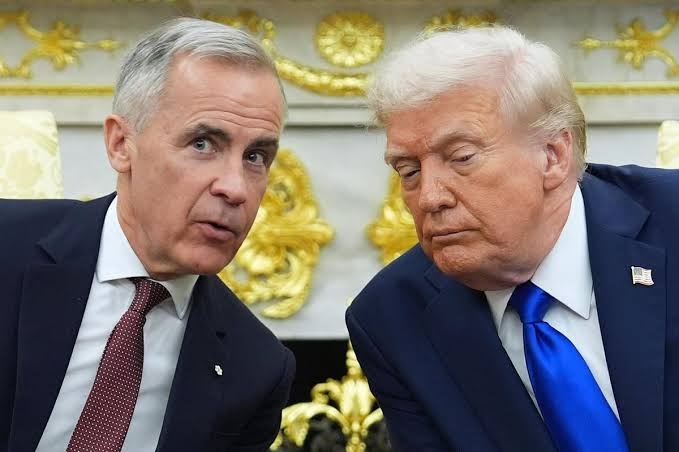


Washington: The United States and Canada are working towards a possible agreement to ease American tariffs on Canadian steel and automobiles, as the two governments seek to repair strained trade relations following the breakdown of negotiations in August.
According to sources on both sides of the border, discussions are focused on tariffs imposed under Section 232 of US trade law, including duties of up to 50 per cent on Canadian steel and 25 per cent on automobiles. Negotiators are exploring possible relief from the tariffs, although the scope and timing of any agreement remain uncertain.
The talks come amid growing political pressure on US President Donald Trump and his Republican Party ahead of the November 3 midterm elections. Tariffs on Canadian imports have become a contentious issue, with some Republican candidates in border states calling for an end to the trade dispute.
One Canadian source briefed on the negotiations said an agreement on steel and auto tariffs could be reached before the elections. US sources, however, indicated that the Trump administration was seeking further concessions from Canada.
The sources spoke on condition of anonymity because the negotiations are private. Neither government has announced a final agreement.
Steel and auto tariffs at the centre of negotiations
The proposed discussions focus on Section 232 tariffs, which the United States imposes on certain imports on national security grounds.
Canadian steel faces duties of up to 50 per cent, while automobiles and automotive parts are subject to tariffs of 25 per cent under the measures discussed by the negotiators.
These duties have increased costs for businesses operating across the US-Canada border, particularly manufacturers that depend on integrated supply chains. The automotive industry is especially exposed because components and finished vehicles frequently cross the border during production and distribution.
US and Canadian companies had hoped that trade negotiations would provide relief from the original 25 per cent auto tariffs. However, talks collapsed in August over several issues, including whether duties should be reduced on medium- and heavy-duty vehicles that are important to Canadian manufacturing facilities.
The latest discussions suggest that both governments are again exploring a possible arrangement, although it remains unclear whether the outcome would cover only selected products or a wider range of steel and automotive imports.
Commerce Secretary Howard Lutnick plays key role
The negotiations are being handled in part through the US Commerce Department, which administers Section 232 tariffs.
This has placed Commerce Secretary Howard Lutnick at the centre of discussions, rather than leaving the negotiations entirely to the Office of the United States Trade Representative.
Lutnick and Dominic LeBlanc, Canada’s minister responsible for Canada-US trade, have reportedly been in regular contact in recent weeks.
The US Trade Representative’s office has also been communicating with Canadian officials about the broader structure of a possible agreement and other outstanding trade issues.
A spokesperson for LeBlanc said Canada remained engaged in discussions with its American counterparts.
“Canada remains in constructive dialogue with our U.S. counterparts on a range of priorities,” the spokesperson said, adding that Ottawa was prepared to work in good faith towards a more mutually beneficial trading relationship that respected Canadian interests.
The White House and the Commerce Department did not immediately respond to requests for comment on the reported negotiations.
Ottawa signals renewed engagement
Canadian Prime Minister Mark Carney has indicated that discussions with Washington have intensified, although he has not disclosed the details of any potential agreement.
Carney described the change as a “slight intensification” in talks and said Canada’s position had not changed.
“To the extent any progress has been made, it’s because the US is coming closer to our position,” he told reporters.
His remarks suggest that Ottawa believes the renewed engagement reflects movement towards Canada’s preferred terms. However, they do not establish that the two governments have reached an agreement on tariff reductions.
Canadian industry sources have also suggested that a deal, if reached, could be negotiated quickly but might be limited in scope.
One source said the agreement would probably be narrower than a comprehensive settlement of the trade dispute, while cautioning that it was not certain a deal would materialise at all.
Another Canadian source said an agreement on Section 232 tariffs before the midterms had appeared possible for some time. The source added that any settlement would depend on decisions by Trump and Carney.
Both leaders have previously indicated that a mutually beneficial trading arrangement could be possible.
Trump faces pressure ahead of midterm elections
The negotiations are taking place against the backdrop of domestic political pressure in the United States.
According to the figures cited in the source report, only 32 per cent of Americans approved of Trump and his Republican Party faced the possibility of losing control of Congress in the November 3 midterm elections.
Tariffs on Canadian goods have become a political issue in border states, where businesses and manufacturers depend on cross-border commerce. Republican candidates in some of these states have called for an end to the trade dispute, arguing that tariffs can raise costs for domestic industries and consumers.
Trump has also suggested that the dispute could be resolved soon. Speaking at a political rally on Sunday, he predicted that a resolution would come “soon” but did not provide details about the terms or timing.
The political context has added urgency to the discussions, but it does not guarantee that an agreement will be reached before the elections.
For the administration, any potential settlement would need to address the tariff dispute while meeting its demands for further concessions from Canada.
Trump announces relief for selected Canadian products
A separate development came when Trump signed an order on Friday removing 50 per cent tariffs on certain Canadian agricultural and forestry products.
The change could benefit businesses in Maine, where some companies rely on trade in products from Canada.
The measure represents a targeted adjustment to the tariff regime rather than a comprehensive settlement of the wider trade dispute.
The order also demonstrates that the administration has been willing to modify tariffs for selected product categories. However, it does not confirm that similar relief will automatically be extended to steel or automobiles.
Those sectors remain the subject of separate negotiations under Section 232.
Why the auto industry is particularly important
The automotive sector is a major point of contention because production networks in the United States and Canada are closely connected.
Vehicles and components can cross the border multiple times during the manufacturing process. Tariffs imposed on imported parts or finished vehicles can therefore affect costs at several stages of production.
Canadian factories supply parts and vehicles to the US market, while American manufacturers also rely on cross-border supply chains. Higher duties can complicate production planning, raise costs and affect decisions about where to manufacture vehicles and components.
The dispute over medium- and heavy-duty vehicles has been particularly significant because these vehicles are important to certain Canadian factories and their associated supply networks.
A targeted agreement could provide some relief to affected manufacturers if it reduces duties on the products they trade most frequently. The actual impact would depend on which products are covered, the size of any tariff reductions and the conditions attached to the deal.
Can the two countries reach an agreement before November 3?
The possibility of a pre-election agreement remains open, but the negotiations have not yet produced a publicly confirmed settlement.
Canadian sources have suggested that a limited deal could be reached quickly. US sources, however, have indicated that Washington wants additional concessions, leaving important differences to be resolved.
Carney has maintained that Canada’s position remains unchanged, while Trump has publicly predicted that the dispute will be settled soon.
The coming days will therefore be important in determining whether the renewed engagement leads to concrete tariff relief or remains another round of negotiations without an immediate outcome.
For businesses, the key question is whether any agreement will provide predictable trading conditions across the border. For the two governments, the challenge is to find terms that address their respective priorities without leaving the underlying trade dispute unresolved.
Until an agreement is formally announced, the existing tariff measures and the uncertainty surrounding future trade arrangements remain important considerations for steelmakers, automakers and other businesses operating across the US-Canada border.