


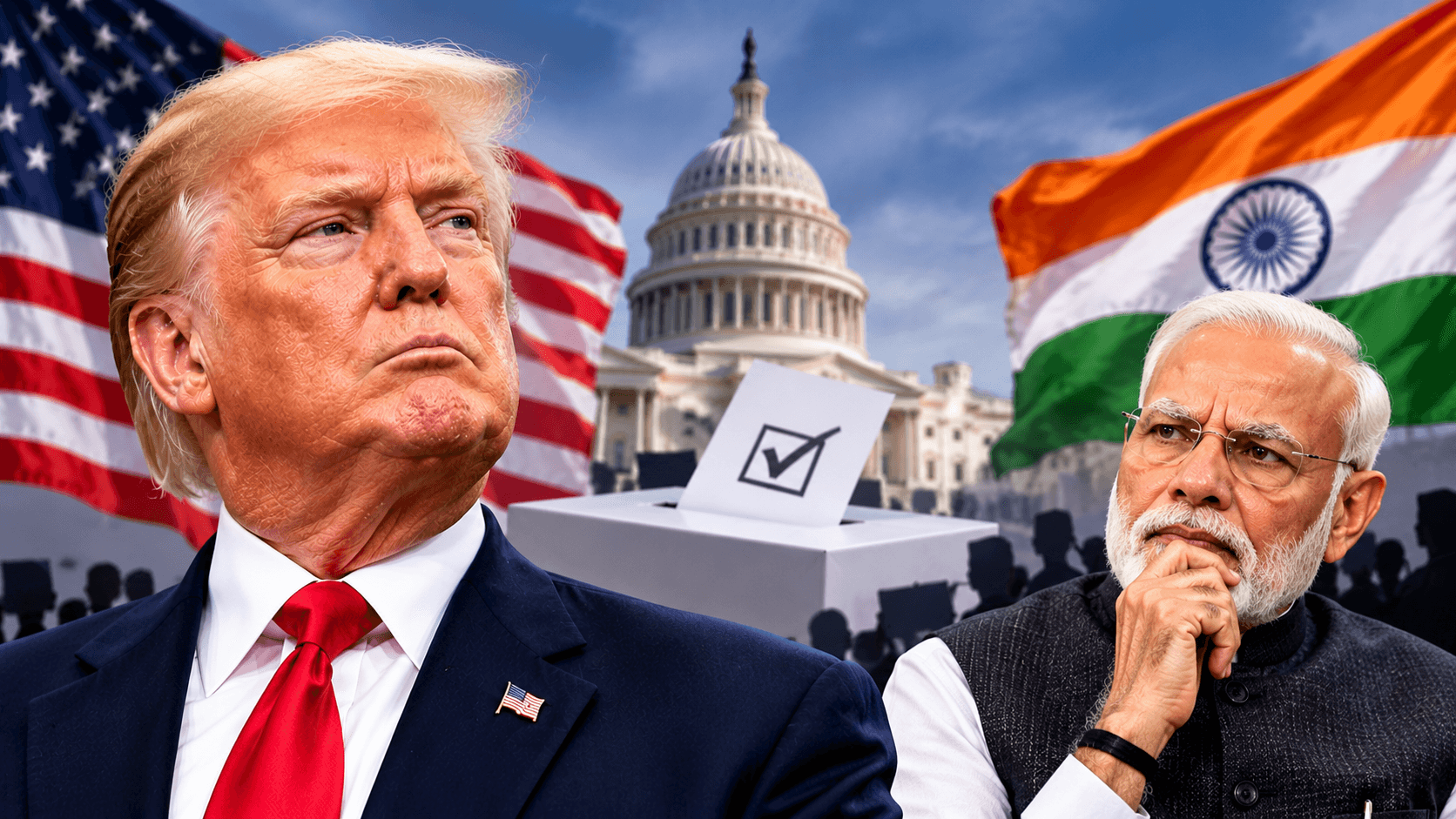


New Delhi: The Democratic Party‘s major victory in the US midterm elections, which ended President Donald Trump’s unified Republican control of Congress, could reshape the outlook for India’s trade, currency and investment environment. While the results may reduce the risk of sudden tariff escalation, uncertainty over US trade policy is expected to continue, leaving Indian policymakers with room to negotiate without rushing into a trade agreement.
The election outcome could limit Trump’s ability to push through parts of his domestic and economic agenda, particularly those requiring congressional approval. However, trade remains an area where the US President retains considerable executive authority, meaning that tariffs and trade negotiations could continue to create uncertainty for India’s exporters and businesses.
Madhavi Arora, Chief Economist at Emkay Global, described the result as a major political rebuke to Trump, with Democrats securing control of both chambers of Congress. She said the scale of the victory was unprecedented in two decades and could have consequences extending beyond immediate market reactions.
According to Arora, some of the movements in financial markets following the election may prove temporary, while others could indicate a more lasting change in the political and economic environment.
For India, the implications could be mixed but offer some potential macroeconomic benefits, particularly if the election encourages a softer US approach towards Iran and contributes to lower global crude oil prices.
Iran war and crude oil prices could shape India’s outlook
One of the important economic implications identified by Arora is the possibility that Trump’s political setback could encourage his administration to pursue an agreement with Iran.
The economist said voter fatigue over the Iran war and the loss of political capital could push Trump towards a diplomatic settlement in the coming quarters. Such a development could reduce geopolitical uncertainty and eventually provide relief to global energy markets.
However, the near-term outlook for crude oil remains uncertain. Policy changes and geopolitical developments could continue to trigger fluctuations in Brent crude prices before a more sustained decline becomes possible.
Oil prices are particularly important for India because the country relies heavily on imports to meet its energy requirements. Higher crude prices increase the import bill, put pressure on the current account deficit and can contribute to domestic inflation.
Arora projected India’s current account deficit (CAD) at 1.7% of GDP if Brent crude averages $100 per barrel and 1.4% if prices average $90 per barrel in FY27.
These estimates suggest that lower oil prices could provide meaningful relief to India’s external balance. A reduction in the import bill would also ease pressure on the rupee and help improve the country’s overall macroeconomic position.
The benefits, however, would depend on how crude prices actually move and whether geopolitical tensions ease. A renewed escalation involving Iran or other regional players could quickly reverse any improvement in the energy outlook.
Softer US dollar could give the RBI breathing space
The election outcome could also influence the US dollar and global interest-rate environment, with possible consequences for India’s currency and monetary policy.
Arora said a softer dollar, lower crude oil prices and a more stable tariff environment could support the Indian rupee. These factors may also encourage a gradual reduction in India’s risk premium, rather than triggering an abrupt revaluation of Indian assets.
However, the economist cautioned that the rupee’s potential gains could remain limited because of India’s external financing requirements and the Reserve Bank of India’s foreign exchange management strategy.
India continues to have current account funding needs, while the RBI has a substantial forward dollar liability of $239 billion. The need to rebuild foreign exchange reserves could therefore limit the extent to which the central bank allows the rupee to appreciate.
The central bank may prefer a gradual and orderly currency adjustment instead of allowing a sharp rise in the rupee’s value.
Interest rates in the United States will also remain important. Even if the Federal Reserve makes only limited changes to its policy rates, US borrowing costs could remain elevated. This would require the RBI to remain attentive to global financial conditions when making domestic monetary policy decisions.
For Indian businesses and investors, the combination of a softer dollar and relatively high US interest rates could create a complicated environment. Currency movements may become more favourable, but global borrowing costs could continue to influence capital flows and domestic bond yields.
US fiscal gridlock may keep global interest rates elevated
The change in control of Congress could make it more difficult for Trump to secure approval for new fiscal spending packages and other legislative priorities.
A divided government generally creates greater difficulty in passing major budgetary measures. However, Arora pointed out that neither party appears particularly keen to address the underlying US fiscal deficit.
As a result, the election outcome may not automatically lead to a sustained decline in US Treasury yields.
The economist expects global interest rates to remain relatively high because the political deadlock is unlikely to resolve the broader fiscal challenges facing the United States.
This could have implications for Indian government securities and corporate borrowing costs. When US Treasury yields remain elevated, international investors may continue to demand attractive returns from emerging-market assets.
Higher global yields can also influence the cost of financing for Indian companies and the government’s borrowing environment.
Therefore, even if the election reduces some policy risks, it may not immediately translate into cheaper financing for India.
AI investment faces regulatory uncertainty but growth remains supported
The midterm results could introduce additional uncertainty for companies investing in artificial intelligence and related infrastructure, particularly at the state level.
Arora said the change in political balance could add a small premium for regulatory and local-permitting risks. This is relevant because large AI projects, including data centres and semiconductor facilities, require substantial investment in land, power infrastructure and local approvals.
However, she does not expect either political party to deliberately undermine a growth sector that has become important to the US economy.
Federal policy levers remain under Trump’s control, while major technology companies, often described as hyperscalers, are financing much of their own AI-related capital expenditure.
This means the broader AI investment cycle could remain supported despite political uncertainty.
For emerging-market Asia, continued investment in AI infrastructure would also support demand across the semiconductor supply chain. Companies involved in chip manufacturing, equipment, materials and related technology could continue to benefit if planned investments proceed.
Arora cautioned that any slowdown in AI and data-centre spending could create temporary headwinds for industrial metals, particularly copper and metals linked to power infrastructure. Such a slowdown is not her base-case assumption.
At the same time, metals associated with the green-energy transition could receive modest support. A somewhat weaker US dollar would also be favourable for commodity prices.
The economist added that tighter credit conditions could pose a greater risk to AI investment than political or regulatory changes alone.
India may not need to rush into a US trade deal
Trade policy remains one of the areas where Trump retains considerable executive authority, even after losing unified Republican control of Congress.
This means that the midterm results are unlikely to bring an immediate end to uncertainty over US tariffs. The existing tariff structure could remain in place, although further escalation may become slower as the administration faces greater political constraints.
Arora said trade volatility could continue because the President retains significant control over trade-related decisions. However, the political environment could reduce the likelihood of sudden tariff shocks, particularly under measures such as Section 301 and Section 232.
Section 301 allows the US to respond to certain foreign trade practices, while Section 232 provides a mechanism for imposing trade restrictions on national security grounds.
The economist also pointed to Trump’s need to deliver improvements in consumer affordability ahead of the 2028 presidential election. Higher import costs and tariff-related price pressures could complicate that objective, potentially encouraging a less aggressive approach to additional trade restrictions.
For India, this creates an opportunity to avoid rushing into a trade agreement.
Arora noted that India currently faces a 10% tariff rate, compared with the 18% rate associated with a proposed deal that has not been implemented. In this situation, she sees no immediate urgency for India to finalise an agreement amid continuing geopolitical tensions and regulatory uncertainty.
The distinction between the existing tariff position and the unimplemented deal rate is important for Indian negotiators. Any agreement would need to be assessed on its actual economic benefits, rather than simply on the expectation that it would remove uncertainty.
However, the possibility of further US action cannot be ruled out. Arora identified potential executive action under Section 232 involving pharmaceuticals and electronics as risks that India would need to monitor.
Another concern is the possibility that setbacks in US diplomacy with Russia or Iran could revive pressure on India over its oil imports.
What the election means for India’s economic strategy
The Democratic victory in the US midterms could create a more complicated political environment for Trump’s administration, but it does not necessarily signal a fundamental shift in every area of US economic policy.
For India, the potential benefits include softer crude oil prices, a weaker US dollar and a lower risk of sudden tariff escalation. These factors could improve the external economic outlook and provide some support to the rupee.
At the same time, high global interest rates, geopolitical tensions and uncertainty over AI-related regulation could continue to affect investment decisions and financial markets.
The trade relationship is likely to remain particularly sensitive because Trump retains executive authority over several tariff-related measures. India will therefore need to balance the benefits of securing a long-term agreement with the risks of accepting terms that may not offer sufficient economic advantages.
Arora’s assessment suggests that India has some breathing space and does not need to rush into a deal simply because of uncertainty surrounding US trade policy. The larger priority will be to monitor developments in Washington, crude oil markets and global investment conditions while protecting India’s trade and economic interests.