




Senatobia: A Mississippi police officer who fatally shot a one-year-old Black boy during a police response to an alleged shoplifting incident has resigned, hours after authorities released body camera footage of the shooting. The city’s interim police chief has also stepped down, amid renewed scrutiny of the incident and calls for an independent federal investigation.
The child, Kohen Wiley, was killed on June 14 when Senatobia police officer Hunter Foster fired into a moving vehicle outside a Walmart store. Police suspected Kohen’s mother, Vellesiya Wiley, and her friend of stealing diapers. Neither woman has been charged, and the mother has denied the allegation.
The resignations came after Mississippi Attorney General Lynn Fitch said Foster’s use of force was justified. The decision has been challenged by Kohen’s family, whose lawyers argue that the newly released footage raises questions about whether the officer faced an immediate threat when he fired.
Senatobia Mayor Greg Graves confirmed Foster’s resignation on Friday but did not say whether the officer had been asked to leave. Interim police chief Angelica Maze also resigned, according to a letter reported by local media.
Foster’s lawyer, Martin Zummach, told NBC News that his client had resigned “for the good of the city and the police department and to permit the process of healing”.
The child’s family, however, said the resignation did not resolve their concerns about the shooting or the decision to clear the officer of criminal wrongdoing. Their lawyer, Ben Crump, has called for the US Department of Justice to investigate the incident.
“No mother should have to bury her baby over an allegation of shoplifting diapers,” Crump said on Friday.
Newly released footage shows moments before shooting
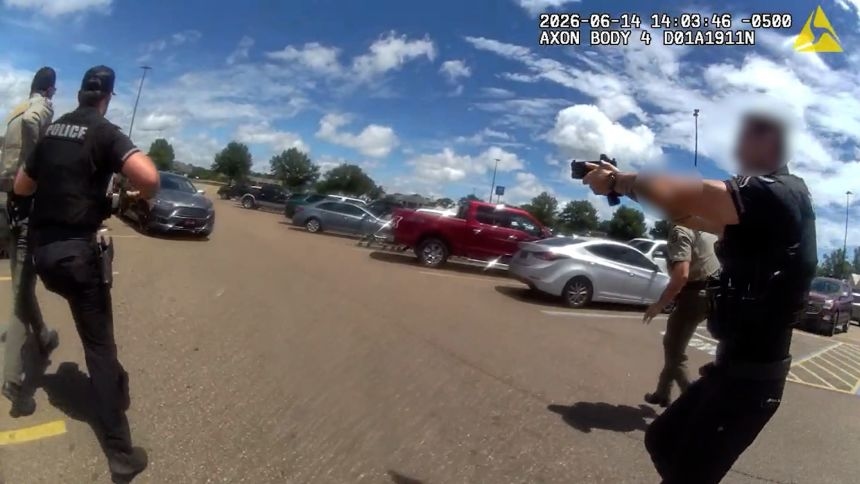
The body camera footage, released by the Mississippi Department of Public Safety, provides a view of the events in the Walmart car park before the fatal shot was fired.
The footage shows two women, one carrying a baby, running across the parking lot before getting into a vehicle. Five officers approach the car with their guns drawn.
The vehicle reverses into a parked car as officers shout commands for it to stop. It then moves forward while one officer stands in its path with his weapon drawn.
As the vehicle advances, its front wheels turn away from the officer. He appears to touch the bonnet as he moves aside before firing a shot that shatters the front passenger-side window. The vehicle then drives away.
The footage has become central to the dispute over whether Foster faced an imminent threat when he fired.
The Mississippi Bureau of Investigation said the driver drove towards officers as they attempted to stop the vehicle. Kohen’s mother has disputed that account, denying that she deliberately drove at the officers.
Vellesiya Wiley has also said she held her son up to show officers that the baby was inside the vehicle. Her account and the family’s interpretation of the video have intensified questions about the circumstances in which the officer decided to shoot.
The released footage does not, by itself, resolve every disputed detail of the encounter. The accounts of the family, the investigating authorities and the officer’s legal representative differ on the level of danger posed to police at the moment the shot was fired.
Family challenges decision to clear officer
The decision by the Mississippi attorney general’s office to describe Foster’s use of force as justified has drawn criticism from Kohen’s relatives and their legal team.
Crump has argued that Foster fired from the side of the vehicle when he was no longer in danger of being struck. He has also cited an independent autopsy commissioned by the family, which he said indicated that the fatal shot came from the side.
The family’s position is that the circumstances visible in the footage warrant further scrutiny, particularly because the incident began with suspicions of shoplifting rather than a reported violent crime.
Foster’s lawyer, Zummach, has rejected the family’s interpretation. He argued that the vehicle was about to hit the officer and that Foster had “no choice” but to fire. According to the lawyer, the footage supports the officer’s account of the encounter.
The opposing accounts highlight the central question in the case: whether Foster reasonably believed that he faced an immediate threat of serious physical harm when he discharged his weapon.
The legal assessment of a police shooting involving a moving vehicle can depend on several factors, including the vehicle’s direction and speed, the officer’s position, the actions of other people at the scene and the time available to react.
The family has maintained that the video undermines the justification given for the shooting. The officer’s lawyer, meanwhile, has argued that the danger developed quickly and required an immediate decision.
Grandmother says word ‘justified’ has haunted family
Kohen’s grandmother, Veronica Roberson, said she learnt through news reports that Foster had been cleared of criminal wrongdoing. She also watched portions of the footage that circulated online before the official release.
Speaking at a news conference on Thursday, Roberson criticised the decision to describe the shooting as justified.
“The word ‘justified’ has haunted me,” she said. “There’s no justification for that.”
Her remarks reflect the family’s frustration with the official finding and the circumstances surrounding the death of a child who was inside the vehicle during the encounter.
For the family, the officer’s resignation does not answer the questions raised by the shooting or provide a substitute for an independent review. Crump’s call for a US Department of Justice investigation is aimed at securing further scrutiny of the incident.
The release of the body camera footage has also placed the actions of the officers at the scene under renewed public attention. The footage shows several officers approaching the vehicle with their guns drawn, but the precise interpretation of the threat posed at the moment of the shooting remains disputed.
Experts disagree over use of force
Two experts in police use of force who reviewed the footage for The Associated Press reached different conclusions about whether Foster was justified in firing.
Charles “Joe” Key, a former Baltimore police lieutenant, said Foster had to make a split-second decision as the vehicle moved towards him and another officer. Key described the shooting as “objectively reasonable”, supporting the argument that the officer faced an immediate danger.
John P Gross, who studies police shootings involving moving vehicles, questioned why Foster had positioned himself in the car’s path. He argued that an allegation of shoplifting did not justify shooting at a person attempting to flee.
The differing assessments illustrate the debate surrounding police responses to moving vehicles. Officers may face genuine risks when a car moves towards them, but experts also examine whether their positioning and tactical decisions contributed to the danger.
Gross’s criticism focuses on the decision to stand in front of the vehicle and the proportionality of using deadly force in a case involving suspected property theft. Key’s assessment places greater emphasis on the immediate circumstances confronting the officer as the vehicle moved.
Neither expert’s assessment replaces a formal investigation or judicial determination. Their differing views, however, underscore why the footage has become a significant part of the public debate over the shooting.
Resignations leave questions unanswered
Foster’s resignation and Maze’s departure have added another development to a case that has drawn attention to police use of force, accountability and the treatment of suspects in alleged property crimes.
The Mississippi attorney general’s decision to clear Foster of criminal wrongdoing remains contested by Kohen’s family. The family’s legal team has called for federal scrutiny, while Foster’s lawyer maintains that the officer acted in response to an immediate threat.
The case also raises broader questions about how police officers approach vehicles that are moving away from a scene, particularly when the original suspicion concerns a non-violent offence.
For Kohen’s relatives, the central issue remains the death of a one-year-old child and whether the circumstances of the shooting have been fully examined. The family continues to dispute the official justification, while the officer’s defence rests on the claim that he was at risk of being struck.
The resignations mark a significant change in the local police department’s leadership, but they do not settle the disagreement over the shooting. The family’s demand for a federal investigation keeps the focus on the evidence, the decisions made during the encounter and the accountability process that followed.