


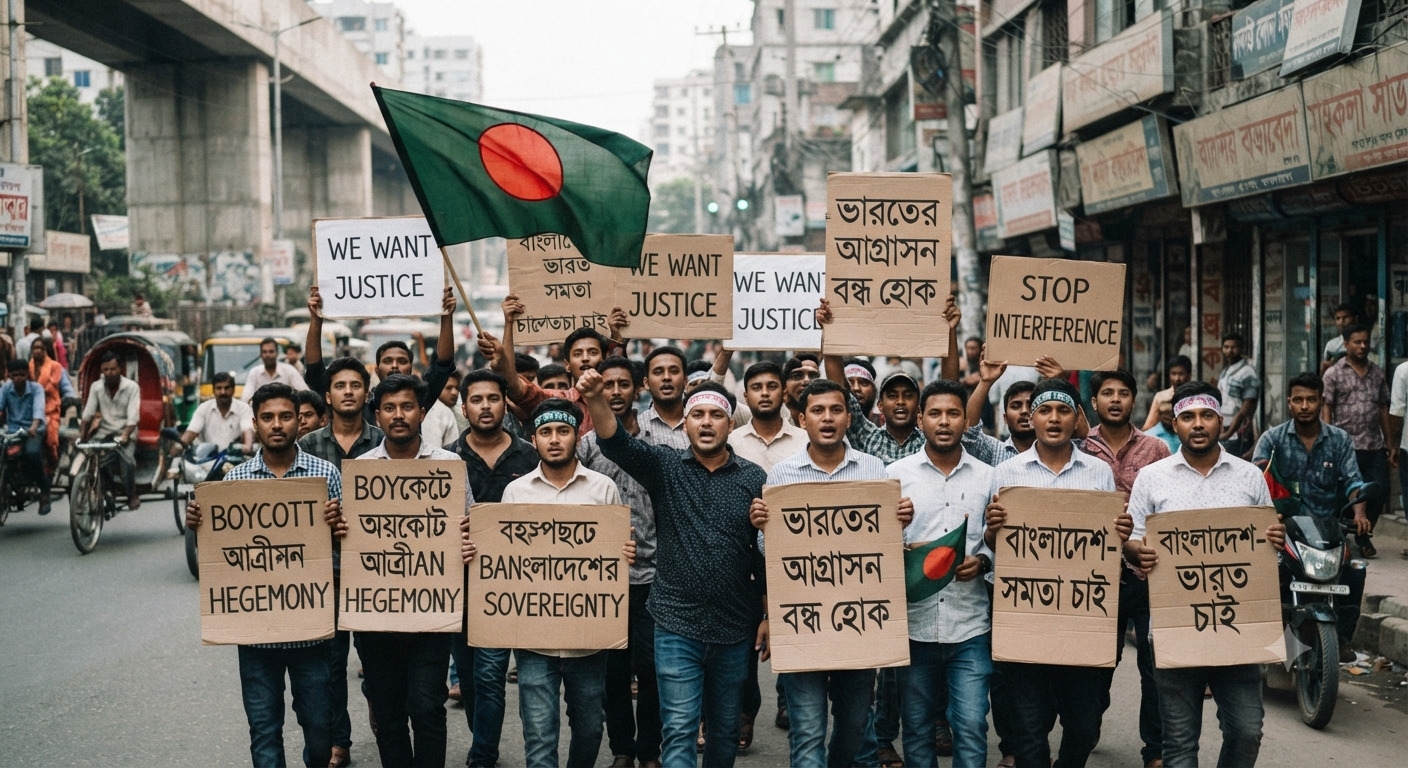


Dhaka: Anti-India rhetoric is gaining momentum in Bangladesh, with political leaders and protesters raising questions over water-sharing arrangements, regional connectivity projects and alleged Indian interference. The renewed criticism comes just weeks before the Ganga water-sharing treaty is due for renewal and amid former prime minister Sheikh Hasina’s stated intention to return to the country in December.
Prime Minister Tarique Rahman, who came to power after the Bangladesh Nationalist Party (BNP) won the February elections, is facing pressure on several fronts. Opposition parties have accused his government of failing to deliver on campaign promises, while protests by garment workers have exposed continuing economic difficulties.
India has increasingly become part of this political debate. The Ganga treaty, a Japan-backed industrial and connectivity initiative involving India’s northeastern states, and allegations surrounding Hasina’s possible return have provided fresh opportunities for political mobilisation against New Delhi.
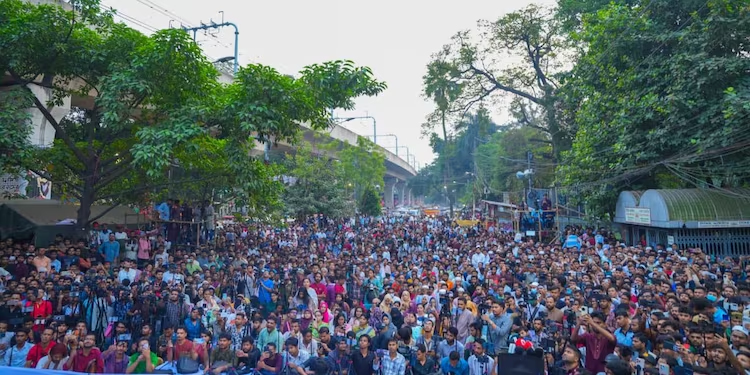
The renewed rhetoric was particularly visible at a rally organised by the National Citizen Party (NCP) in Dhaka on October 30. Protesters raised the slogan, “Dilli na Dhaka? Dhaka, Dhaka!” — meaning “Delhi or Dhaka? Dhaka, Dhaka!” Similar slogans were heard during the protests against Hasina in 2024 and under the subsequent interim administration led by Muhammad Yunus.
The developments raise questions about whether Rahman’s government can manage domestic political pressure without allowing relations with India to deteriorate.
NCP turns criticism of Rahman into an anti-India campaign
The NCP was formed by students who led the protests against the Awami League government and contributed to Hasina’s departure from Bangladesh in August 2024. With the Awami League barred from political activity, the NCP joined hands with Jamaat-e-Islami to contest the February elections against the BNP. The alliance has since emerged as a prominent opposition force.
At the October 30 rally, NCP leaders demanded the resignation of several ministers in Rahman’s Cabinet, accusing them of failing to fulfil important promises. They also accused the prime minister of authoritarian tendencies.
One speaker alleged that Rahman had returned from London with a plan to establish corruption, looting, extortion, terrorism and political occupation in Bangladesh.
The gathering also became a platform for criticism of India. NCP convener Nahid Islam accused New Delhi of conspiring against Bangladesh and raised allegations concerning killings along the India-Bangladesh border and the treatment of Muslims in Assam and West Bengal. He also claimed that there were plans to demolish mosques in Delhi. These were allegations made at the political rally and were not independently established by the statements cited in the report.
NCP leader Hasnat Abdullah, who attended the gathering, has previously made controversial remarks about India’s northeastern states, including a threat to isolate the region and provide shelter to anti-India elements.
The latest statements suggest that the NCP and its political allies are using bilateral disputes and domestic grievances to challenge the BNP government while questioning its approach towards India.
Ganga treaty renewal becomes a major flashpoint
The 1996 Ganga Water Sharing Treaty is one of the most immediate sources of tension between the two countries. Signed on December 12, 1996, by then prime ministers HD Deve Gowda and Sheikh Hasina, the agreement regulates the sharing of Ganga waters at the Farakka Barrage during the dry season. It is due to expire on December 12, 2026.
Under the treaty, the two countries share the available water according to a formula based on river flow. When the flow falls to 70,000 cusecs or less, the allocation is divided equally. If the flow is between 70,000 and 75,000 cusecs, Bangladesh receives 35,000 cusecs and India gets the remainder. The agreement also provides for both countries to receive 35,000 cusecs each during three alternate 10-day periods between March 11 and May 10.
Bangladesh’s BNP-led government is seeking revised terms that would provide greater protection for its water requirements during lean periods. Dhaka wants the restoration of a minimum-guarantee provision similar to the one in the 1977 agreement, which ensured Bangladesh received at least 80 per cent of its scheduled allocation during low-flow periods.
The renewal process remains uncertain. India’s Ministry of External Affairs told Parliament in February that discussions on renewing the treaty had not yet commenced. Digital Sansad+1
The absence of a clear agreement has given opposition leaders an opportunity to turn the issue into a political mobilisation campaign. At the October 30 rally, Nahid Islam said Bangladesh would not compromise on its share of Ganga waters.
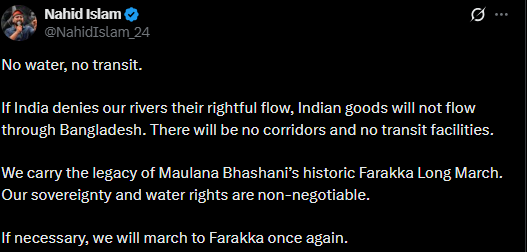
On November 1, he posted on X: “No water, no transit”. He warned that Bangladesh should not allow Indian goods to pass through its territory or provide transit and corridor facilities if India failed to meet its water-sharing demands.
Nahid also invoked the Farakka Long March led by Maulana Abdul Hamid Khan Bhashani in 1976 to protest India’s diversion of Ganga waters. He warned that Bangladeshis could march to Farakka again if their water rights were not protected.
The BNP government, however, has indicated that it wants to pursue negotiations rather than abandon the treaty. Bangladesh’s State Minister for Foreign Affairs, Shama Obaed Islam, said on November 2 that Dhaka remained hopeful of renewing the agreement. She said Rahman had formed a committee to prepare for negotiations and that discussions were taking place at different working levels. Prothomalo+1
Japan-backed Matarbari project draws allegations of an India corridor
A second source of friction involves Japan’s infrastructure partnership with Bangladesh and the proposed connectivity links between India’s northeastern states and the Bay of Bengal.
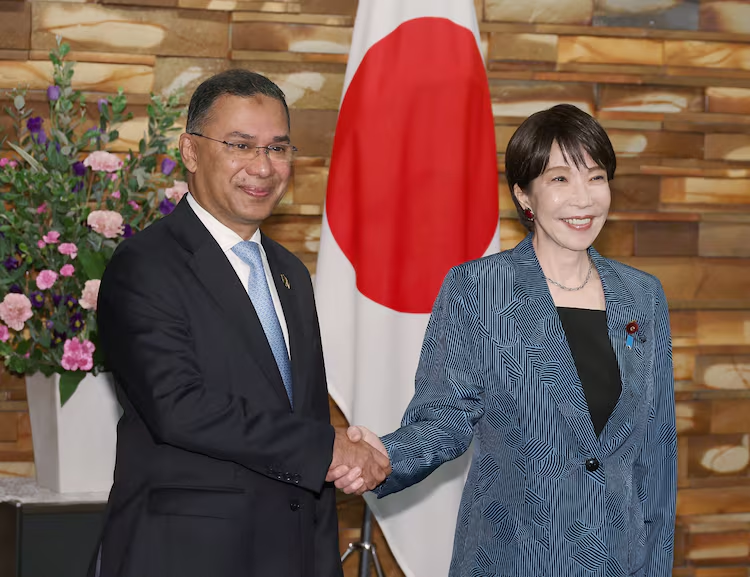
During Rahman’s visit to Tokyo on October 26, Japan and Bangladesh agreed to expand the Bay of Bengal Industrial Growth Belt (BIG-B) into a broader framework called BIG-B for Shared Prosperity. The initiative is intended to support industrial development and transport infrastructure, with the Matarbari deep-sea port in Cox’s Bazar district playing a central role.
The debate has become more contentious because of a separate Japanese proposal announced in 2023: the Bay of Bengal–Northeast India Industrial Value Chain Initiative. It envisages improved infrastructure and cross-border trade links that could allow goods from India’s seven northeastern states to reach the Bay of Bengal through Bangladesh.
The two initiatives are related to regional connectivity but are not identical. Dhaka has denied that the expanded BIG-B framework discussed during Rahman’s Tokyo visit involved negotiations over the participation of a third country.
Nevertheless, opposition leaders have questioned whether the government is considering arrangements that could give India access to the Matarbari port through Bangladesh.
At the October 30 rally, Nahid accused Rahman’s government of attempting to provide India with an “illegal corridor” during the Japan visit. He said Bangladeshis would not accept such an arrangement.
Jamaat-e-Islami chief Shafiqur Rahman also questioned the outcome of the prime minister’s four-day visit to Japan. He demanded that the government explain the purpose of the discussions and the proposed Matarbari project, warning that Bangladesh could not be “leased out in the name of connectivity”.
The criticism has put the government in a difficult position. Regional infrastructure projects could offer economic benefits through trade, investment and improved transport links. However, opposition parties are framing the proposed arrangements as questions of national sovereignty and control over strategic infrastructure.
Garment workers’ protests add to political pressure
The renewed anti-India rhetoric is also unfolding amid growing economic discontent. Bangladesh’s ready-made garment industry, one of the country’s biggest sources of export earnings and employment, has been hit by protests over wages and working conditions.
Workers are demanding an increase in the minimum monthly wage from 12,500 taka to 30,000 taka. They argue that rising prices and household expenses have reduced the value of their earnings, while the minimum wage has remained unchanged since 2023.
The demonstrations have spread across Dhaka, Gazipur, Savar, Ashulia and other industrial areas. Workers have blocked highways and clashed with police, while some factories and vehicles have been vandalised or set on fire.
The unrest continued for a fourth day on November 3, with fresh clashes and road blockades disrupting factory operations and transport around Dhaka. Nearly 700 factories had been closed the previous day, according to reports. The government has formed a six-member wage board to review pay, but the move has not immediately brought the protests under control. Reuters+2
The government has accused the former ruling Awami League of attempting to destabilise the garment industry. Home Minister Salahuddin Ahmed has also alleged that people from across the border were encouraging workers to create unrest and disrupt production and exports.
Some senior police officials have reportedly referred to possible third-party instigation and domestic and foreign conspiracies behind the violence in industrial areas such as Savar and Ashulia. Jamaat chief Shafiqur Rahman has also accused conspirators and opportunists of trying to damage the garment industry by fuelling unrest.
These allegations have not established any foreign role in the labour protests. However, references to cross-border interference have added another layer to the political debate and helped bring India into discussions about Bangladesh’s internal problems.
The economic backdrop is significant. The garment industry employs millions of people and accounts for more than 80 per cent of Bangladesh’s export earnings. Prolonged factory closures could affect production schedules, shipments and the country’s standing among international buyers.
Hasina’s planned return adds another complication
The political debate is also being shaped by Sheikh Hasina’s stated intention to return to Bangladesh in December.
Hasina has been living in India since leaving Bangladesh in August 2024 following the mass protests that ended her government. Her presence in India has remained a sensitive issue in bilateral relations, with Dhaka repeatedly seeking her extradition.
In August, Hasina said at a press conference in New Delhi that she intended to return to Bangladesh in December, describing it as her responsibility to go back. Her proposed return has since become a subject of political debate in Dhaka.
The former prime minister has been sentenced to death by Bangladesh’s International Crimes Tribunal for crimes against humanity. The Awami League is currently banned from political activity, although it continues to have a support base among sections of the population.
At the October 30 rally, Nahid Islam referred to Hasina’s proposed return and urged those who participated in the July uprising to unite again. He questioned whether Rahman’s government would be able to confront the former prime minister if she returned.
The statement reflects the NCP’s concern that Hasina’s return could reshape Bangladesh’s political landscape. It also shows how the former prime minister’s presence in India continues to influence political narratives within Bangladesh.
For Rahman, the issue presents a diplomatic challenge. Any decision concerning Hasina could have implications for relations with New Delhi, while his domestic opponents may use the matter to question his government’s commitment to the political changes that followed the 2024 uprising.
Can Tarique Rahman prevent ties with India from deteriorating?
The renewed criticism of India is being driven by several issues rather than a single diplomatic dispute. The approaching expiry of the Ganga treaty has revived long-standing concerns over water allocation. The Matarbari connectivity debate has raised questions about sovereignty and regional access, while economic difficulties and labour unrest have created an atmosphere in which allegations of foreign interference can gain political traction.
Hasina’s planned return adds a further complication because it links Bangladesh’s domestic political contest directly with its relationship with India.
The BNP government faces the task of balancing national interests, opposition pressure and the economic benefits of regional cooperation. Negotiations over the Ganga treaty and greater transparency about infrastructure agreements could help address some of the concerns being raised.
However, the political use of anti-India rhetoric may make diplomatic engagement more difficult. Whether Rahman can keep bilateral relations stable will depend on how his government handles the water-sharing negotiations, connectivity proposals and the sensitive question of Hasina’s return.
For New Delhi and Dhaka, the challenge will be to prevent domestic political disputes from undermining cooperation on trade, water resources and regional development.