







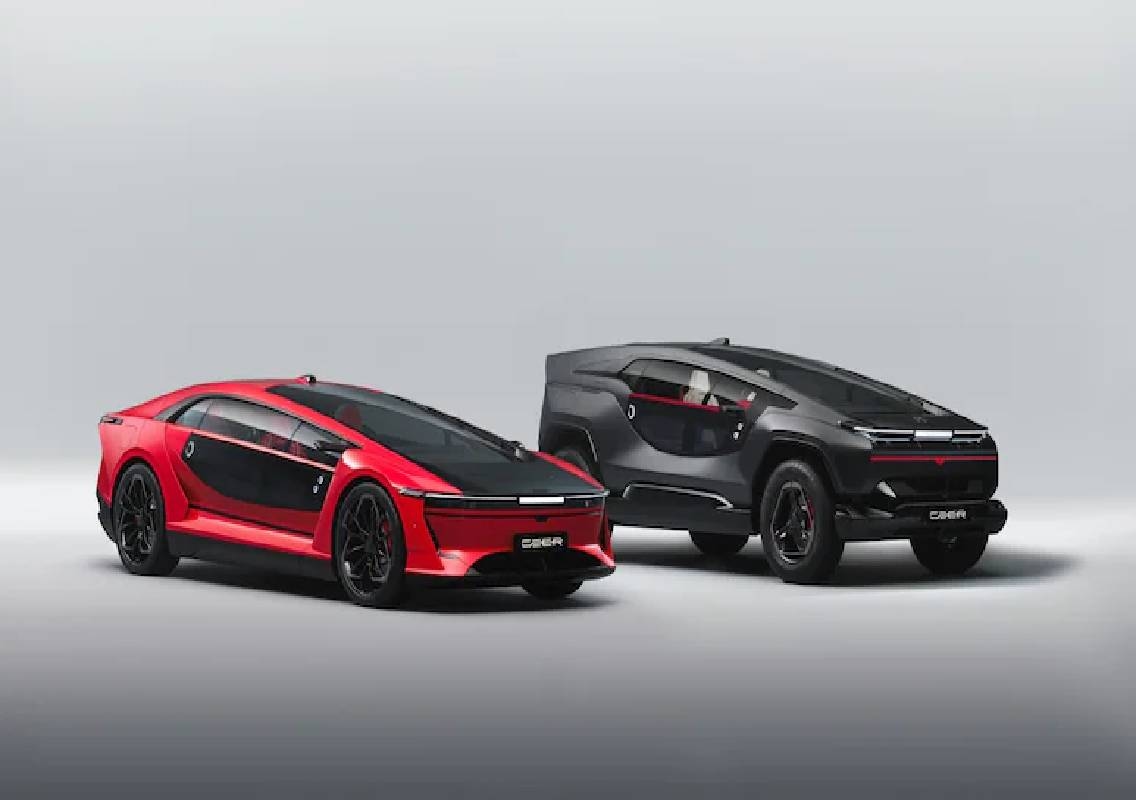


Riyadh: Saudi Arabia’s national automotive brand CEER has unveiled its first electric vehicles, the futuristic Exobot sedan and SUV, marking the company’s entry into the passenger EV market. The flagship electric models combine a tri-motor all-wheel-drive powertrain, advanced technology and a distinctly Saudi-inspired design.
The top-specification Exobot can produce up to 1,111 hp and 1,500 Nm of torque, while the Exobot sedan has a claimed range of up to 670 km on the NEDC cycle. The electric sedan can accelerate from 0 to 100 kmph in 2.1 seconds in its highest-power configuration, while the SUV takes 2.4 seconds.
However, CEER will initially launch the Exobot First Edition, which uses an 850 hp tri-motor setup and offers up to 670 km of NEDC range in the sedan. The First Edition will be followed by the Exobot Plus.
CEER Exobot comes as sedan and SUV
The Exobot range consists of two body styles — a large sedan and an SUV. Both models share the same electric architecture and several technology features, while differing in dimensions and performance.
The Exobot sedan measures approximately 5.26 metres in length, 2.1 metres in width and 1.43 metres in height. The SUV measures about 5.02 metres long, 2.1 metres wide and 1.69 metres tall. Both models have a 3.2-metre wheelbase.
One of the most distinctive design elements is the huge windscreen, which measures around 2.4 metres in length and is positioned at a steep 15-degree angle. CEER says the glass has been designed to improve aerodynamics, visibility and solar heat management.
The vehicles also feature nearly three-metre-long Shahin wing doors, inspired by the Shahin falcon. The doors open through a 60 cm arc and are designed to provide easier access to both front and rear seats.
Exobot produces up to 1,111 hp
At the top of the range, the Exobot uses a tri-motor all-wheel-drive system capable of producing up to 1,111 hp and 1,500 Nm.
In this specification, the Exobot sedan can sprint from 0 to 100 kmph in 2.1 seconds and reach a top speed of 250 kmph. The SUV completes the same acceleration run in 2.4 seconds and has a claimed top speed of 210 kmph.
CEER says the powertrain is supported by continuous torque vectoring and active chassis systems to improve stability and handling.
The initial First Edition models, however, produce 850 hp and 1,000 Nm. The First Edition sedan is claimed to accelerate from 0 to 100 kmph in 2.6 seconds, while the SUV takes 2.9 seconds.
670 km range and 800V charging
The Exobot uses a 112 kWh battery and an 800V electrical architecture.
The sedan has a claimed NEDC range of up to 670 km, while the SUV offers up to 560 km. CEER says the battery can be charged from 10% to 80% in under 30 minutes using DC fast charging.
The range figures are based on the NEDC testing cycle and may differ from real-world driving conditions.
The combination of a large battery and 800V architecture is intended to give the Exobot both long-distance capability and faster charging compared with conventional EV charging systems.
Futuristic cabin gets 48-inch 8K display
The Exobot’s interior has been designed around a large digital cockpit.
A 48-inch pillar-to-pillar curved Digital Horizon display dominates the dashboard. It is accompanied by a 10.4-inch central control screen and an 8-inch display for rear occupants.
The vehicles also feature steer-by-wire technology and rear-wheel steering. CEER has incorporated a camera-based mirror system, 3D navigation and a voice assistant supporting Arabic and English.
The cabin also gets SoundStage Audio, a personalised fragrance system, climate control and advanced air filtration.
Through the CEER smartphone app, owners can remotely monitor the vehicle, manage charging, pre-condition the cabin, locate the car and use remote parking functions.
Wing doors and Saudi-inspired design
CEER has used several design elements inspired by Saudi Arabia’s heritage and landscape.
The Exobot features 32 lighting elements, with the design reportedly drawing inspiration from Saudi heritage. The forged aluminium wheels also incorporate architectural influences.
The company says the large windscreen has been designed with Saudi Arabia’s hot climate in mind. CEER claims that under extreme heat conditions, the cabin temperature can fall from 65°C to 32°C within 10 minutes using the vehicle’s thermal-management system.
The Shahin wing doors are another major styling feature, opening upwards rather than using conventional doors.
Safety and driver assistance features
The Exobot is equipped with a range of active and passive safety systems.
The electric architecture incorporates a cell-to-pack battery structure, multiple airbags and an aluminium casting and extrusion space frame. The vehicles also feature advanced driver-assistance systems.
These include lane-centering and lane-keeping assistance, adaptive cruise control with stop-and-go functionality, blind-spot detection and rear cross-traffic assistance. CEER also says the vehicles support automated lane changes and point-to-point highway navigation.
The company plans to use over-the-air software updates to add features and improve vehicle performance over time.
First Edition to launch before Exobot Plus
CEER will introduce the Exobot range with the limited First Edition, available in both sedan and SUV body styles.
The First Edition gets a distinctive black exterior package with red brake callipers, along with red-and-black Nappa leather interiors. Buyers can choose between Harrat Grey and White Musk exterior finishes. Each First Edition vehicle will also carry a numbered plaque corresponding to its VIN.
The company will subsequently introduce the Exobot Plus, which will offer greater scope for personalisation and additional exterior and interior choices.
CEER plans seven models by 2030
The Exobot is the first step in CEER’s planned seven-model portfolio.
CEER was established in 2022 as part of Saudi Arabia’s strategy to develop a domestic automotive industry. The company is a joint venture involving Saudi Arabia’s Public Investment Fund and Foxconn.
The Exobot models will be manufactured at the CEER Manufacturing Complex in King Abdullah Economic City, which the company describes as the largest automotive production facility in the Middle East.
CEER plans to introduce seven models by 2030, including compact and mid-size vehicles with different propulsion options.
The company also aims to achieve 45% local content by 2034 as Saudi Arabia works to expand its domestic automotive manufacturing capabilities.
Saudi Arabia’s new electric car enters the global spotlight
The unveiling of the Exobot marks an important step in Saudi Arabia’s ambitions to establish a domestic automotive industry.
With up to 1,111 hp, tri-motor all-wheel drive, a 112 kWh battery and a claimed 670 km NEDC range for the sedan, the Exobot has been positioned as a high-performance electric flagship.
Sales in Saudi Arabia are expected to begin in early 2027. CEER has not yet announced pricing for the Exobot or confirmed plans for an India launch.