







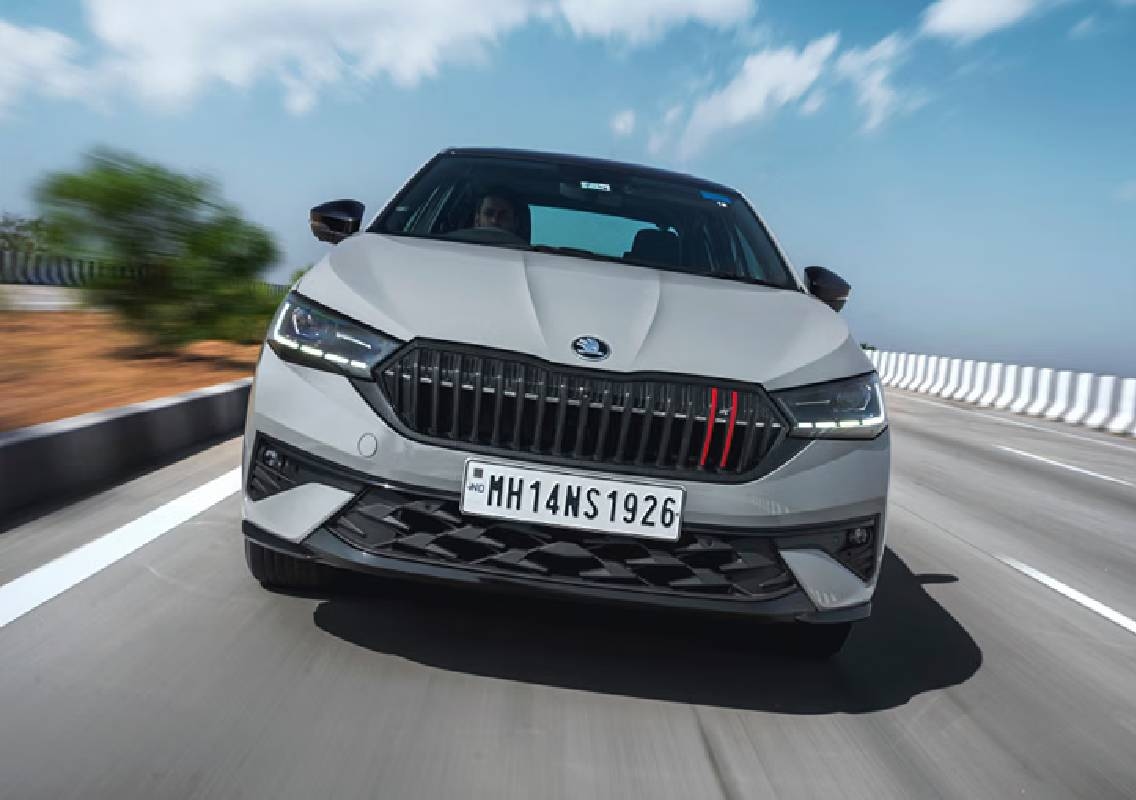


India: The Skoda Slavia has received its first major update since its launch, bringing subtle styling changes, additional features and a new automatic gearbox. While the facelift does not transform the midsize sedan, the combination of small improvements makes the updated Slavia a more complete package.
The biggest mechanical change is the introduction of an eight-speed torque-converter automatic gearbox with the 1.0-litre TSI engine. Skoda has also added features such as a 360-degree camera, rear-seat massage function, a larger digital driver’s display and an improved air-conditioning system.
The facelift retains the Slavia’s core strengths, including its turbo-petrol engines, high-speed stability and spacious cabin. The changes are therefore more evolutionary than revolutionary, but they address several areas where the earlier model had room for improvement.
Exterior changes remain subtle
The Slavia facelift does not receive a completely redesigned body. Instead, Skoda has concentrated on revising the lighting elements, bumpers and other exterior details.
The headlamp housings retain their basic shape, but the LED daytime-running-light signature has been redesigned. The front bumper also gets changes, including revised detailing and new fog-lamp elements.
At the rear, the tail-lamp housings continue with the same overall design, but the LED elements have been revised. Sequential turn indicators are another addition.
The sedan also gets redesigned 16-inch alloy wheels and new exterior colour options, including Arctic Silver and Cappuccino Beige. A revised trim element bearing the Skoda name further differentiates the updated model from its predecessor.
These changes are not dramatic, but together they give the Slavia a fresher appearance without moving away from the clean design of the original car.
Cabin retains familiar layout
Inside, the Slavia facelift continues with broadly the same dashboard architecture as before.
The infotainment screen has grown slightly to 10.1 inches and receives updated graphics and functions. The bigger change is in front of the driver, where the previous 8-inch digital instrument display has been replaced by a 10.25-inch unit on higher variants.
The larger display can show additional information and turn-by-turn navigation. Lower variants continue with simpler instrumentation depending on the trim level.
Skoda has also introduced new colour and trim combinations. The overall cabin remains familiar, which means buyers moving from the previous Slavia will find the controls and driving position largely unchanged.
Rear-seat massage adds a premium touch
One of the more unusual additions to the facelift is a massage function for the outer rear seats.
This feature is available on the higher Prestige and Monte Carlo variants and has been carried over from the Kushaq. It gives the Slavia an additional comfort feature that is uncommon in this segment.
The rear seat continues to benefit from the sedan’s spacious cabin, making the Slavia suitable for buyers who regularly travel with passengers.
The massage function may not be a feature that everyone considers essential, but it adds to the premium character of the top-end versions and gives the facelift a feature that stands out among its rivals.
360-degree camera improves usability
Another useful addition is the 360-degree camera.
The outgoing Slavia offered a conventional rear-view camera, while the facelift adds a surround-view system. This should make parking and manoeuvring the sedan in narrow spaces easier.
Skoda has also added front parking sensors, complementing the existing rear parking assistance system. The combination should be particularly useful in crowded urban environments where parking spaces can be tight.
The 360-degree camera is therefore a more practical upgrade than some of the cosmetic changes, particularly for owners who frequently drive in busy city conditions.
Air-conditioning performance gets attention
Climate control performance was one area where the previous Slavia had scope for improvement.
For the facelift, Skoda has replaced the fixed-geometry air-conditioning compressor with a variable-geometry unit. The manufacturer says this change improves the effectiveness of the climate-control system.
For Indian conditions, stronger and more consistent cooling can make a meaningful difference, particularly during summer months and when the vehicle is parked outdoors.
This is an example of a change that is not immediately visible but could have a bigger impact on everyday ownership than an exterior styling update.
New eight-speed automatic gearbox
The most important mechanical update is the new automatic transmission for the 1.0-litre TSI engine.
The 115hp, 1.0-litre three-cylinder turbo-petrol engine now gets an eight-speed torque-converter automatic gearbox instead of the previous six-speed automatic. The engine continues to produce 178Nm of torque.
The new gearbox has improved the Slavia’s low-speed drivability, according to the road test. This is particularly relevant for city driving, where the smoother response of a torque-converter automatic can make stop-and-go traffic less tiring.
The 1.0-litre engine continues to be offered with a six-speed manual gearbox as well.
1.5 TSI remains the performance choice
The larger 1.5-litre TSI engine continues to produce 150hp and 250Nm.
Unlike the 1.0-litre engine, the 1.5 TSI continues to be paired with a seven-speed dual-clutch automatic gearbox.
This remains the performance-oriented choice in the Slavia range. The engine offers strong acceleration and suits buyers who prioritise highway performance.
The Slavia’s high-speed stability continues to be one of its strengths, and the facelift does not alter the fundamental characteristics of the chassis or suspension setup.
Strong high-speed manners remain
The Slavia has traditionally been known for its stability at higher speeds, and the facelift retains this character.
The car feels planted on highways and remains composed when driven through sweeping bends. The punchy turbo-petrol engines also complement the sedan’s driving dynamics.
The 1.0 TSI is likely to appeal to buyers looking for a balance between performance and everyday usability, while the 1.5 TSI remains the more exciting option for enthusiasts.
The updated 1.0 automatic, however, addresses one of the weaker aspects of the previous model by providing smoother low-speed behaviour.
Google-based AI assistant added
The updated Slavia also receives a Google Cloud-based AI assistant.
The system is designed to understand Indian English accents and provide information through voice commands. It can also be used for functions such as music, calls and climate-control settings.
This adds a technology-focused element to the cabin, although its usefulness will ultimately depend on how naturally owners use voice controls in everyday driving.
The existing infotainment system also receives an updated user interface, while wireless Apple CarPlay and Android Auto continue to be available.
What has not changed?
Despite the updates, the Slavia remains recognisably the same car underneath.
The two turbo-petrol engines continue unchanged in terms of their headline power and torque figures. The 1.5 TSI still uses the seven-speed DCT, while the 1.0 TSI retains its six-speed manual option.
The basic cabin layout and overall dimensions have also not undergone major changes.
The sedan continues to compete with the Honda City, Hyundai Verna and Volkswagen Virtus. Its appeal remains centred on driving dynamics, strong engines, a spacious cabin and a feature-rich equipment list.
Verdict: Small changes improve the package
The Skoda Slavia facelift is not a radical redesign, but it does not need to be.
The changes address several practical areas while preserving what made the original Slavia appealing. The eight-speed automatic improves the 1.0 TSI’s city manners, while the 360-degree camera, rear-seat massage, larger driver display and improved air-conditioning add everyday convenience.
The exterior updates are more restrained, but they give the sedan a fresher appearance without compromising its established design.
The result is a Slavia that feels more polished rather than completely new. For existing owners, the upgrades may not alone justify switching. However, for new buyers considering a midsize sedan, the facelift strengthens the Slavia’s position in a segment increasingly dominated by SUVs.
Conclusion
The Skoda Slavia facelift focuses on incremental improvements rather than a complete transformation. Its revised styling, improved cabin technology, 360-degree camera, rear-seat massage function and stronger air-conditioning add value, while the new eight-speed automatic makes the 1.0 TSI more appealing for city driving. With its punchy engines and strong high-speed stability retained, the facelift makes the Slavia a more rounded midsize sedan.