







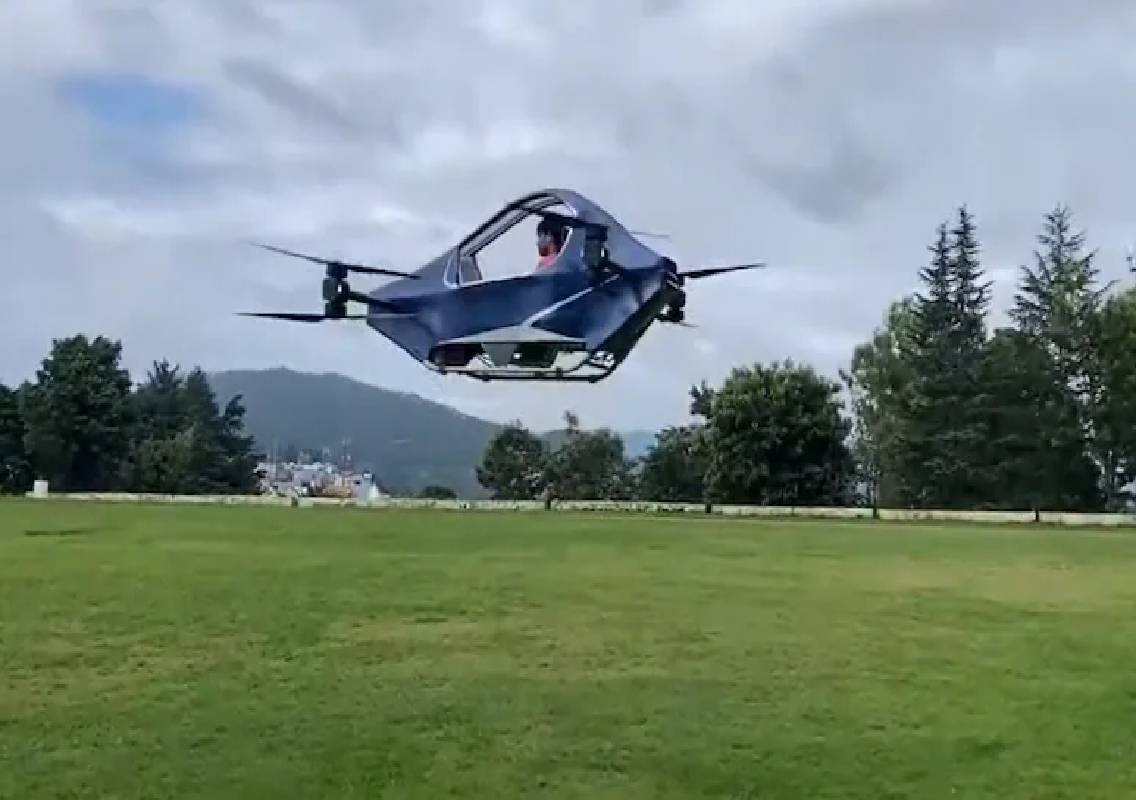


Dehradun: A young innovator from Uttarakhand has attracted widespread attention after successfully conducting a test flight of an electric flying vehicle prototype. A video showing the machine taking off has gone viral on social media, prompting comparisons with the long-discussed concept of flying cars.
The vehicle, developed by Uttarakhand innovator Ravi Tamta, is being described in reports as an electric personal flying vehicle. Its successful test flight marks an early milestone, although the prototype is still far from becoming a commercially available flying car.
Ravi Tamta’s electric flying vehicle takes off
The viral footage shows the electric vehicle lifting off the ground and hovering above the surface during a test.
The demonstration has attracted attention because the machine resembles the futuristic flying cars that have long featured in science-fiction films. However, the technology seen in the footage is more accurately understood as an early-stage electric vertical-lift flying vehicle rather than a conventional car that can seamlessly switch between road and air travel.
Reports say Tamta designed and assembled the prototype himself, demonstrating his technical skills despite working with limited resources.
How the prototype works
The vehicle uses an electric propulsion system and multiple rotating lifting units to generate enough thrust to leave the ground.
Its configuration resembles that of a large personal drone or multirotor aircraft, with a seat positioned within the frame for the operator.
The concept is part of a wider global push towards small electric aircraft and electric vertical take-off and landing (eVTOL) technology.
Unlike conventional aeroplanes, such vehicles are designed to take off and land vertically, potentially reducing the need for long runways.
Viral video sparks excitement online
The test-flight footage quickly gained traction online, with users expressing both excitement and curiosity about the technology.
Some viewers described the machine as a glimpse of the future of transportation, while others questioned whether the prototype should technically be called a “flying car”.
The distinction is important because a true flying car would generally be expected to combine road-going capabilities with safe and practical flight capabilities.
The Uttarakhand prototype, based on the available reports, is better described as an electric personal flying vehicle at the experimental stage.
A small-town innovator draws national attention
Tamta’s achievement has attracted attention because of the reported self-driven nature of the project.
Rather than emerging from a large aerospace company, the prototype has been associated with an individual innovator working from Uttarakhand.
His story has consequently been presented as an example of how independent inventors and young engineers are experimenting with emerging technologies outside India’s traditional aerospace hubs.
The attention could also help bring greater visibility to grassroots engineering projects and encourage investment in experimental mobility technologies.
Flying cars are no longer just science fiction
The concept of flying cars has been under development for decades, but recent advances in electric motors, batteries, lightweight materials and autonomous flight systems have accelerated interest in the sector.
Companies around the world are working on eVTOL aircraft for applications ranging from passenger transport and emergency services to logistics and urban air mobility.
Unlike conventional helicopters, many eVTOL concepts use several electric motors and rotors, potentially offering new approaches to short-distance aerial transportation.
However, battery capacity, payload, flight endurance, noise, safety and air-traffic management remain major challenges.
Prototype still needs extensive testing
The successful flight represents an important demonstration, but it does not mean the vehicle is ready for everyday transportation.
The prototype will require extensive testing to establish its stability, reliability, payload capability, battery performance and emergency safety systems.
Aviation regulations would also need to be satisfied before such a vehicle could legally carry passengers or operate routinely in controlled airspace.
Reports on the Uttarakhand prototype specifically note that it remains at the prototype stage and would require regulatory approvals before any commercial deployment.
Regulatory approval will be crucial
Any manned electric aircraft operating in India would have to comply with the country’s aviation regulations.
This could involve requirements covering aircraft certification, pilot qualifications, flight testing, airworthiness, operating areas and air-traffic coordination.
For an experimental personal aircraft, demonstrating that the machine can fly is therefore only the first step.
Ensuring that it can operate safely under different weather conditions and respond reliably to technical failures would be equally important.
Battery technology remains a major challenge
Electric propulsion offers advantages such as lower local emissions and potentially simpler mechanical systems compared with conventional combustion engines.
However, batteries are considerably heavier than many aviation fuels for the amount of energy they store.
This creates a major engineering challenge for flying vehicles because every additional kilogram affects the amount of energy required for flight.
A practical electric flying vehicle therefore needs to balance battery capacity, passenger weight, structural strength and flight time.
India’s growing interest in eVTOL technology
The Uttarakhand prototype comes at a time when Indian companies and startups are also exploring electric vertical-flight technology.
The broader eVTOL sector is attracting interest for possible applications in urban mobility, medical evacuation, cargo transportation and other specialised uses.
Earlier Indian projects have also demonstrated electric aircraft prototypes, highlighting the growing interest in developing new forms of short-distance aerial transportation.
These developments suggest that electric aviation is gradually moving from research laboratories and concept designs towards physical demonstrations and flight testing.
Could flying cars become common in India?
The idea of flying cars is particularly attractive in densely populated Indian cities where road congestion can make surface travel increasingly time-consuming.
In theory, short-distance aerial transportation could allow passengers to travel above congested roads.
However, large-scale deployment would require much more than individual flying vehicles.
Cities would need designated take-off and landing areas, charging infrastructure, air-traffic management systems and clear safety regulations.
Noise pollution, privacy, emergency response and the risk of collisions would also have to be addressed.
From prototype to commercial vehicle
For Tamta’s vehicle, the journey from a successful demonstration to a commercially viable product could therefore be a long one.
The prototype must first prove that it can perform reliably over repeated flights.
Engineers would then need to improve its efficiency, safety systems, controls and overall design before regulatory certification could be considered.
Only after meeting those requirements could a manned flying vehicle potentially move towards commercial use.
Why the test flight matters
Despite the challenges, the demonstration is significant because it shows how experimental electric aviation is being explored by independent innovators in India.
The flight does not prove that flying cars are about to replace conventional vehicles. Instead, it represents an early experiment in a field that could eventually contribute to new forms of personal and urban air mobility.
For an innovator working outside the traditional aerospace industry, successfully getting an electric prototype into the air is itself a noteworthy engineering milestone.
What comes next for the project?
The immediate focus is likely to be on improving the prototype and conducting more controlled tests.
Additional flight trials could help determine how the vehicle performs with different loads, flight durations and operating conditions.
Further development would also be needed before the machine could be considered for practical passenger use.
The attention generated by the viral video could potentially help the project attract technical expertise, funding or institutional support.
Conclusion
A young innovator from Uttarakhand, Ravi Tamta, has attracted attention after successfully testing an electric flying vehicle prototype. The test-flight video has gone viral online, with viewers fascinated by the possibility of personal aerial transportation.
However, the machine should currently be viewed as an experimental flying vehicle rather than a commercially ready flying car. Extensive testing, safety validation and regulatory approvals would be required before such technology could be used for routine passenger travel.
The successful demonstration nevertheless highlights India’s growing interest in electric aviation and the potential of independent innovators to experiment with technologies that could shape the future of transportation.