







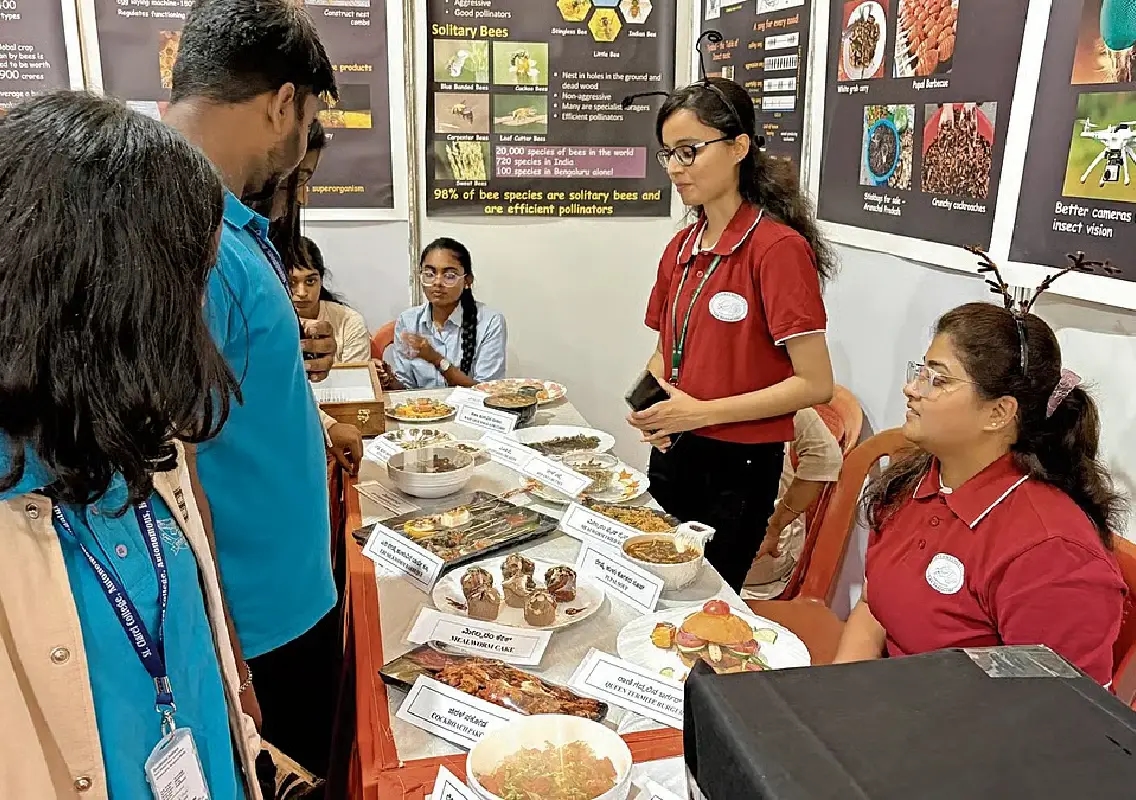


Visitors at the recently concluded Krishi Mela were met with an unexpected — and for many, unsettling — vision of what the future of food might look like. At one of the stalls, a spread of insect-based dishes drew shocked glances, wrinkled noses and hesitant questions. On display were items such as a queen termite tucked inside a burger bun, silkworm pupae floating in soup, trays of cockroach pakodas, grasshopper kebabs, mealworm-topped pizza, red ant chutney and deep-fried crickets.
The unusual exhibit was presented by the Department of Entomology, College of Agriculture, University of Agricultural Sciences (UAS), GKVK, aiming to raise awareness — not offer tastings. Still, the sight proved too much for most visitors.
Public reaction reveals cultural hesitation
Bengaluru: According to Harshini N, an MSc student and one of the three presenters, the display triggered more “disgust” than curiosity. “People walked past saying things like ‘India is heading the China way’. They were especially put off by the cockroach pakodas,” she said. Only a handful showed real interest, asking whether they could sample silkworm pupal manchurian or mealworm cake.
The organisers repeatedly clarified that the dishes were meant solely for educational purposes — not consumption — and were created to generate conversations around alternative nutrition.
This hesitation, experts say, underscores the cultural barriers that stand in the way of mainstreaming entomophagy, the practice of eating insects.
Insect eating is not new to India
Bengaluru: While urban India may baulk at the idea of insect-based foods, the practice is far more widespread than most assume. In 2013, the Food and Agriculture Organization (FAO) highlighted insects as an untapped nutritional resource to combat global food insecurity. In fact, a presentation by the Ashoka Trust for Research in Ecology and the Environment (Atree) notes that more than 300 insect species are consumed across tribal communities in at least ten Indian states.
Closer home, insect-based dishes have deep roots in Karnataka. Jemla Naik D, head of the UAS GKVK entomology department, explains that red ant chutney remains popular in Chikkamagaluru, Kodagu and Hassan. “Flying termites are in high demand during the rains in Kolar and Doddaballapura, while queen termites are sought year-round for their nutritional value,” he says.
With the global population rising, Naik believes insects could eventually serve as a nutritious and sustainable substitute for non-vegetarian diets.
Chefs and researchers experiment with edible insects
Bengaluru: Experimentation with insects is already underway outside academic spaces. Atree has been distributing cricket-infused choco chips and chilli garlic crickets at events since 2018. “People love the chilli garlic crickets. It tastes like chilli prawns,” says Atree entomologist Priyadarsanan Dharma Rajan.
At Bagalur-based restaurant Farmlore, chef and cofounder Johnson Ebenezer has incorporated red ants into his tasting menu, especially for diners who approach food with an open mind. His ‘ant bite’ dish consists of a rice crisp tart layered with chutney made from red ants, burnt onions, tomatoes and chillies. He also serves a sorbet topped with fried ants.
Ebenezer says he sources these ants from mango trees because they lend a natural astringency, though he suspects ants from mulberry trees might offer a sweeter flavour profile.
Policy barriers slow down mainstream adoption
Bengaluru: Despite rising global interest, India still lacks a clear legal framework for edible insects. Rajan points out that countries such as Singapore, Taiwan and several in the European Union have introduced supportive policies for entomophagy. Cricket powder, for example, is now a fast-growing protein supplement worldwide.
However, in India, the Biodiversity Act allows trade only in species approved on its permitted list — and many edible insects do not feature there. Meanwhile, the Food Safety and Standards Authority of India (FSSAI) has no guidelines for packaging or selling insect-based foods.
But the biggest barrier, experts insist, remains consumer psychology. Even some of the UAS GKVK students who prepared the dishes were hesitant to try them. “I tried silkworm manchurian. It tasted just like gobhi manchurian. The red ant chutney was sour,” Harshini recalls.
Conclusion
Bengaluru’s Krishi Mela may not have converted its visitors into insect-eaters, but it succeeded in sparking an important conversation. As the world grapples with rising food insecurity, dwindling resources and environmental pressures, insects may well emerge as a sustainable and nutrient-dense alternative. For now, though, India’s journey from curiosity to acceptance is likely to be slow, shaped by policy changes, culinary innovation and a shift in public perception.