







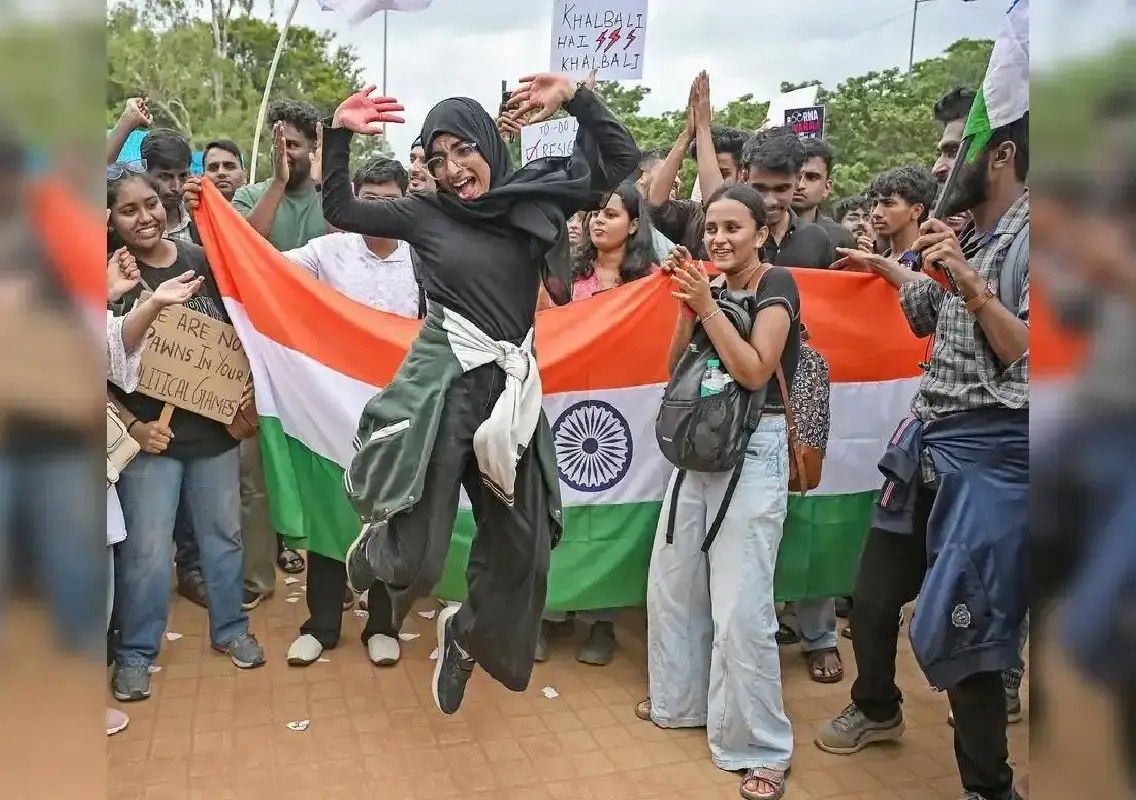


Bengaluru: For nearly 10 days, Bengaluru‘s Freedom Park transformed from the city’s designated protest venue into a vibrant gathering space for thousands of young people expressing solidarity with the nationwide student agitation over alleged examination irregularities and the NEET paper leak.
Without a central leadership, political banners or student unions directing the movement, the protests drew between 1,000 and 3,000 participants daily, reflecting the growing influence of social media in mobilising public action.
Protest inspired by digital movement
While the main protest unfolded at Jantar Mantar in New Delhi, many young people in Bengaluru found themselves closely following developments through Instagram, where reels, memes and live streams kept the movement alive online.
Unable to travel to Delhi because of work, studies or financial constraints, many participants chose Freedom Park as a local platform to express their support.
What began as digital engagement gradually evolved into physical participation, with thousands gathering daily to voice their concerns over alleged examination irregularities, education reforms and accountability.
Social media connected strangers
Participants arrived carrying handmade placards, while portable speakers echoed slogans, music and poetry across the park.
Volunteers organised drinking water for demonstrators, and many first-time participants quickly bonded with strangers united by a common cause.
Kannada, Hindi and English slogans resonated throughout the venue, reflecting the diverse backgrounds of those attending the demonstrations.
Although memes and humour played a visible role in attracting attention online, protesters repeatedly maintained that the issues they were highlighting were serious and extended beyond social media trends.
Young professionals joined students
The protest drew not only students but also young professionals from different sectors.
Abhishek, a Bengaluru-based lawyer, said he initially became involved by watching videos and memes from the Delhi protest online.
He said spending time following updates each night made him feel emotionally connected to the movement, eventually motivating him to participate in person at Freedom Park.
Similarly, Riya, who works in the marketing division of a private company, said she skipped work to attend the protest.
She recalled ordering a printed placard after reaching the venue, realising that nearly every participant had brought one.
According to her, while memes attracted attention, concerns about education and examination integrity were the primary reasons people remained committed to the protest.
Protest remained largely apolitical
One of the defining characteristics of the Freedom Park demonstrations was the limited involvement of political leaders.
Unlike many public protests, the gathering was not dominated by political speeches or organised party campaigns.
Only a few actors made brief appearances, while students and young professionals remained at the centre of the movement.
Participants said the absence of political ownership helped preserve the focus on the issues being raised rather than partisan interests.
Peaceful demonstrations under police watch
The protests were held at Freedom Park, the designated venue for public demonstrations in Bengaluru under Karnataka High Court directions.
Police personnel remained deployed throughout the gatherings, primarily coordinating with volunteers and organisers to ensure the protests remained peaceful.
Officials repeatedly requested participants to stay within the designated protest area and ensured that traffic outside the venue was not disrupted.
The demonstrators also cooperated with police instructions, dispersing peacefully at the end of each day without major confrontations or attempts to breach security arrangements.
Online movement found an offline voice
Observers described the Freedom Park demonstrations as an example of how digital conversations can evolve into peaceful civic participation.
Instagram, memes and online discussions helped sustain interest in the movement, while concerns over education, competitive examinations and accountability motivated people to assemble in person.
For nearly 10 days, Freedom Park reflected the sentiments expressed at Jantar Mantar, illustrating how a digitally connected generation translated online engagement into collective public action without formal leadership or political patronage.