







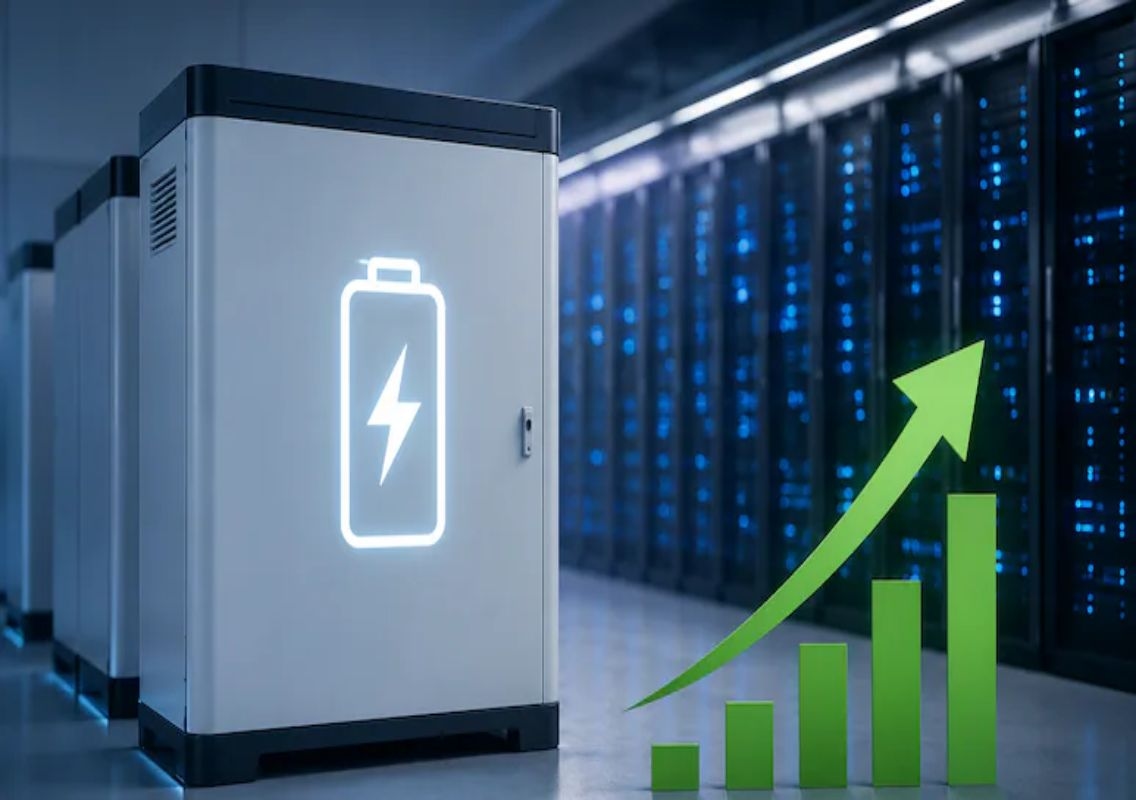


San Francisco: Antora Energy has raised $550 million (around ₹4,500 crore) in a Series C funding round, capitalising on the growing demand for energy storage driven by renewable power and the rapid expansion of data centres. The investment will be used to scale up manufacturing and build a second factory for its thermal battery systems.
The funding round was co-led by Eclipse Ventures and G2 Venture Partners, with participation from major global investors including Breakthrough Energy Ventures, backed by Bill Gates, BlackRock, and Decarbonization Partners, a collaboration between BlackRock and Temasek Holdings.
Rising demand for energy storage solutions
The investment comes at a time when demand for battery storage is surging globally. As renewable energy sources such as solar and wind contribute a growing share of electricity generation, the need for efficient storage systems has become critical.
Battery storage enables users to store electricity when supply is high and prices are low, and deploy it when demand peaks or renewable output drops. Antora’s thermal batteries are designed to deliver reliable, round-the-clock energy, addressing one of the key limitations of intermittent renewable sources.
Andrew Ponec, co-founder and chief executive officer of Antora, emphasised the importance of cost competitiveness in driving adoption. He noted that while sustainability is a key consideration, affordability remains the deciding factor for most industrial and commercial customers.
Thermal batteries target heavy industry
Antora’s technology focuses on thermal energy storage, where heat is stored at extremely high temperatures. The company’s batteries can operate at approximately 2,400°C, making them particularly suitable for industries such as steel and cement manufacturing, which require high heat for production processes.
These sectors have traditionally relied on fossil fuels due to their energy-intensive nature. Thermal batteries offer a potential pathway to decarbonisation by replacing conventional fuel-based heating systems with stored renewable energy.
Unlike conventional lithium-ion batteries, thermal batteries are built using relatively inexpensive materials and can store energy for longer durations, sometimes extending over several days. However, they are less efficient when it comes to converting stored energy back into electricity.
Expansion into data centres and power generation
Beyond industrial applications, Antora is also exploring opportunities in powering data centres — a sector witnessing exponential growth due to artificial intelligence and cloud computing.
Many data centres face delays in grid connectivity and are increasingly turning to on-site power generation and storage solutions. Thermal batteries can play a role here by storing energy as heat, which can then be converted into electricity through steam generation.
The company is also working on thermophotovoltaic technology, which uses principles similar to solar panels to convert heat into electricity. This innovation could further enhance the flexibility and application of thermal storage systems.
Investors have shown particular interest in this diversification. Joe Fath, partner at Eclipse Ventures, highlighted that the potential to serve data centres and commercial electricity needs was a key factor behind the investment.
First major project signals scale
Antora has already begun deploying its technology commercially. Its first major project, launched earlier this year, is a wind-powered thermal battery system for biofuel producer POET in South Dakota.
The facility is currently the largest thermal energy storage site globally, accounting for a significant share of installed capacity worldwide. The project allows Antora to purchase surplus wind energy at reduced costs, store it, and supply it to the client when needed.
This model also enables customers to benefit from government incentives aimed at promoting clean energy and fuel production, improving the financial viability of such projects.
Conclusion
Antora Energy’s latest funding round underscores the growing importance of energy storage in the global transition towards cleaner power. As industries and data centres seek reliable and cost-effective alternatives to fossil fuels, thermal battery technology could play a crucial role.
With fresh capital and expansion plans underway, Antora is positioning itself as a key player in the evolving energy landscape, where scalability, affordability and sustainability will determine long-term success.