







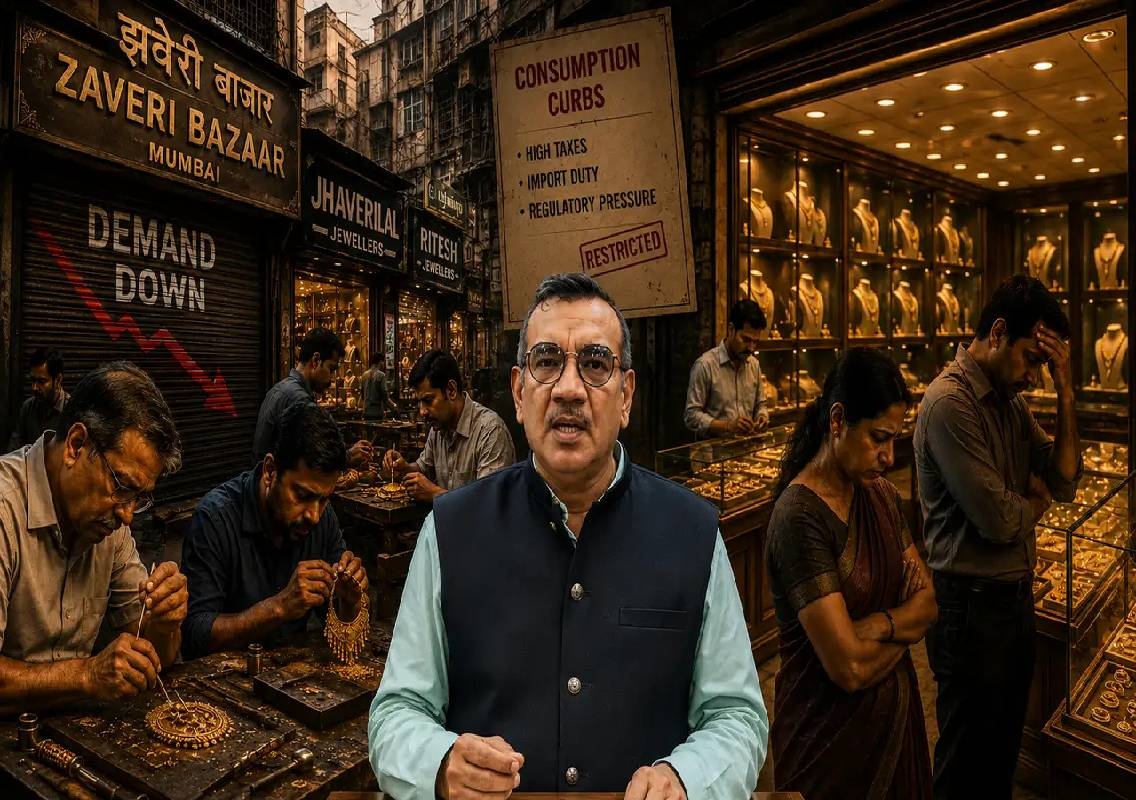


New Delhi: India Bullions & Jewellery Association has warned that recent government measures aimed at curbing gold consumption could severely impact India’s gems and jewellery sector, threatening jobs and business stability across the industry.
In an exclusive interaction, IBJA National Secretary Surendra Mehta said the sector may face salary payment pressures, reduced artisan work and financial stress after the hike in import duty on gold and silver, combined with Prime Minister Narendra Modi’s appeal to reduce unnecessary gold purchases.
Industry seeks relief measures from government
Mehta said if the government wants the industry to temporarily slow down, it should also introduce relief measures for jewellers, artisans and MSMEs operating in the sector.
“If business activity slows, then questions arise over how artisans will be paid, how salaries will be managed and how businesses will service bank loans. We hope the government considers measures like interest subvention and financial support,” he said.
According to IBJA, nearly 85 lakh workers depend directly or indirectly on India’s gems and jewellery ecosystem, many of them engaged in traditional handmade jewellery manufacturing.
Concerns over artisans and MSMEs
Mehta warned that artisans and small businesses are likely to face the biggest impact if consumer demand weakens sharply.
“The biggest challenge today is ensuring artisans continue to get sufficient work. India is globally known for handmade jewellery and the industry must survive,” he noted.
The jewellery sector remains one of India’s largest employment-generating industries, especially for skilled workers and traditional craft communities.
Gold demand may decline by 10-12%
The IBJA also projected a significant decline in gold demand during calendar year 2026 following the increase in import duties.
The government recently raised import duty on gold and silver from 6 per cent to 15 per cent.
“As an association, we expect that this could reduce India’s total gold imports by about 10 per cent this calendar year. Demand may also decline by around 10-12 per cent,” Mehta said.
The industry body acknowledged the government’s concerns regarding rising foreign exchange outflows due to soaring gold prices.
Rising gold prices increasing forex burden
Mehta pointed out that global gold prices have nearly doubled over the past year, significantly increasing India’s import bill.
“Gold is one of the largest foreign exchange expenditures for the government. Even if import quantities remain the same, the outflow rises significantly because prices have surged,” he explained.
He added that geopolitical tensions involving Iran and global oil market instability have compelled the government to prioritise imports of crude oil, edible oils and fertilisers over gold imports.
IBJA suggests monetising household gold
One of the key recommendations made by the association is to bring household gold into the formal financial ecosystem.
According to Mehta, Indian households collectively hold nearly 34,000 tonnes of gold that could potentially be monetised through mechanisms such as electronic gold receipts.
“This can help both the government and the jewellery industry. Consumers can exchange old gold instead of purchasing fresh gold, while the government benefits through lower current account deficit pressure,” he said.
The association also called for amendments in GST and income tax regulations to make gold monetisation easier and more attractive for consumers.
Shift towards investment products
IBJA observed that consumer behaviour is gradually changing, with many buyers shifting from traditional jewellery purchases to investment-oriented products.
Mehta said nearly 18 per cent of jewellery business has already transitioned towards investment buying, including:
- Gold exchange-traded funds (ETFs)
- Gold SIPs
- Digital gold investment products
“Consumers looking purely for returns are moving toward ETFs and gold SIPs,” he noted.
Smuggling concerns rise with higher duties
The association also expressed concerns that steep import duties could trigger a rise in illegal gold imports and smuggling activities.
“Illegal imports always rise when duties become higher. The government will have to ensure strict border monitoring so that smuggling activities do not increase,” Mehta warned.
Industry observers believe the coming months will be crucial in determining how the jewellery sector adapts to higher duties, changing consumer trends and economic uncertainty.