


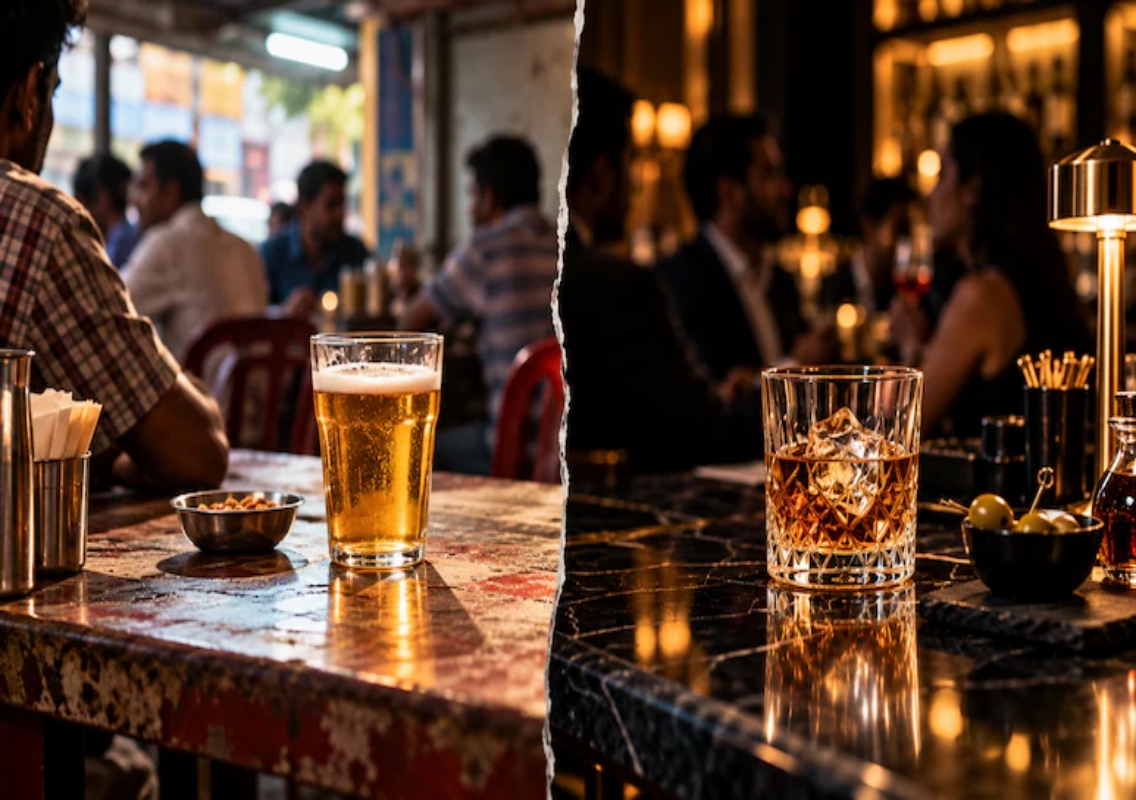


New Delhi: India’s alcoholic beverages market is witnessing contrasting consumer trends, with premium drinks gaining traction even as inflation puts pressure on spending among lower-income urban consumers. Recent earnings commentary from major liquor companies suggests that demand is not moving uniformly across price categories, creating what industry executives describe as a market with three distinct consumer segments.
While premium beer and spirits are recording strong volume growth, United Spirits has flagged signs of wallet fatigue among consumers at the lower end of its urban market. The divergence highlights the challenge facing alcohol manufacturers as they balance premiumisation with affordability.
The trend was discussed in the September quarter earnings updates of United Spirits, United Breweries, Radico Khaitan and Allied Blenders and Distillers. Their reported figures show that different product categories and consumer groups are experiencing different growth patterns.
Three consumer groups, three spending patterns
United Spirits CEO Praveen Sameshwar discussed the divergence during the company’s second-quarter earnings call. The company classifies its urban consumers into three broad groups — India 1, India 2 and India 3 — to understand differences in spending capacity and consumption behaviour.
India 1 represents the lower end of the company’s urban consumer base and is an important target audience for the lower half of its Indian-made foreign liquor portfolio. The other two segments represent consumers with different spending profiles.
Sameshwar said India 1 consumers were showing signs of fatigue, while India 2 and India 3 remained resilient. The company attributed subdued consumer sentiment to factors including the prolonged West Asia crisis, softer monsoons and inflation.
The company did not disclose the extent of the pressure or quantify how much consumption had been affected. It also did not establish whether consumers were reducing purchase frequency, shifting to less expensive brands or choosing smaller packs.
The comments therefore point to a change in consumer sentiment rather than confirming a broad decline in demand across the lower-priced liquor market.
Premium beer and spirits continue to grow
The premium segment has been a significant source of growth for several alcohol companies.
United Breweries reported a 38% year-on-year increase in premium beer volumes during the September quarter. The growth indicates continued demand for higher-priced beer products despite the pressure being reported in some other consumer segments.
Radico Khaitan also reported strong performance in its Prestige and Above portfolio, with volumes rising 36% year on year. The company’s performance reflects the growing contribution of premium spirits to its business.
However, the picture is not limited to premium products. Allied Blenders and Distillers reported 15.5% volume growth in its Mass Premium and Others segment, compared with 6.1% growth in its Prestige and Above category.
The figures show that the industry’s growth is spread across different price bands, although the pace varies between companies and product portfolios. They also underline why manufacturers cannot rely on premiumisation alone to sustain growth.
United Spirits looks at pricing and pack sizes
United Spirits is working on a calibrated price and pack structure to address the requirements of all three consumer groups. The approach is intended to provide products across different spending levels rather than concentrating only on premium offerings.
Price and pack-size decisions are important in the Indian liquor market, where consumers often make purchasing choices based on the amount they can spend on an individual purchase. Smaller packs and different price points can help brands reach customers with varying budgets, although the company has not detailed the exact changes planned.
United Spirits has also relaunched J&B Scotch as a 100% Scotch product at what it describes as an attractive price point. The company said the India-UK free trade agreement had enabled the proposition.
The relaunch forms part of its broader portfolio strategy. It also illustrates how changes in trade arrangements can influence product positioning and pricing in the imported spirits category.
Companies expand into new products and flavours
Alcohol manufacturers are also looking beyond conventional beer and spirits categories to attract consumers through new formats and flavour options.
United Spirits has introduced Smirnoff Ice, a ready-to-drink product, in Goa and Mumbai. Bengaluru is next on the company’s rollout plan. The product is available in variants containing 4.8% and 8% alcohol by volume.
Ready-to-drink products offer a different format from conventional spirits and beer, giving companies an opportunity to reach consumers looking for packaged beverages suited to different occasions.
Radico Khaitan has also expanded its flavoured vodka range. Its Magic Moments Aam Panna product, launched in August, brings the flavour of a familiar Indian summer drink into the company’s portfolio.
Such launches reflect the industry’s efforts to diversify product offerings and develop new consumption occasions. However, the companies have not said that these specific launches are a direct response to the wallet fatigue identified by United Spirits.
Inflation adds to the industry’s challenge
The latest management commentary comes against a backdrop of economic uncertainty and pressure on household budgets. Inflation can affect discretionary spending, particularly among consumers who have limited flexibility in their monthly expenses.
For alcohol companies, the challenge is to protect volumes without compromising profitability. Raising prices may help offset higher costs, but it can also make products less affordable for price-sensitive consumers. Keeping prices stable, meanwhile, can put pressure on margins if input and distribution costs rise.
The contrasting performance across price categories makes product positioning increasingly important. Companies need to maintain a presence in affordable and mass-premium segments while also developing higher-value brands that can support revenue growth.
The September quarter figures suggest that premiumisation remains an important growth driver, but the pressure reported by United Spirits indicates that consumer affordability cannot be ignored.
A market that requires different strategies
India’s liquor market is not moving in one direction. Premium beer and spirits are recording strong growth, while some lower-end urban consumers are showing signs of reduced spending capacity. At the same time, mass-premium products continue to contribute to growth at companies such as Allied Blenders and Distillers.
For manufacturers, the task is to understand these differences and adapt pricing, pack sizes and product portfolios accordingly. The coming quarters will help establish whether the reported wallet fatigue remains limited to a section of urban consumers or becomes more visible in sales volumes across affordable categories.
For now, the industry is dealing with three distinct consumer realities: premium buyers supporting growth, resilient middle segments and lower-end urban consumers facing greater pressure on their budgets.