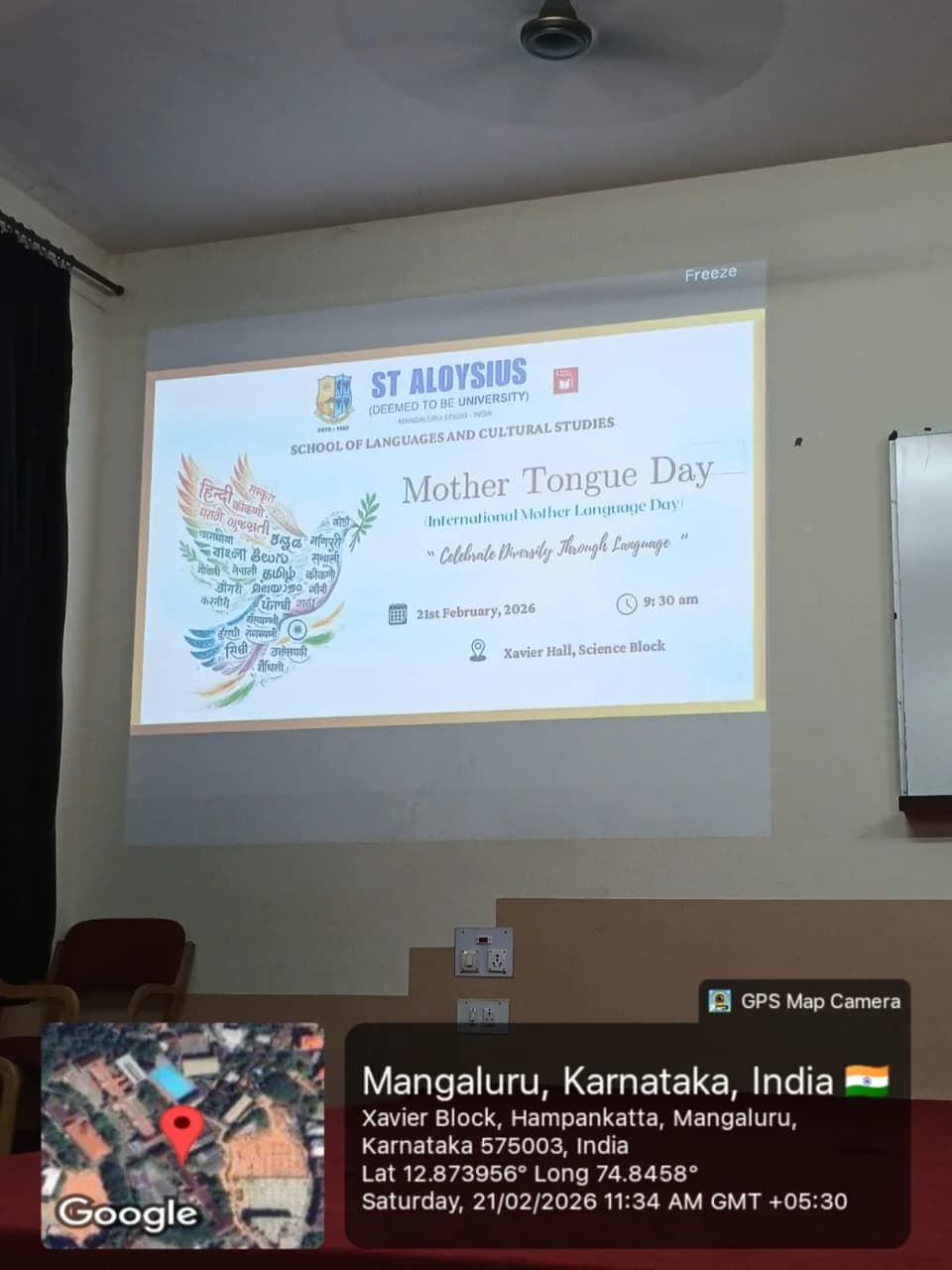
Mangaluru: St Aloysius Deemed to be University marked International Mother Language Day with a vibrant one-day programme organised by the School of Language and Cultural Studies under the theme “Mother Tongue is My Identity.” The event celebrated linguistic diversity and reaffirmed the importance of preserving native languages as a cornerstone of cultural heritage.
Observed globally on International Mother Language Day, the day highlights the need to protect linguistic diversity and promote multilingualism. The University’s programme reflected this spirit by bringing together students from 37 different mother tongues, representing various regions of India as well as international participants from Japan and Sri Lanka.
Emphasis on preserving linguistic identity
The Chief Guest, Shri Taranath Gatti, President of the Karnataka Tulu Literary Academy, delivered an inspiring address to the students. He emphasised that a mother tongue is not merely a language but the identity of one’s culture and heritage. He noted that many languages in India are on the verge of extinction due to declining usage among younger generations.
Encouraging practical steps towards preservation, he urged students to speak in their mother tongue for at least one hour every day with family members. According to him, such daily practice not only strengthens linguistic identity but also deepens familial bonds and mutual understanding.
His message resonated strongly with the audience, particularly in a multilingual academic environment where students often communicate in English or other widely spoken languages.
Registrar underscores cultural responsibility
The programme was presided over by Dr. Ronald Nazareth, Registrar of the University. In his address, he observed that although English is widely regarded as a global language, it is not the sole medium of communication or knowledge transmission. He emphasised that many countries have successfully preserved their linguistic identity by prioritising education in their native languages.
Citing examples such as Japan and France, he noted how citizens in these nations take pride in their mother tongues and continue to pursue academic and professional excellence through them. Referring to a Japanese student who had visited the University under a student exchange programme, he remarked that learning in one’s own language enables deeper comprehension and more meaningful intellectual growth.
His address reinforced the idea that multilingual competence should complement, rather than replace, respect for one’s mother tongue.
Celebration of diversity through cultural expression
The inauguration commenced on a vibrant note with traditional instrumental music, setting the tone for a culturally rich programme. Students representing all 37 mother tongues collectively took a pledge to respect other languages while nurturing and enriching their own.
The gathering reflected remarkable diversity, with participants from South, North and Northeast India, alongside international students. The cultural segment that followed featured traditional group dances and songs representing various regional traditions, highlighting India’s linguistic and cultural plurality.
The performances underscored the theme that language is deeply intertwined with art, music and social customs. Through these expressions, students demonstrated how mother tongues serve as carriers of collective memory and identity.
Academic leadership and participation
Mrs Greeshma Damodaran delivered the welcome address, setting the context for the day’s observance. The vote of thanks was proposed by Dr. Mahabubali A. Nadaf, while the programme was efficiently compered by Ms Navya.
Dr. Mahalinga Bhat, Dean of the School of Languages and Cultural Studies, along with faculty members Mrs Flora Castelino, Mrs Prashanthi and Mrs Ratnamma, were present at the event. Their active involvement highlighted the School’s continued commitment to promoting linguistic awareness and cultural scholarship.
Approximately 150 participants contributed to the successful conduct of the programme, making it a significant campus-wide celebration of linguistic pride and unity.
Conclusion
The International Mother Language Day celebration at St Aloysius Deemed to be University served as a meaningful reminder that language preservation is both a personal responsibility and a collective mission. By encouraging students to cherish and actively use their mother tongues, the University reaffirmed its commitment to fostering cultural awareness, mutual respect and academic inclusivity.
In a globalised world where dominant languages often overshadow smaller ones, such initiatives play a vital role in ensuring that linguistic diversity continues to thrive across generations.