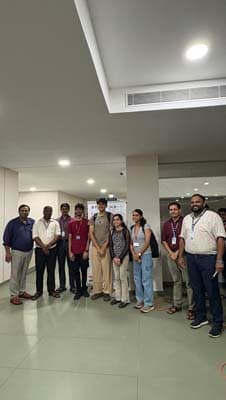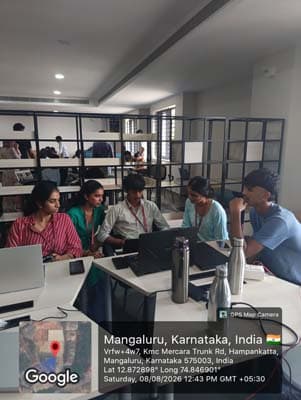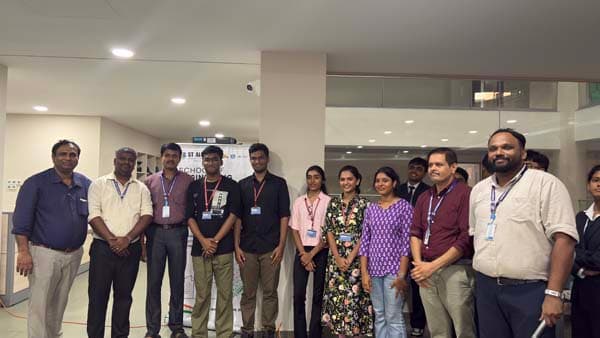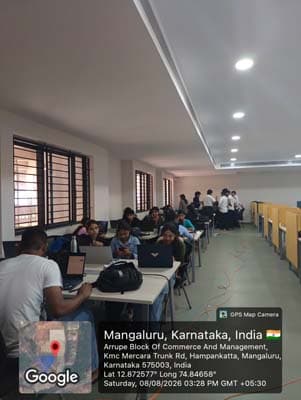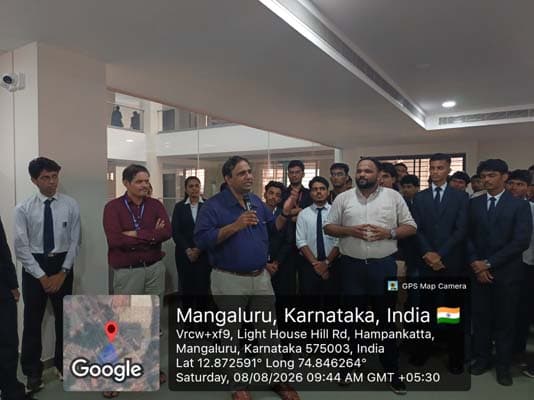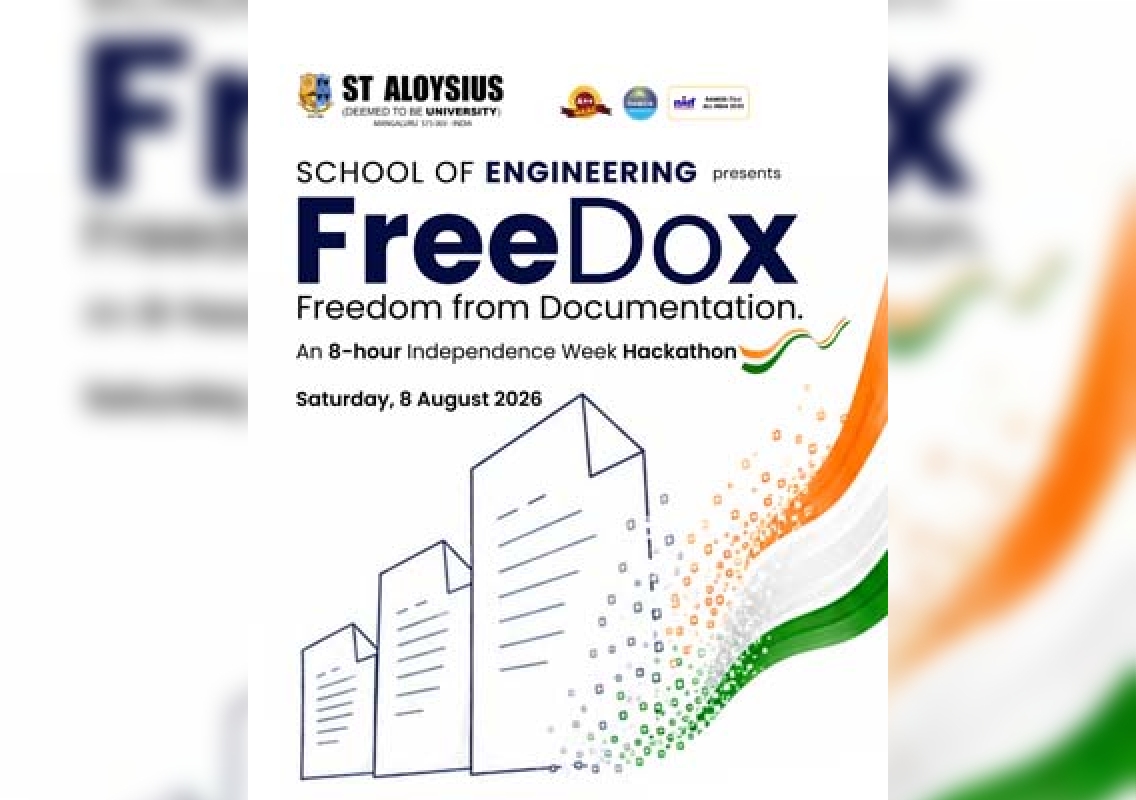


Mangaluru: More than 200 students of the School of Engineering, St Aloysius (Deemed to be University), participated in FreeDOx – Freedom from Documentation, an eight-hour hackathon organised as part of the Independence Week celebrations.
The hackathon provided students with an opportunity to explore how technology could reduce the burden of repetitive documentation and simplify institutional processes through practical, technology-driven solutions.
Students tackle real-world documentation challenges
The problem statements for the hackathon were drawn from various documentation requirements within the School of Engineering. These included academic documentation, accreditation, data consolidation, reporting and administrative processes.
Student teams worked on developing practical modules aimed at improving institutional efficiency and reducing manual effort. The initiative encouraged participants to move beyond conventional classroom exercises and address problems arising from actual institutional processes.
The teams were required to understand the identified challenges, develop suitable technology-based solutions and demonstrate how their ideas could be applied in practice.
Students urged to use technology responsibly
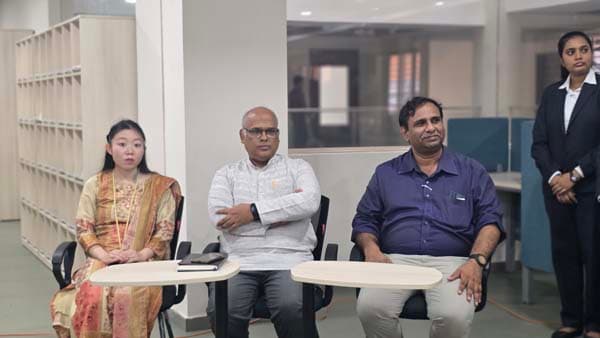
In his inaugural address, Rev. Dr Melwyn D’Cunha SJ, Pro Vice Chancellor, spoke about the responsibilities associated with being a technology practitioner in an increasingly artificial intelligence-driven world.
He emphasised the importance of empathy and sensitivity to the human dimension of technology, urging students to ensure that technological advancement contributes to the upliftment of all sections of society.
Referring to the growing influence of Artificial Intelligence, Fr Melwyn observed that technology would continue to transform the way people work. However, he stressed that human thinking must be consciously nurtured to ensure that people remain relevant in the age of AI.
He also encouraged students to approach emerging technologies responsibly and remain conscious of their broader social impact.
Ms Uri from Japan was also present during the inaugural programme.
From classroom learning to practical solutions
The FreeDOx hackathon created a platform for students to apply their technical knowledge to genuine institutional requirements. Rather than working exclusively on theoretical or classroom-based assignments, participants were challenged to identify practical problems, design solutions and demonstrate their possible applications.
The event also encouraged collaboration, innovation and problem-solving among engineering students while highlighting the potential of technology to streamline routine institutional processes.
Winning teams felicitated
The eight-hour hackathon concluded with the felicitation of the winning teams by Dr S. Ruban, Dean, School of Engineering, and Dr Glenson Toney, Assistant Dean, School of Engineering.
The programme was coordinated by Dr Glenson Toney, Mr Gaurav Prasad and Mr Vijay Ganesh of the School of Engineering.
The FreeDOx initiative reflected the School of Engineering’s emphasis on experiential learning and responsible technological innovation, giving students an opportunity to develop solutions that could contribute to more efficient institutional processes.