







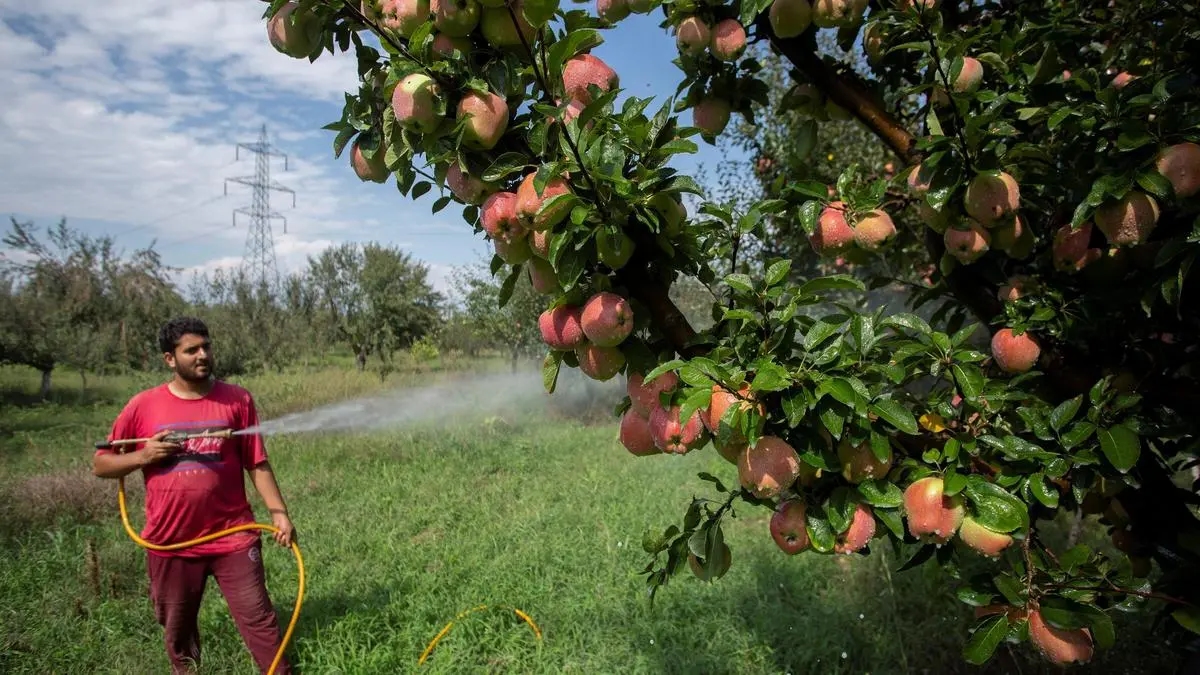


In Srinagar, politics briefly disappeared from the corridors of the J&K Assembly on December 8 — replaced by urgent discussions about a frightening rise in cancer among Kashmir’s apple farmers.
The House Committee on Environment, led by CPM legislator MY Tarigami, met top officials, doctors and scientists to address a long-ignored danger: the toxic pesticide exposure that orchard workers face each season.
Old warnings resurface — with greater urgency
A Sher-i-Kashmir Institute of Medical Sciences (SKIMS) study, conducted between 2005 and 2008, had sounded the first major alarm. Examining more than 400 cancer patients, it reported unusually high rates of malignant brain tumours in key apple-growing districts like Baramulla, Budgam, Kupwara, Shopian and Anantnag.
Those warnings received little attention back then. But with new medical findings emerging across the Valley, lawmakers are finally taking the threat seriously.
Tarigami told TOI, “We don’t want to scare farmers, but we cannot ignore data that points to a serious health hazard.”
How Kashmir’s apple boom turned toxic
Kashmir’s celebrated apple revolution began after land reforms in the 1950s and expanded through scientific orchard development in the 60s. Today, apples are the backbone of the Valley, employing 3.5 million people and contributing nearly 10% to J&K’s GDP.
But experts warn the sector now relies on dangerously heavy chemical use.
Dr Shahid Rasool of CSIR-IIIM said orchardists typically spray fungicides and insecticides up to 15 times in a single season — far above recommended limits. Many farmers over-spray every 10–12 days instead of the safer 18–21 day cycle.
With most farmers unable to afford proper gloves, masks or protective gear, chronic cough, rashes and eye irritation have become routine.
Pesticides found in human blood, say researchers
Perhaps the most disturbing findings come from a study led by Dr Sobia Nisar at Government Medical College, Srinagar. After six years of research in Shopian and Pulwama, she found pesticide traces not just on fruit — but in the blood samples of orchard workers and residents living nearby.
Her upcoming study also links exposure to obesity, lipid disorders, early kidney impairment and metabolic syndrome.
“When patterns repeat across entire populations, it demands urgent scientific scrutiny,” Dr Nisar said.
Government to draft urgent safety guidelines
The Assembly committee will soon issue recommendations to the health and horticulture departments — including PPE subsidies, spray monitoring, scientific field studies, and stronger regulations.
As Tarigami said, “If pesticides are harming lives, the government must step in. Our farmers deserve protection.”