









New Delhi : South African President Cyril Ramaphosa has described BRICS as an important global forum, underlining the growing economic and demographic weight of the grouping and its expanding role in international affairs.
Ramaphosa made the remarks on Friday while highlighting the significance of BRICS, which has expanded considerably in recent years and brought together a larger group of emerging economies from different regions of the world.
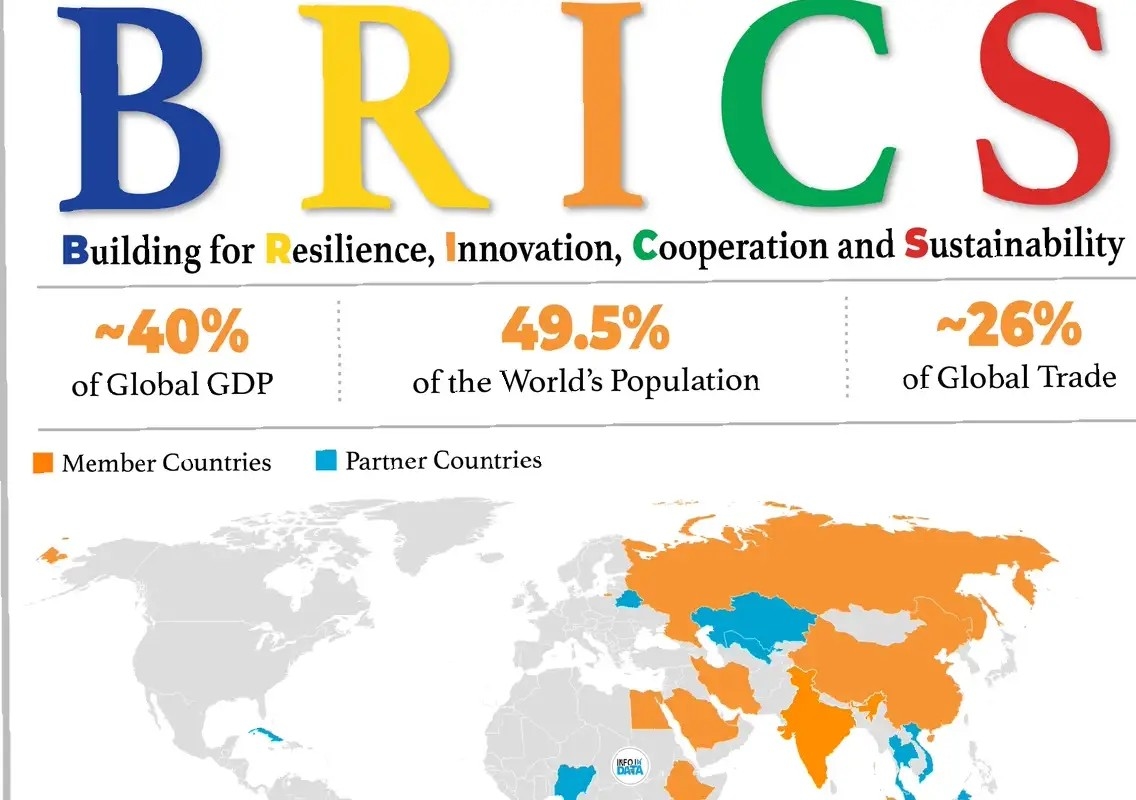
According to a report by Rediff, Ramaphosa said BRICS now represents around 50 per cent of the world’s population and 40 per cent of global gross domestic product (GDP).
BRICS emerges as a major global forum
BRICS was initially formed by Brazil, Russia, India and China, with South Africa joining the grouping in 2010. Its membership has since expanded, reflecting the growing interest among emerging economies in strengthening cooperation outside traditional Western-led international institutions.
The grouping has increasingly focused on economic cooperation, trade, investment, development financing and greater representation for developing countries in global decision-making.
Ramaphosa’s comments come at a time when BRICS is seeking to strengthen its collective voice on major international issues. The grouping has increasingly presented itself as a platform through which countries of the Global South can coordinate their positions on global economic and political matters.
The expansion of BRICS has also increased its geographical reach and economic significance. Its members include some of the world’s largest economies and most populous nations, giving the grouping considerable influence in discussions on trade, energy, finance and development.
Focus on the Global South
A central theme of BRICS has been the call for a more representative international system.
Developing countries have long argued that institutions created in the aftermath of the Second World War do not adequately reflect the current distribution of economic and demographic power. BRICS countries have advocated reforms to international institutions, including greater representation for developing and emerging economies.
South Africa has consistently emphasised the importance of strengthening the voice of Africa and other developing regions within global institutions.
Ramaphosa’s description of BRICS as an important global forum therefore reflects South Africa’s broader foreign-policy emphasis on multilateralism and cooperation among countries of the Global South.
India plays a significant role
India remains one of the key members of BRICS and has been an important participant in efforts to expand economic and diplomatic cooperation within the grouping.
For New Delhi, BRICS provides a platform to engage with major emerging economies while also advancing issues relating to development, technology, trade and reform of international institutions.
India has also promoted greater cooperation among developing countries on matters such as digital public infrastructure, sustainable development and access to finance.
The country’s participation gives BRICS an important link between Asia, Africa, Latin America and other emerging regions.
Economic weight continues to grow
The economic significance cited by Ramaphosa is one of the principal reasons for the increased international attention being paid to BRICS.
A grouping representing a substantial share of the global population and GDP has the potential to influence discussions on international trade, energy markets, investment and financial cooperation.
BRICS members also possess significant natural resources, manufacturing capacity, consumer markets and technological capabilities. Their combined economic strength provides opportunities for greater intra-group trade and investment.
However, the grouping is also diverse, with its members having different economic structures, political systems and foreign-policy priorities. Reaching consensus among a larger membership can therefore present challenges.
Expansion brings opportunities and challenges
The expansion of BRICS has created new opportunities for cooperation but has also increased the complexity of managing the grouping.
Its members have different priorities on issues ranging from international security to trade and monetary policy. Despite these differences, BRICS has continued to promote cooperation in areas where members share common interests.
The grouping’s future influence will depend partly on its ability to translate its growing economic and demographic weight into practical cooperation.
Areas such as development finance, trade facilitation, infrastructure investment, energy cooperation and technology could provide opportunities for deeper engagement among members.
The New Development Bank, established by BRICS, has also been positioned as an important mechanism for financing infrastructure and sustainable development projects in emerging economies.
A changing global order
Ramaphosa’s remarks reflect a wider transformation taking place in the international system, with emerging economies seeking a greater role in shaping global institutions and policies.
The growing prominence of BRICS is part of this broader shift. Countries across Asia, Africa, the Middle East and Latin America have increasingly sought stronger representation in global decision-making and greater cooperation among developing nations.
The grouping is therefore being watched closely not only for its economic potential but also for its ability to influence debates on global governance.
For South Africa, BRICS provides an important avenue for advancing African interests and strengthening ties with major economies in the developing world.
As BRICS continues to expand, its growing share of the global population and economy is likely to remain central to discussions about the future balance of power in international affairs.
Ramaphosa’s latest remarks underline the argument that BRICS has moved well beyond its origins as a four-country economic grouping and is emerging as a significant forum representing a substantial portion of the world’s people and economic activity.