







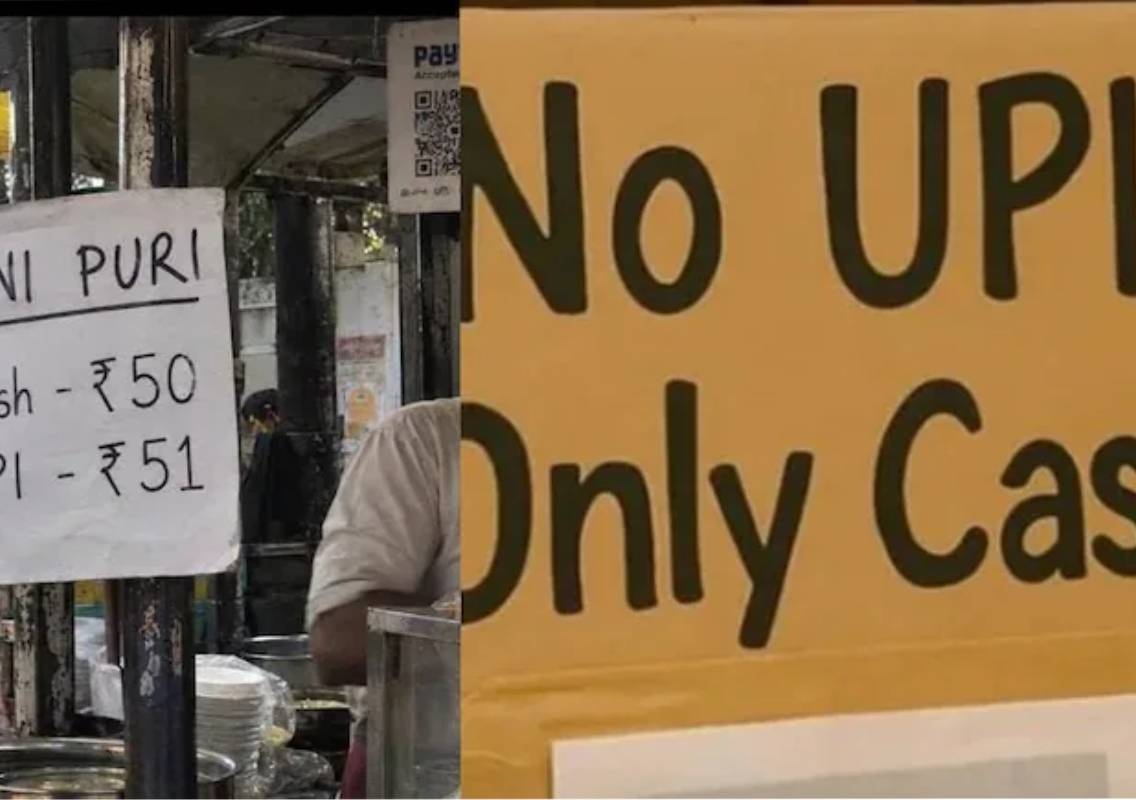


Ghaziabad: Several traders in Ghaziabad, Uttar Pradesh, have started displaying notices outside their shops saying they will accept cash payments only from October 15, protesting the proposed Merchant Discount Rate (MDR) on certain higher-value UPI transactions.
The notices have appeared in areas including Vijay Nagar, Pratap Vihar, Gaushala Fatak and Crossings Republic, according to local reports. Traders say the proposed 0.4% MDR on specified person-to-merchant (P2M) UPI transactions above Rs 2,000 could increase their costs at a time when many businesses are already operating on narrow margins.
The National Payments Corporation of India (NPCI) has notified the new framework, which is scheduled to take effect from October 15, 2026. The charge will be borne by merchants and will be capped at Rs 300 for transactions of Rs 75,000 and above.
Traders display cash-only notices
The notices appearing across Ghaziabad are intended to alert customers that UPI may not be accepted for purchases above the applicable threshold once the new framework takes effect.
One such notice outside Vaishvi Jewellers in Crossings Republic states that UPI payments will not be accepted because of MDR charges and that the shop will accept cash payments instead. Similar notices have reportedly appeared at other businesses in the city.
Akshay Kumar Gupta, owner of Vaishvi Jewellers, told The Times of India that most purchases at his shop exceed Rs 2,000. He said requiring customers to make such payments in cash could create inconvenience and argued that businesses with thin margins may find it difficult to absorb the additional cost.
The concern is not limited to jewellery businesses. Traders from different sectors have also expressed reservations about the impact of the new MDR on their operations.
Why traders are opposing the MDR
The proposed 0.4% charge has become a point of concern among traders because many businesses regularly process UPI payments above Rs 2,000.
For example, a merchant processing a Rs 10,000 eligible UPI transaction would face an MDR of Rs 40. On a Rs 50,000 transaction, the corresponding charge would be Rs 200. For transactions of Rs 75,000 and above, the MDR is capped at Rs 300.
Traders argue that even relatively small charges can matter for businesses operating with limited margins, particularly when high-value purchases form a significant share of their sales.
A beauty parlour owner identified as Shahnaz also displayed a cash-only notice, according to The Times of India. She said services such as facials can cost Rs 2,000 or more and expressed concern that customers could be inconvenienced if they have to arrange cash for such payments.
Grocery store owner Sanjay Bindal of Vijay Nagar similarly raised concerns about competition. He said customers could potentially move to businesses that continue accepting UPI for larger purchases.
What changes under the new UPI MDR framework?
Under the notified framework, a 0.4% MDR will apply to specified person-to-merchant UPI transactions above Rs 2,000 from October 15.
The charge is imposed on the merchant rather than the customer. The MDR will be capped at Rs 300 for transactions of Rs 75,000 and above.
Person-to-person UPI transactions will remain free, regardless of the amount transferred. Payments between individuals, such as sending money to family members or friends, will therefore not attract the new MDR.
P2M payments of up to Rs 2,000 will also remain outside the new charge. The government and NPCI have said more than 95% of P2M transaction volume falls within the low-value category and will continue to attract zero MDR.
This means a customer paying Rs 1,500 to a shopkeeper through UPI will not face the new MDR.
The framework also provides for a different flat charge of Rs 5 for certain categories, including specified transactions involving railway services, fuel, insurance and utilities.
Government says merchants should not pass on the cost
The Centre has maintained that the new MDR is a merchant-side charge and should not be separately passed on to customers.
The Finance Ministry has advised banks to ensure merchants do not transfer the MDR to UPI users. The government has also begun discussions with payment aggregators and platforms that onboard merchants to determine how the rule can be implemented.
Finance Ministry officials said the government plans to monitor whether merchants pass the MDR on to consumers after the framework comes into force on October 15.
The government has also said the MDR is not a tax collected by the Centre. Instead, it is intended to support participants in the digital payment ecosystem, including banks and payment service providers.
Why is the government introducing MDR?
The revised framework is aimed at creating a financial mechanism to support the long-term sustainability and expansion of the UPI ecosystem.
The government has argued that the rapid growth of UPI requires continued investment in payment infrastructure, cybersecurity, resilience and innovation. The MDR will provide a revenue stream within the payment ecosystem while keeping most everyday UPI payments free.
The framework follows changes to the Payment and Settlement Systems Act, 2007, which created an enabling mechanism for levying MDR on UPI and other notified electronic payment modes. NPCI subsequently notified the specific MDR structure and its October 15 implementation date.
Most everyday UPI payments will remain free
Despite the controversy surrounding the new MDR, the majority of ordinary UPI transactions will not be affected.
Small-value purchases of up to Rs 2,000 from merchants will continue without MDR. Person-to-person transfers will also remain free. Small merchants that qualify under the zero-MDR framework can also continue to receive UPI payments without the new charge under specified conditions.
The impact will therefore be concentrated on specified higher-value merchant transactions.
For traders in Ghaziabad, however, the issue is significant because businesses such as jewellery stores and service providers can routinely process transactions above the Rs 2,000 threshold.
Cash-only notices signal trader concerns
The cash-only notices in Ghaziabad have brought the dispute into direct view for consumers. Traders say they do not want to absorb additional costs, while the government has maintained that customers should not be charged separately for MDR.
The government has also said it does not expect the revised framework to trigger a broad shift from digital payments back to cash and has indicated that compliance will be monitored after implementation.
For now, the notices remain a protest measure by individual traders rather than a change to UPI’s availability across the country. From October 15, the key issue will be how merchants, payment providers and banks implement the new framework while keeping the MDR from being separately passed on to customers.