







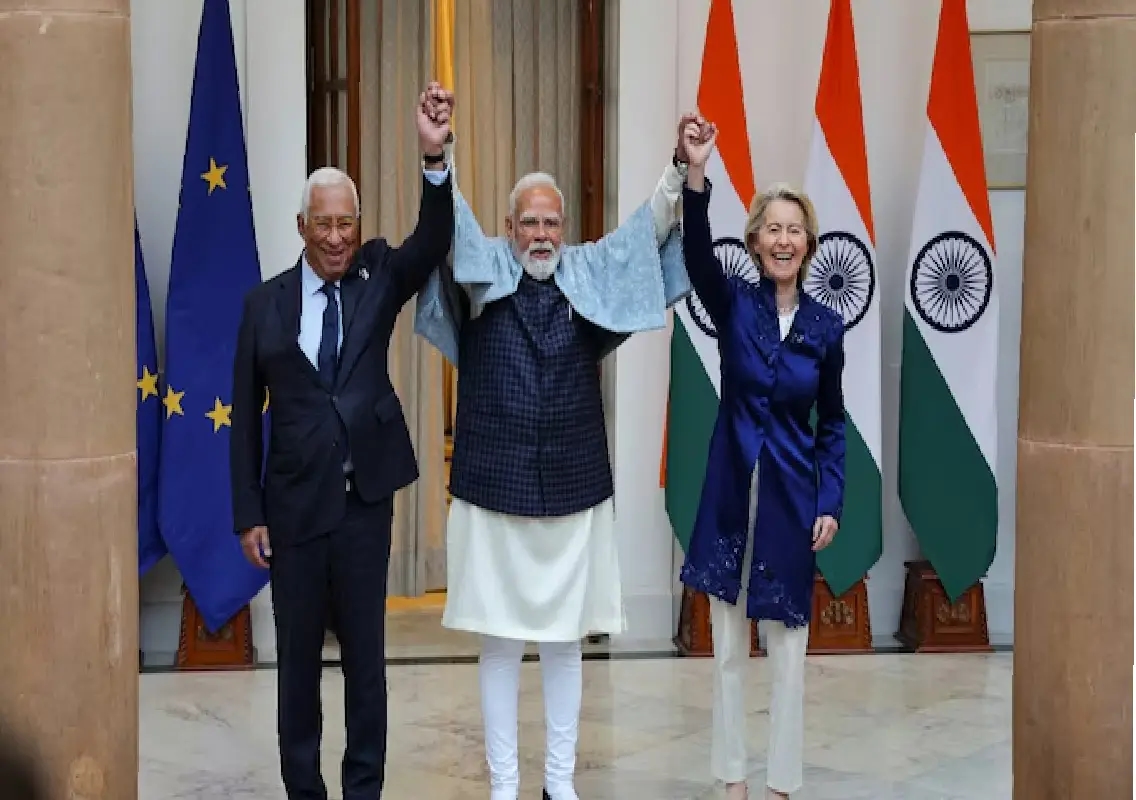


New Delhi: The proposed free trade framework between India and the European Union, covering nearly 2 billion people and accounting for about 25 per cent of global GDP with a combined market value of $27 trillion, has renewed focus on the India–Middle East–Europe Economic Corridor (IMEC) as a transformative pillar of global trade and sustainable development. Prime Minister Narendra Modi has underlined that India and the EU would work closely to operationalise IMEC, positioning it as a strategic alternative supply and connectivity route between Asia and Europe.
IMEC: A landmark G20 outcome
The IMEC initiative emerged as one of the most significant outcomes of the G20 Summit hosted by India in September 2023. Envisioned as a multi-modal connectivity corridor, IMEC seeks to link India with Europe through the Middle East using a combination of sea routes, rail networks and digital infrastructure. According to estimates shared at the time of its announcement, the corridor has the potential to reduce transit times between India and Europe by nearly 40 per cent and cut logistics costs by around 30 per cent, offering a faster and more resilient alternative to traditional shipping routes.
The corridor is designed to connect Indian ports to the Gulf region, traverse through key Middle Eastern countries and extend onwards to Europe. Beyond trade, IMEC has been projected as a platform for energy cooperation, digital connectivity and sustainable infrastructure, aligning with broader global climate and development goals.
Strategic importance for India and Europe
For India, IMEC represents a strategic opportunity to deepen economic integration with Europe while strengthening partnerships in West Asia. The European Union, on its part, views the corridor as a means to diversify supply chains, reduce over-dependence on existing chokepoints and enhance connectivity with one of the world’s fastest-growing major economies.
Prime Minister Modi has repeatedly stressed that IMEC is not merely a trade route but a long-term investment in shared prosperity. By linking manufacturing hubs, ports and logistics networks across regions, the corridor is expected to boost exports, generate employment and promote technology-driven growth.
Setbacks following West Asia conflict
Despite its ambitious vision, the implementation of IMEC has faced significant hurdles. Progress on the corridor slowed sharply after the October 7, 2023, attacks by Hamas on Israeli civilians, which triggered a full-scale war in Gaza. The conflict disrupted regional stability and introduced new geopolitical uncertainties in West Asia, a region central to the corridor’s success.
Although an uneasy calm has since returned to parts of the region, the long-term security situation remains fragile. These uncertainties have raised questions about timelines, investments and the willingness of all stakeholders to move forward at the required pace.
Dubai–Haifa link: The linchpin
At the heart of IMEC lies the proposed Dubai–Haifa corridor, an overland route that could dramatically reduce transit times by seven to ten days. In December 2023, the United Arab Emirates and Israel established a temporary land corridor via Saudi Arabia and Jordan to bypass the Red Sea, after Houthi attacks disrupted merchant shipping in that area.
This route, connecting Dubai’s Jebel Ali port with Israel’s Haifa port, currently handles about 350 trucks daily. While the arrangement has demonstrated the feasibility of overland connectivity, experts point out that road transport alone is insufficient for IMEC’s long-term viability.
Rail connectivity crucial for scale
Rail infrastructure is widely seen as the backbone of the corridor. A single freight train can carry goods equivalent to nearly 300 trucks, offering far greater efficiency, lower emissions and reduced congestion. The UAE has already completed its domestic railway segment, signalling its commitment to the project.
However, Saudi Arabia and Jordan are yet to complete their respective rail links, which are essential to connect the Gulf rail network to Israel’s ports. Until these links are operational, Abu Dhabi cannot establish a seamless rail connection to Haifa, limiting the corridor’s capacity and cost advantages.
GCC railway project and regional politics
The rail segments required for IMEC form part of the broader Gulf Cooperation Council (GCC) railway project, which aims to connect all GCC countries by rail by 2030. While the project has long been on the agenda, progress has been uneven due to financial, technical and political challenges.
Adding to the complexity are reported tensions between Saudi Arabia’s Crown Prince Mohammed bin Salman and the UAE’s President Mohammed bin Zayed. Diplomatic strains, including a reported Saudi attack on a UAE arms shipment in Yemen last year that led to the UAE’s withdrawal from the conflict, have underscored underlying rivalries that could affect regional cooperation.
Need for reconciliation and coordination
Analysts argue that for IMEC to realise its full potential, reconciliation and close coordination between key regional partners are indispensable. The completion of the so-called “Peace Railway” linking the Gulf to the Mediterranean is viewed as a prerequisite for transforming IMEC from a strategic vision into a functional global trade artery.
Conclusion
As India and the European Union push ahead with a sweeping free trade framework, IMEC stands out as a project with the capacity to reshape global commerce. While geopolitical tensions and infrastructural gaps pose serious challenges, sustained political will, regional cooperation and timely investments could yet enable the corridor to emerge as a game-changer in international trade and connectivity.