







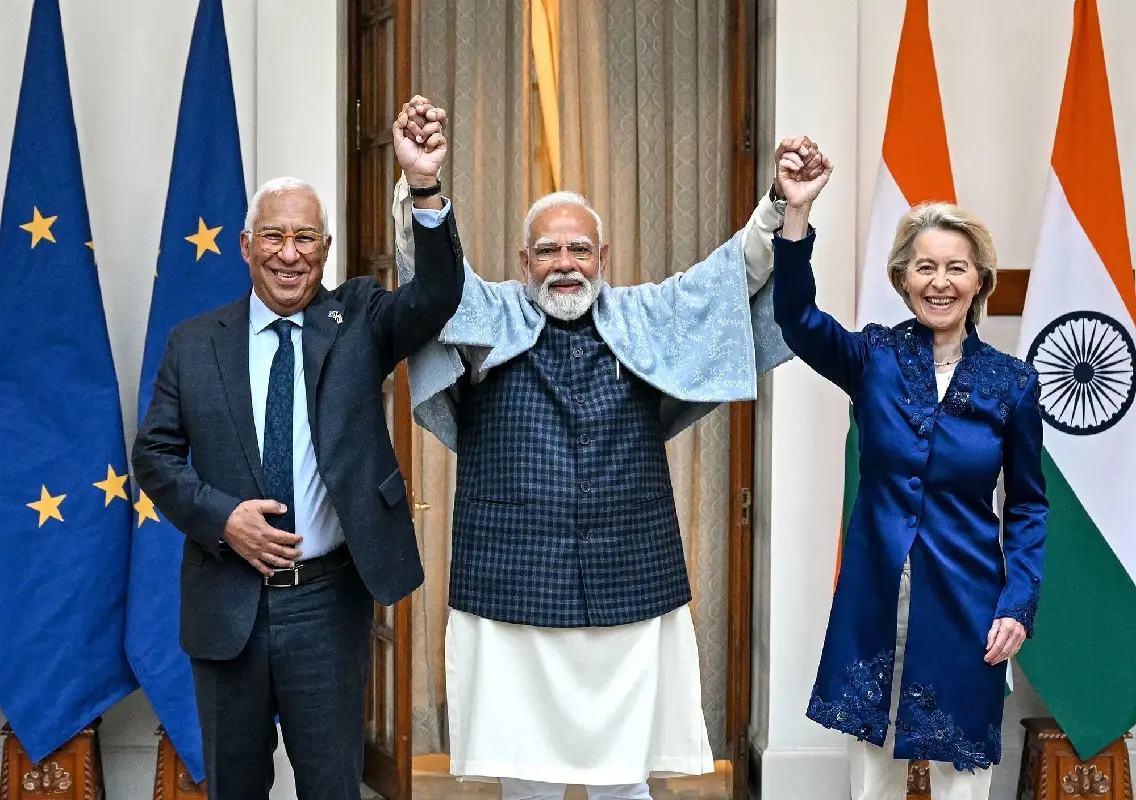


New Delhi: India and the European Union on Tuesday sealed a long-awaited Free Trade Agreement (FTA), marking a historic milestone in bilateral relations between two of the world’s largest democratic trading blocs. Prime Minister Narendra Modi described the pact as the biggest trade agreement in India’s history, while European Commission President Ursula von der Leyen termed it “the mother of all trade deals”.
Deal signed after nearly two decades of negotiations
The agreement was formally concluded after European Council President Antonio Costa and Prime Minister Modi signed a joint declaration, bringing to a close negotiations that began in 2007 and faced several setbacks over the years. Talks had stalled in 2016 due to unresolved differences, particularly over market access to India’s agricultural and dairy sectors, before being revived in 2022.
In a post-signing statement on X, Prime Minister Modi said the FTA represented a decisive step forward for global trade cooperation. He noted that two of the world’s biggest democratic economies, with combined trade valued at around US$ 213 billion, had now “sealed the biggest FTA in our history”.
PM Modi calls pact blueprint for shared prosperity
Addressing the media, the Prime Minister said the agreement was far more than a trade arrangement. “This is not just a trade agreement. It is a new blueprint for shared prosperity,” he said, adding that several decisions taken under the pact would directly benefit people on both sides.
Modi highlighted that around eight lakh Indians currently living in EU countries would gain significantly from improved economic integration, employment opportunities and smoother movement of professionals.
Calling it a symbolic moment, the Prime Minister pointed out that the agreement was signed on January 27 with all 27 countries of the European Union. “India has concluded the largest Free Trade Agreement in its history. It is a happy coincidence that today we are signing this with 27 EU nations,” he said.
EU leaders hail strategic partnership with India
European Council President Antonio Costa described India and the EU as “strategic and reliable partners” who were taking their relationship to the next level. He said the agreement would help shape a resilient global order that promotes peace, stability and economic growth.
Costa underlined that the combined market created by the deal would serve nearly two billion people, making it one of the most significant economic partnerships in the world. He also stressed Europe’s expectations from the partnership, particularly in areas such as green energy, climate action and sustainable development.
“Dear Prime Minister, we can count on you for creating conditions for peace and dialogue. Together, we must show leadership on global issues,” Costa said, calling for deeper cooperation in the transition from fossil fuels to renewable energy.
Ursula von der Leyen: ‘A tale of two giants’
European Commission President Ursula von der Leyen, who was also the chief guest at India’s Republic Day celebrations, said India’s rise was essential for global stability. “India has risen and Europe is truly glad about it. When India succeeds, the world is more secure and we all benefit,” she said.
Calling the agreement a historic achievement, von der Leyen remarked, “We did it. We delivered the mother of all deals. It is a tale of two giants,” underscoring the scale and importance of the pact.
Key sectors expected to benefit
The India-EU FTA is expected to bring sweeping changes across multiple sectors. Prime Minister Modi said the agreement would positively impact domestic industries such as textiles, gems and jewellery, leather goods and manufacturing.
One of the most significant provisions includes a phased reduction in tariffs on European cars imported into India, with duties expected to be slashed from 110 per cent to 40 per cent initially and eventually to 10 per cent. Norms for steel and textile exports are also expected to be eased, giving Indian exporters improved access to European markets.
The EU, in turn, is set to gain greater access in areas such as financial services, legal services and public procurement.
Defence and strategic cooperation expanded
Beyond trade, the two sides also unveiled a defence framework pact and a broader strategic agenda aimed at strengthening cooperation in security, technology and innovation. Observers noted that the agreement reflects Europe’s efforts to reduce dependence on the United States and China, while deepening engagement with India as a key global partner.
The timing of the deal is seen as significant, coming amid disruptions to global supply chains following the COVID-19 pandemic, the Russia-Ukraine conflict and shifting global trade dynamics.
Trade expected to grow sharply
Officials indicated that bilateral trade between India and the EU is expected to grow substantially over the next five years, with estimates suggesting a jump of over US$ 40 billion during this period. The agreement is also expected to enhance investor confidence and promote long-term economic cooperation.
Conclusion
The sealing of the India-EU Free Trade Agreement marks a turning point in India’s global economic engagement. After nearly two decades of negotiations, the pact signals a deepening of trust, strategic alignment and economic ambition between India and Europe. As both sides look to navigate a rapidly changing global order, the agreement is expected to play a crucial role in shaping trade, diplomacy and shared prosperity in the years ahead.