


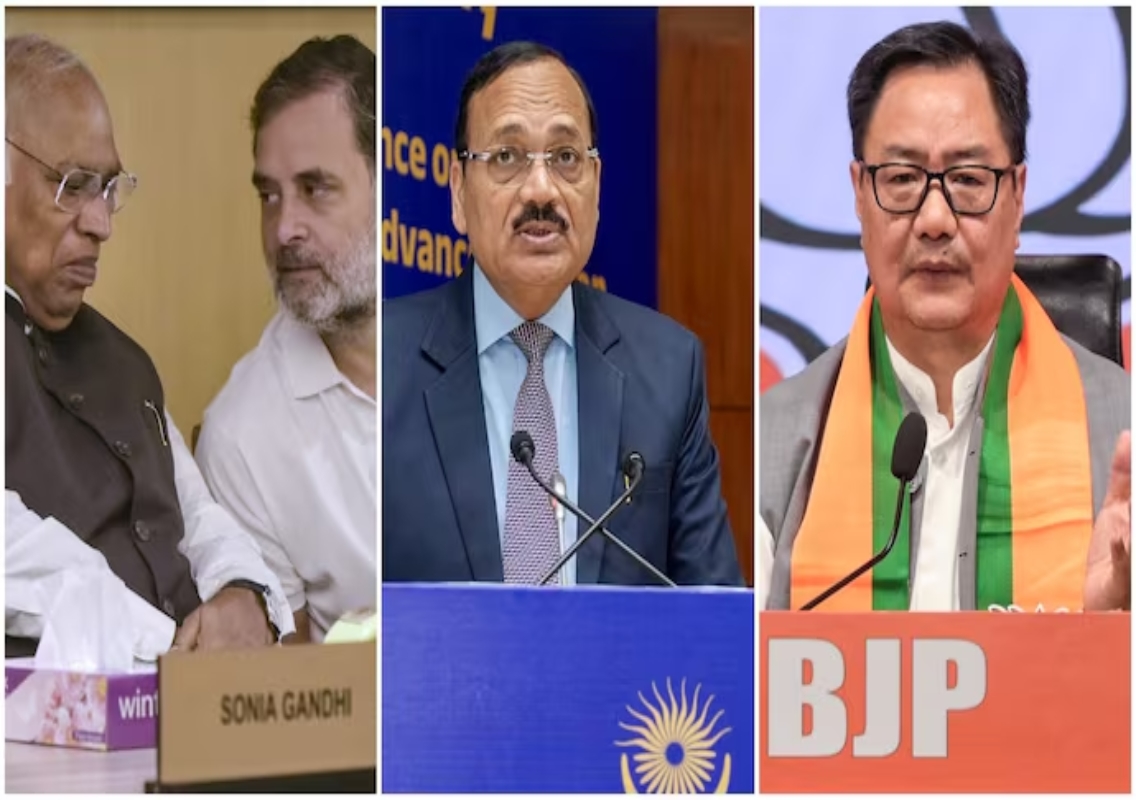


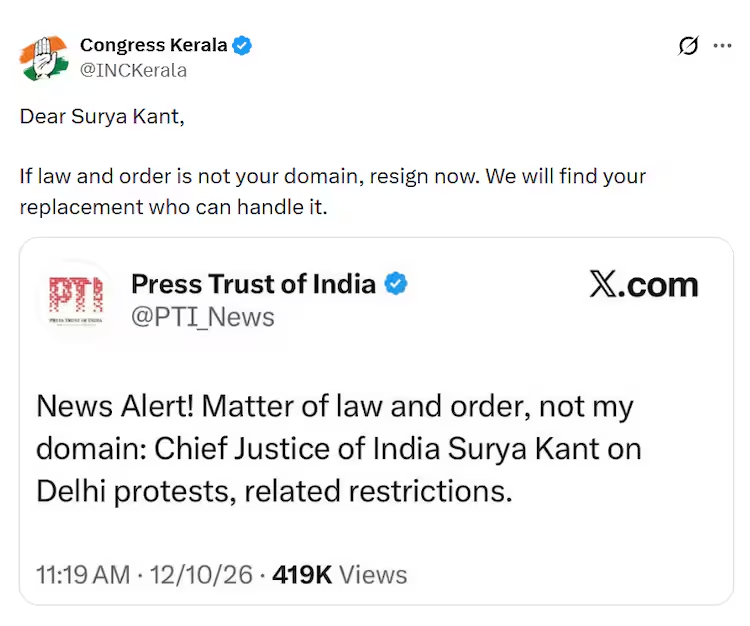
NEW DELHI: The Kerala Congress has deleted a post on X calling for Chief Justice of India (CJI) Surya Kant to resign over his reported remarks on law and order amid protests in Delhi. Union Minister Kiren Rijiju reacted to the now-deleted post, accusing the Congress of targeting the judiciary and attempting to undermine India’s constitutional and democratic institutions.
The controversy has brought renewed attention to the relationship between political criticism, judicial independence and public debate over the functioning of constitutional institutions. The deleted post followed remarks attributed to the Chief Justice in connection with law-and-order concerns during protests in the national capital.
Rijiju criticised the Congress over its social media post, arguing that targeting the head of the judiciary was inappropriate and could weaken public confidence in democratic institutions. His response added a political dimension to the dispute, with the issue extending beyond the original remarks to questions about how political parties engage with the judiciary.
Congress removes post after backlash
The Kerala Pradesh Congress Committee (KPCC) deleted the post after it triggered criticism from political leaders and members of the legal community. The party subsequently said the message had been published without the knowledge, consent or consultation of its state leadership.
KPCC president Sunny Joseph clarified that the post did not represent the official position of the party leadership. He said the Congress had no disagreement with the impartiality of the judiciary and that social media messages contrary to this position should not be treated as the party’s stand.
Joseph also confirmed that the person responsible for publishing the message had been removed from the position. The committee said it would examine the circumstances under which the post appeared on its official X account.
The clarification was significant because the original message was published through an official party account rather than a personal profile. Its deletion and the subsequent action against the person responsible were attempts by the state leadership to distance itself from the controversy.
What Chief Justice Surya Kant said about Delhi protests
The controversy originated in remarks by Chief Justice Surya Kant concerning restrictions on protests in Delhi. When asked about the situation in the national capital, he said that the matter was related to law and order and was not within his domain.
The remarks came amid demonstrations by opposition parties over the revision of electoral rolls and demands for action concerning Chief Election Commissioner Gyanesh Kumar. Opposition leaders had also raised concerns about restrictions imposed on protests and the detention of demonstrators.
The Chief Justice’s comments followed his decision to decline a request from Congress leaders for a meeting to submit a memorandum. He explained that the issues they wished to raise were already being considered by the Supreme Court and that a separate meeting could raise concerns about the separation of powers.
The judiciary’s role in such circumstances is distinct from that of the executive authorities responsible for policing and maintaining public order. Courts can examine legal challenges and assess whether government action complies with the law, while police and administrative agencies have direct responsibility for managing public demonstrations.
The Congress Kerala unit’s post challenged the Chief Justice’s position by arguing that he should resign if law and order did not fall within his remit. The subsequent deletion of the post shifted the focus towards the political fallout and the party’s response.
Kiren Rijiju accuses Congress of targeting the judiciary
Union Parliamentary Affairs Minister Kiren Rijiju strongly criticised the Congress after the post became public. Sharing a screenshot of the deleted message on X, he said the incident confirmed his earlier warning that the judiciary would become the party’s next target.
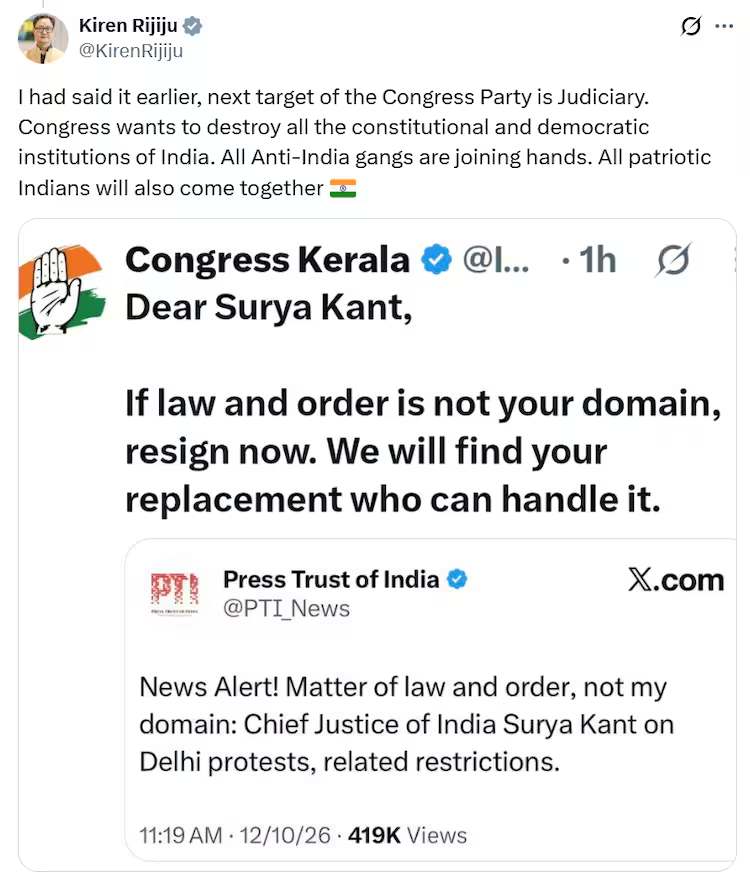
Rijiju accused the Congress of attempting to undermine India’s constitutional and democratic institutions. His response framed the controversy as a question of respect for the judiciary and the independence of constitutional bodies.
The minister’s remarks reflected the BJP’s broader criticism of the Congress over its approach to institutions such as the judiciary and the Election Commission. However, his statements represent the government’s political response to the incident rather than an independent finding about the party’s intentions.
The deleted post also prompted criticism from legal circles. The Supreme Court Bar Association expressed concern about remarks directed at the Chief Justice, with critics arguing that public pressure on judicial authorities could affect confidence in the administration of justice.
The controversy has therefore developed along two lines: criticism of the language used in the Congress post and debate over the extent to which political parties should question judicial remarks on matters involving public order and ongoing legal proceedings.
Political dispute unfolds amid wider protest controversy
The episode comes against the backdrop of demonstrations in Delhi over electoral roll revisions and demands for action by the Election Commission. Opposition parties have questioned the process and called for greater scrutiny of changes to voter lists, while the BJP has criticised the opposition’s approach.
The protests and related legal proceedings have brought the responsibilities of the Election Commission, the police, the executive and the judiciary into public debate.
The Supreme Court’s involvement is particularly important because petitions concerning electoral processes and restrictions affecting demonstrators are matters that may require judicial consideration. The Chief Justice’s comments about the limits of his role must therefore be understood in the context of the separation of powers and the cases before the court.
The Congress post transformed that discussion into a direct political confrontation. Its deletion, the state leadership’s clarification and the removal of the person responsible have since become central developments in the controversy.
The episode also highlights the speed with which statements published on official social media accounts can generate political consequences. Even after a post is removed, screenshots and reactions can continue circulating, extending the dispute beyond the original message.
Conclusion
The Kerala Congress’s deleted post seeking Chief Justice Surya Kant’s resignation has triggered a political dispute involving the Congress, the BJP and representatives of the legal community. While Rijiju accused the opposition party of targeting constitutional institutions, the KPCC leadership said the post did not reflect its official position and removed the person responsible for publishing it.
The incident underscores the importance of distinguishing political criticism from claims about institutional conduct. The wider debate over Delhi’s protests, electoral roll revisions and the judiciary’s role is likely to remain significant as the related legal and political developments continue.