







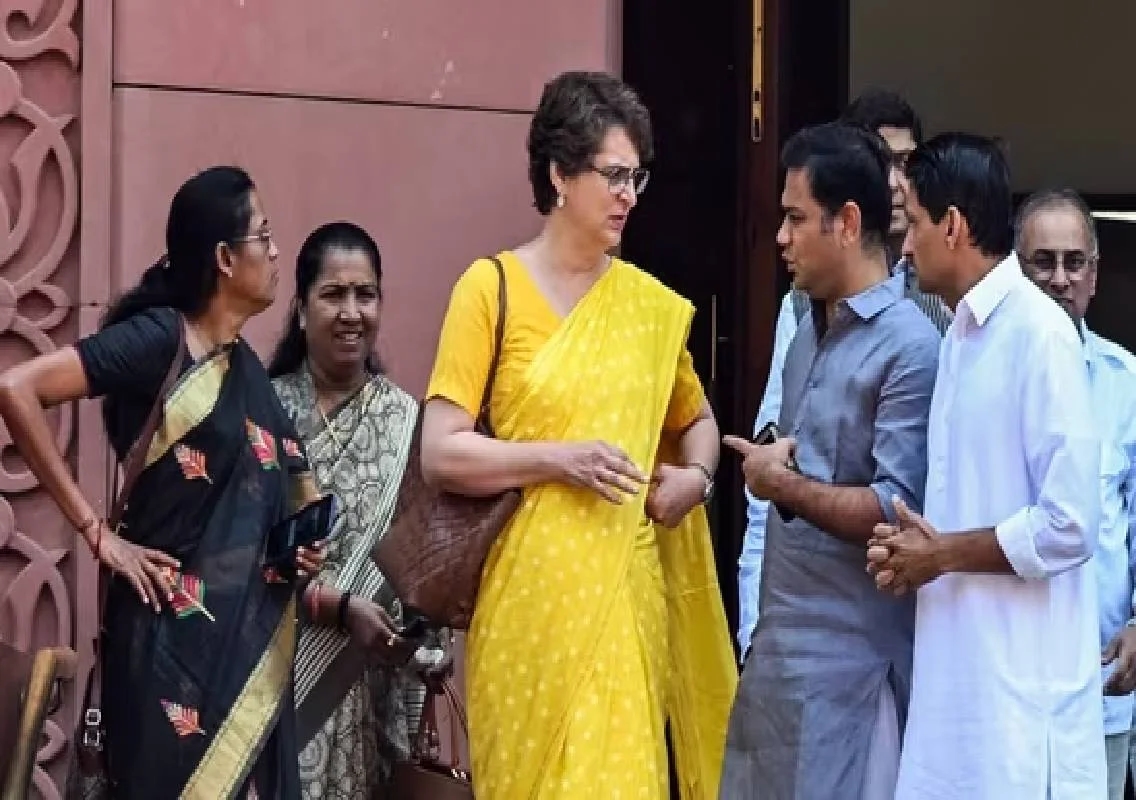


New Delhi: A day after the Centre’s Constitution (131st Amendment) Bill failed to pass in the Lok Sabha, the Opposition intensified its attack, with Priyanka Gandhi Vadra challenging the government to immediately bring back the earlier women’s reservation law and prove its commitment to gender equality.
Addressing the media, Priyanka Gandhi said the government should convene Parliament on Monday and pass the “old bill” referring to the Nari Shakti Vandan Adhiniyam which provides for 33 per cent reservation for women in legislatures.
“Bring the bill and let’s see who is anti-women. We will support it,” she said, accusing the ruling alliance of politicising the issue ahead of key state elections.
Bill defeat fuels political showdown
The government’s recent legislative setback has triggered a sharp political confrontation. The proposed amendment, linked to delimitation and census provisions, failed to secure the required majority in Parliament marking a rare defeat for the Centre.
Opposition parties have since sought to shift the narrative, asserting that they fully support women’s reservation but oppose linking it to delimitation.
What is the ‘old bill’?
The “old bill” referenced by Priyanka Gandhi is the 2023 law that guarantees one-third reservation for women in the Lok Sabha and state assemblies. Although the law has been passed and notified, it includes a key condition: implementation will only take place after a fresh Census and delimitation exercise.
Opposition leaders argue that this condition delays the rollout unnecessarily and have demanded immediate implementation based on the current strength of 543 Lok Sabha seats.
INDIA bloc writes to PM
Leaders of the INDIA bloc have decided to formally write to Narendra Modi, urging him to enforce the 2023 law without linking it to delimitation.
At a joint meeting, senior leaders including Sonia Gandhi expressed unity among alliance partners on the issue. Several parties also held press conferences, reiterating their support for women’s reservation while opposing the delimitation clause.
Regional parties push alternative proposals
The Dravida Munnetra Kazhagam (DMK) has taken a legislative route by introducing a private member’s bill in the Rajya Sabha. The proposal seeks immediate implementation of 33 per cent reservation without waiting for census or delimitation.
The bill also suggests making the reservation permanent, unlike the current law, which limits it to 15 years.
Similarly, the Trinamool Congress has indicated support for even higher quotas, provided they are not tied to a delimitation exercise based on outdated population data.
Government defends its stand
The BJP has strongly countered Opposition claims, maintaining that the proposed framework ensures fairness across states. Home Minister Amit Shah accused Opposition parties of blocking a “historic reform” and warned of political consequences.
He argued that increasing Lok Sabha seats by up to 50 per cent would ensure that no state loses its proportional representation while accommodating women’s reservation.
Delimitation concerns remain central
The core of the dispute lies in delimitation — the redrawing of constituencies based on population. Southern and smaller states fear that such an exercise could reduce their representation due to lower population growth compared to northern states.
Opposition leaders have insisted that women’s reservation can be implemented immediately, while delimitation should be discussed separately.
OBC reservation debate resurfaces
Another unresolved issue is the absence of a quota for Other Backward Classes (OBCs) within the women’s reservation framework. While the current law includes sub-quotas for Scheduled Castes and Scheduled Tribes, it does not extend similar provisions to OBC women.
Leaders like Akhilesh Yadav have raised concerns, demanding equitable representation for all communities.
Conclusion
The ongoing standoff reflects deeper political and structural disagreements over how and when women’s reservation should be implemented. While both the government and Opposition claim to support the cause, differences over delimitation and representation continue to stall consensus. As the debate intensifies, the issue is set to remain a key political flashpoint in the run-up to future elections.