


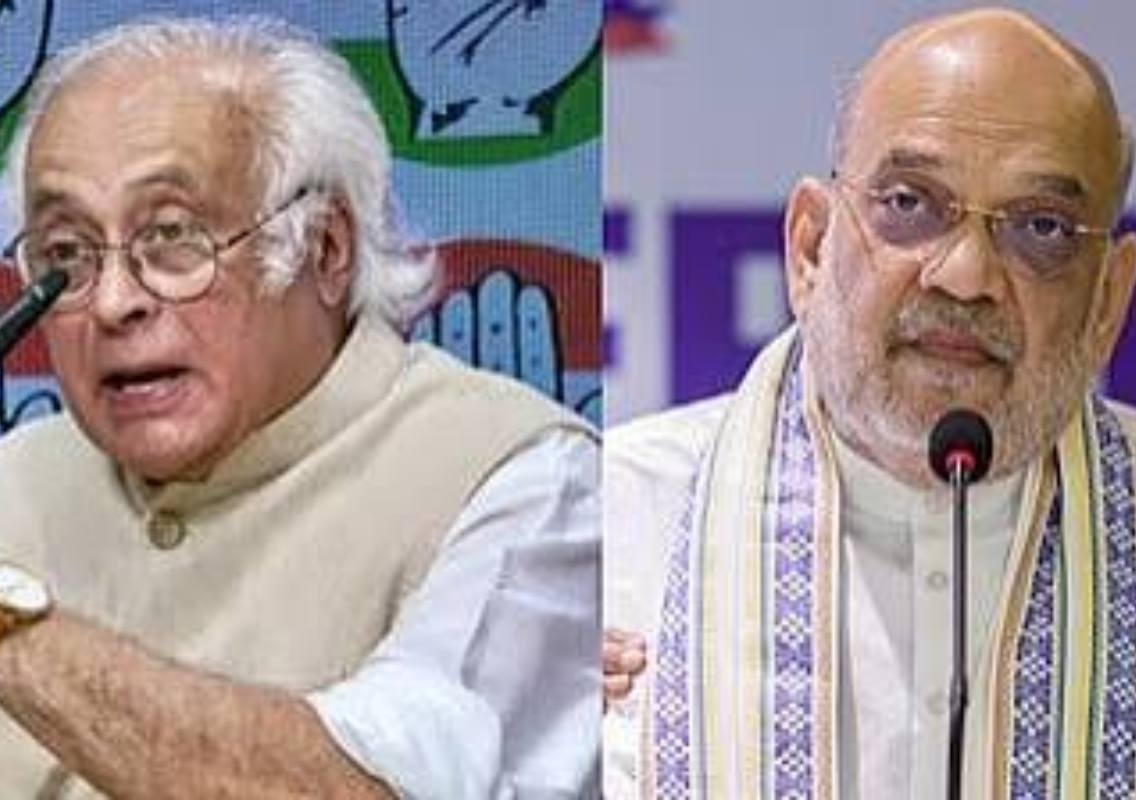


New Delhi: Parliament‘s Monsoon Session has remained formally open for a record 88 days despite both Houses not meeting since August 13. The unusual delay in proroguing the session has triggered a political controversy, with the Congress accusing the BJP-led Centre of keeping the option open to reconvene Parliament and make another attempt to pass its controversial delimitation bills.
Congress general secretary Jairam Ramesh has alleged that Union Home Minister Amit Shah is using the extended period to gather the numbers required for a two-thirds majority in the Lok Sabha. He has also warned against what he described as the government’s “trademark bulldozer tactics”.
The controversy comes nearly seven months after the Opposition defeated the Centre’s attempt to fast-track women’s reservation alongside a proposed expansion of the Lok Sabha from 543 to a maximum of 850 seats.
On Monday, November 9, Parliament’s 88-day gap without formal prorogation surpassed the previous record of 87 days, set in 2008 during the Congress-led United Progressive Alliance (UPA) government.
But why has the government kept the session technically alive? Can the move help the NDA bring back the defeated bills? And does the ruling alliance now have the numbers required to pass the constitutional amendment?
Why Congress suspects a delimitation plot
The Congress believes the prolonged delay in formally ending Parliament’s Monsoon Session could be connected to the Centre’s plans to revive its delimitation proposals.
Reacting to the 88-day record, Jairam Ramesh alleged that the government had deliberately kept the session open to give Amit Shah additional time to secure the required parliamentary support.
In a post on X, Ramesh claimed that the delay was intended to help the Union Home Minister assemble a “super-tainted two-thirds majority” to pass what he described as “dangerous and destructive” delimitation bills.
He also warned that the Opposition parties, which had united to defeat the proposals in April, would resist another attempt.
Ramesh further claimed that Congress president Mallikarjun Kharge had written to Prime Minister Narendra Modi four times in the preceding six months, seeking an all-party meeting to discuss delimitation before legislation was introduced.
According to Ramesh, the Prime Minister had not agreed to the request.
The government’s intentions behind the prolonged session have not been officially established. The extended period does, however, provide the Centre with the option of reconvening Parliament without summoning an entirely new session.
What is the 88-day Parliament record?
The Monsoon Session began on July 20 and its scheduled sittings concluded on August 13.
On that day, both the Lok Sabha and Rajya Sabha were adjourned sine die, meaning their proceedings were suspended indefinitely without announcing a date for the next sitting.
However, neither House was formally prorogued.
As a result, the session remained technically open even though Parliament had not conducted any business for 88 days.
This surpassed the previous record of 87 days, established in 2008 during the UPA government’s tenure.
The distinction is important because an adjourned session can be reconvened without the formal process required to summon an entirely new session.
According to the reports cited in the source, an extended sitting within an existing session can be convened with a minimum notice of two days, compared with at least 14 days for a fresh session.
The Centre had also reportedly considered holding a special parliamentary sitting in October to take up the constitutional amendment proposals.
However, the record-setting delay does not establish that another sitting has been planned or that the government has decided to reintroduce the defeated legislation.
What is prorogation? How is it different from adjournment?
The controversy has brought attention to parliamentary procedures that determine when proceedings are suspended and when a session formally comes to an end.
The Constitution and parliamentary rules distinguish between adjournment, adjournment sine die, prorogation and dissolution.
Prorogation: Under Article 85 of the Constitution, the President has the power to prorogue either House of Parliament. It formally brings a parliamentary session to an end but does not terminate the life of the House.
Adjournment: This temporarily suspends a sitting for a specified period. The Speaker of the Lok Sabha or the Chairman of the Rajya Sabha exercises this authority.
Adjournment sine die: This means ending the sittings of a House indefinitely without specifying when it will meet again. However, the session itself remains formally open until prorogation.
Dissolution: This brings the life of the Lok Sabha to an end, either after its five-year term or earlier. Unlike prorogation, dissolution terminates the House itself. The Rajya Sabha cannot be dissolved because it is a permanent House.
Suspension of a sitting: This is a temporary interruption of proceedings, generally used when the House cannot continue its business because of disorder or other disruptions.
In the present case, Parliament was adjourned sine die on August 13 but was not prorogued. This distinction has allowed the Monsoon Session to remain technically alive.
Importantly, the Constitution does not prescribe a specific deadline for proroguing a House after it has been adjourned sine die. Therefore, keeping a session open for an extended period is not, by itself, a constitutional violation.
Why did the Centre’s delimitation bills fail in April?
The current controversy has its roots in the special parliamentary proceedings held in April 2026.
The Centre introduced three interconnected legislative proposals on April 16 to accelerate the implementation of 33% reservation for women in the Lok Sabha and state legislative assemblies.
The proposals included:
- The Constitution (131st Amendment) Bill, seeking constitutional changes to facilitate the proposed exercise.
- Legislation to redraw constituencies and increase the strength of the Lok Sabha.
- The Union Territories Laws (Amendment) Bill, extending related provisions to Delhi, Puducherry and Jammu and Kashmir.
The government proposed advancing delimitation to facilitate the implementation of women’s reservation before the 2029 Lok Sabha elections.
Under the existing framework of the Women’s Reservation Act, 2023, the reservation is linked to a delimitation exercise following the relevant Census.
The Centre’s proposal sought to accelerate the process and potentially increase the Lok Sabha’s strength from 543 to a maximum of 850 seats.
However, Opposition parties raised concerns about the proposed use of the 2011 Census data for redrawing constituencies.
Several parties, particularly those representing southern states, argued that relying on older population figures could change the balance of political representation between states and potentially disadvantage southern India.
The government rejected these concerns, with Prime Minister Narendra Modi and Amit Shah assuring Parliament that southern states would not be treated unfairly.
Despite the assurances, the constitutional amendment failed in the Lok Sabha on April 17.
It received 298 votes in favour and 230 against, falling short of the required two-thirds majority.
How many votes does the government need?
Since the proposed legislation involves a constitutional amendment, it must satisfy the requirements of Article 368 of the Constitution.
A constitutional amendment requires two separate conditions in each House:
- A majority of the total membership of the House.
- At least two-thirds of the members present and voting.
During the April 17 voting, 528 MPs participated in the Lok Sabha.
This meant the government needed at least 352 affirmative votes to secure the required two-thirds majority.
However, the Bill received only 298 votes in favour, leaving the government short by 54 votes.
The NDA’s position has reportedly improved since that defeat, but securing the required majority remains a challenge.
Does the NDA now have the numbers to pass the bills?
The political arithmetic in Parliament has changed since April, with reported realignments and defections improving the ruling alliance’s position.
The NDA had secured support from 293 MPs during the April voting, with five additional votes coming from outside the alliance.
Subsequent political developments reportedly increased its support in the Lok Sabha to approximately 318–319 MPs by July.
These changes included a reported rebellion involving 20 Trinamool Congress MPs and the defection of six Shiv Sena (UBT) MPs to the Eknath Shinde-led Shiv Sena.
However, the alliance still remained short of the required two-thirds majority.
On September 23, Jairam Ramesh claimed that the government was at least 26 MPs short of the necessary numbers.
There have also been reports of the BJP exploring possible support from Sharad Pawar’s NCP (SP), which has eight Lok Sabha MPs, amid discussions about a possible merger or cooperation between the two NCP factions.
Reports have also suggested efforts to secure support from the DMK.
However, these political possibilities do not amount to confirmed support for the constitutional amendment.
Lok Sabha and Rajya Sabha numbers
According to the figures cited in the report as of November 9, the NDA had 319 MPs in the Lok Sabha and 153 MPs in the Rajya Sabha.
Assuming all 540 Lok Sabha members and 245 Rajya Sabha members participate in the voting, the numbers would be:
| House | Total membership considered | Two-thirds requirement | NDA strength | Shortfall |
|---|---|---|---|---|
| Lok Sabha | 540 | 360 | 319 | 41 |
| Rajya Sabha | 245 | 164 | 153 | 11 |
These figures are based on the assumption that all members participate in voting. The actual two-thirds threshold would depend on the number of members present and voting, while the separate requirement of a majority of the House’s total membership would continue to apply.
Abstentions and absences could therefore affect the number of affirmative votes required.
Even if the NDA secures the necessary support in the Lok Sabha, it would have to clear the constitutional amendment separately in the Rajya Sabha.
This makes support from parties outside the ruling alliance important in both Houses.
Can keeping Parliament’s session open help the NDA?
The prolonged session has a procedural significance for the government.
Since the Monsoon Session has not been prorogued, the Centre retains the option of reconvening Parliament within the existing session.
This could potentially allow the government to call MPs back with shorter notice instead of completing the process of summoning a fresh parliamentary session.
The difference in notice periods is one reason why the Congress has questioned the government’s decision to keep the session formally open.
However, the move does not automatically give the NDA additional votes or reduce the constitutional majority required to pass the amendment.
The government would still need to secure the prescribed support in both Houses.
Nor does the 88-day record establish that the Centre has decided to bring back the defeated bills.
The previous 87-day record in 2008 also demonstrates that an extended period between sittings and formal prorogation is not unprecedented.
At that time, the UPA government kept Parliament’s session alive after the Left parties withdrew support over the India-US nuclear agreement.
The Lok Sabha was adjourned sine die after the confidence vote in July but reconvened in October and December before the session was finally prorogued on December 24.
What happens next?
The 88-day record has reopened the political debate over delimitation, women’s reservation and the balance of parliamentary representation between states.
For the Congress, the delay raises concerns that the Centre could use the existing session to make another attempt at passing legislation defeated in April.
For the government, the constitutional procedure allows an adjourned session to remain open until it is formally prorogued. The prolonged gap alone does not establish any violation or prove that another vote is being planned.
The central challenge for the NDA remains parliamentary arithmetic. It must secure the constitutionally prescribed majority in both the Lok Sabha and Rajya Sabha, regardless of whether it reconvenes the existing session or summons a fresh one.
Ultimately, the controversy is not just about Parliament remaining formally open for 88 days. It is also about the political and constitutional disagreements surrounding delimitation, women’s reservation and the representation of India’s states.