







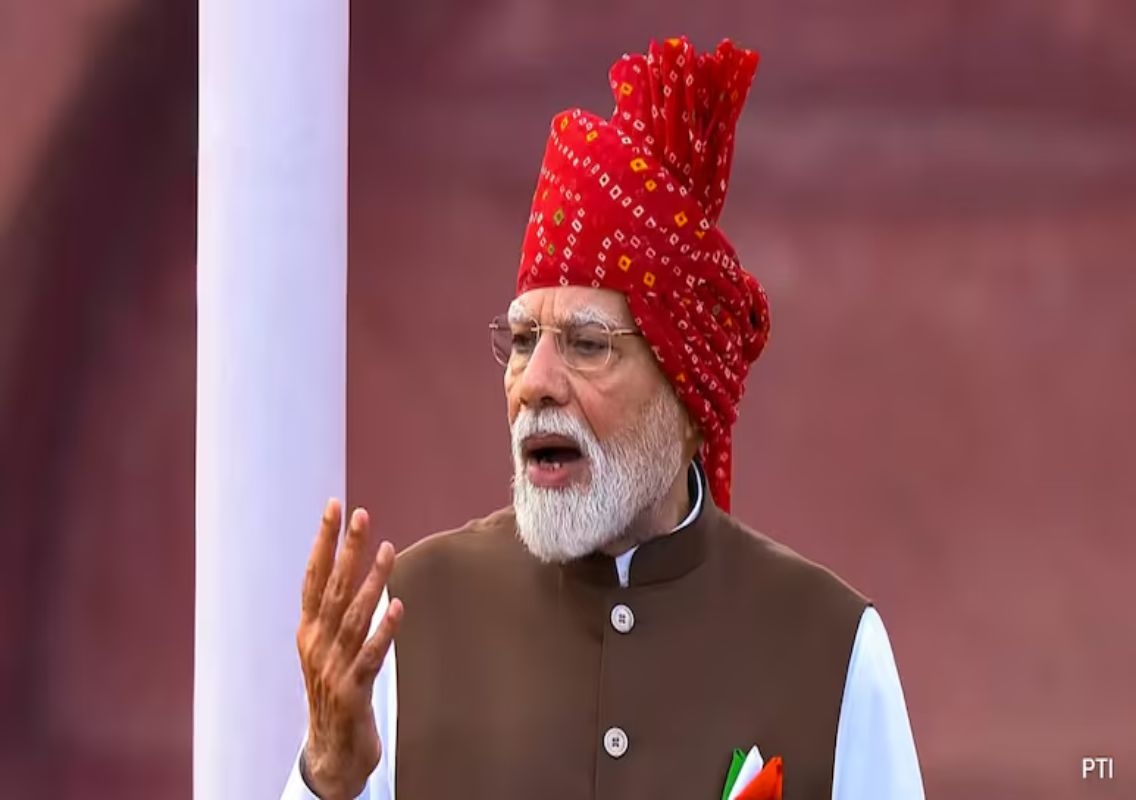


New Delhi: Prime Minister Narendra Modi marked India’s 80th Independence Day on Saturday with a distinctive red tie-and-dye turban as he addressed the nation from the historic Red Fort. The traditional headgear, paired with a white kurta and brown vest, added a strong regional and cultural touch to his Independence Day appearance.
Modi’s choice of attire has become an annual feature of the Independence Day celebrations. Since taking office, he has frequently used his Red Fort appearance to showcase traditional Indian textiles, colours and styles from different parts of the country.
This year, the Prime Minister’s red tie-and-dye turban stood out against his simple white kurta. He also wore saffron, white and green pocket squares, reflecting the colours of the Indian national flag.
Red tie-and-dye turban takes centre stage
The turban worn by Modi on August 15 was described as a traditional style associated with Rajasthan and Gujarat. The bright red headgear featured a tie-and-dye pattern and was paired with a white kurta and brown vest.
The combination gave the Prime Minister’s Independence Day outfit a distinctly traditional appearance while keeping the overall look relatively simple.
The choice of a tie-and-dye turban is also consistent with Modi’s long-standing practice of highlighting India’s regional textile traditions during national occasions. His Independence Day turbans have featured different colours, patterns and styles over the years.
According to NDTV, Modi’s Independence Day turbans have become a distinct visual hallmark of his annual appearance at the Red Fort.
PM Modi’s 13th consecutive Independence Day address
The 2026 Independence Day address was Modi’s 13th consecutive speech from the Red Fort as Prime Minister.
He has delivered the Independence Day address from the historic venue every year since 2014. Over that period, his choice of traditional headgear has attracted considerable attention, with each year’s turban often becoming one of the most recognisable elements of his public appearance on August 15.
The tradition began with his first Independence Day speech as Prime Minister in 2014, when he wore a bright red Jodhpuri Bandhej safa with a green trailing end.
The different styles have allowed Modi to showcase India’s regional diversity through clothing while maintaining the ceremonial character of the occasion.
A look at Modi’s Independence Day turbans
Modi’s Independence Day attire has changed noticeably from year to year.
In 2025, he wore a saffron turban with a white kurta-churidar, a saffron bandhgala jacket and a tricolour stole. The previous year’s appearance featured a Rajasthani leheriya-print turban with a white kurta-churidar and light blue bandhgala jacket.

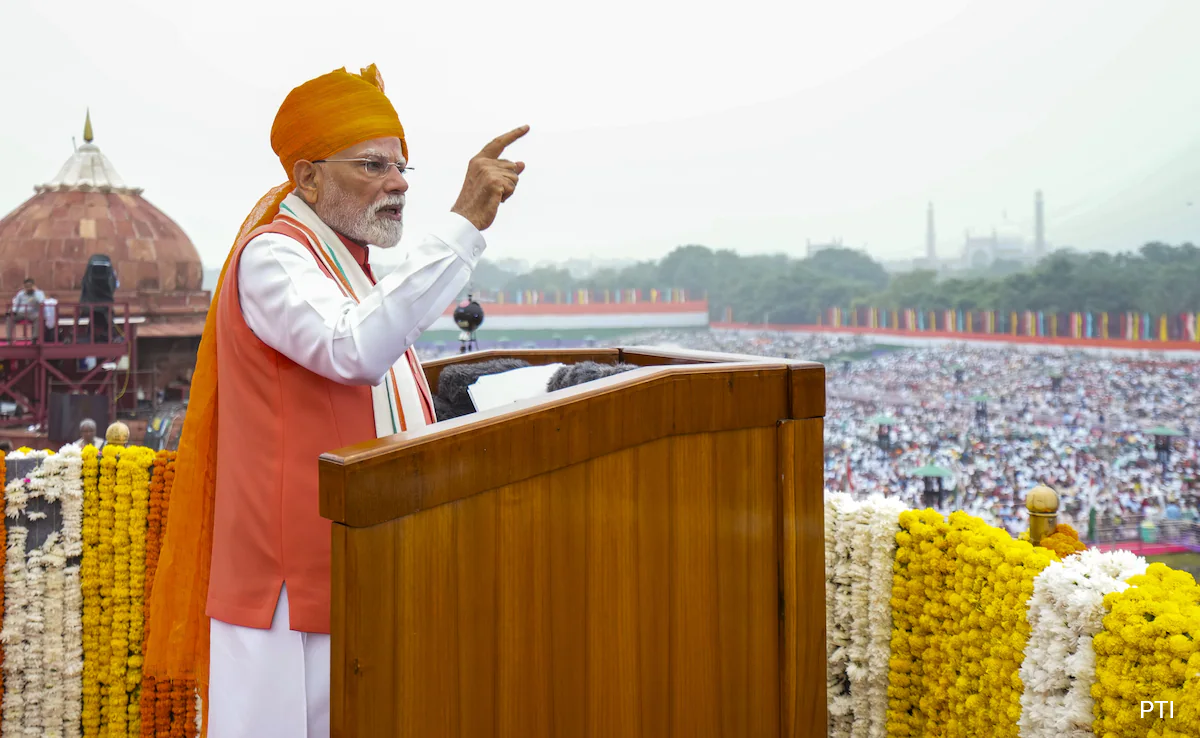
In 2023, Modi wore a bandhani-print turban featuring yellow, green and red shades, along with a black V-neck jacket. In 2022, his saffron turban featured red motifs and a flowing tail and was paired with a blue jacket and stole.

His 2021 headgear was a cream-and-saffron turban, while the 2020 Independence Day appearance was different because of the COVID-19 pandemic. That year, he wore a white scarf with saffron borders that also served as a protective face covering.

In 2019, he chose a Rajasthani-style turban in orange and green, while the 2018 turban featured red and saffron shades. The 2017 headgear used vibrant yellow, orange and red colours.

In 2016, Modi wore a pink, yellow and orange tie-and-dye turban with a long flowing tail. His 2015 turban featured mustard yellow with red, green and pink shades, accompanied by a tricolour pocket square.
The 2014 turban remains significant
Modi’s first Independence Day appearance as Prime Minister in 2014 established the tradition of using the occasion to highlight regional clothing.

He wore a bright red Jodhpuri Bandhej safa with a green trailing end. The style was visually striking and became one of the defining images from his first Independence Day address as Prime Minister.
The 2026 choice therefore carries a visual similarity to his first Independence Day attire, particularly through its use of red and tie-and-dye styling.
However, the latest outfit is more understated, with the red turban complemented by a white kurta and brown vest rather than a more elaborate jacket or stole.
Tricolour details complete the outfit
Another notable element of Modi’s 2026 Independence Day appearance was the use of saffron, white and green pocket squares.
The colours correspond to the three colours of India’s national flag and added a subtle national symbolism to the outfit without making it overly elaborate.
The combination of regional headgear and national colours also reflects the broader visual character of Independence Day, where India’s cultural diversity is often represented alongside national symbols.
Independence Day attire becomes an annual tradition
The Prime Minister’s clothing choices on Independence Day have developed into a tradition closely watched alongside the main ceremony.
Unlike a standard formal political appearance, the Red Fort address provides an opportunity to bring traditional Indian clothing into the national spotlight. Turbans, safas and regional textile patterns have consequently become an important part of the visual identity of the annual ceremony.
The changing designs also provide a chronological record of the different regional styles Modi has chosen to highlight during his tenure.
From the red Jodhpuri Bandhej safa of 2014 to the Rajasthani and bandhani-inspired styles of subsequent years, the choices have covered a wide range of colours and traditional patterns.
Conclusion
Prime Minister Narendra Modi’s red tie-and-dye turban became one of the visual highlights of India’s 80th Independence Day celebrations in New Delhi. Worn with a white kurta, brown vest and tricolour pocket squares, the outfit combined traditional regional styling with national symbolism.
The choice also continued a tradition that began with Modi’s first Independence Day address in 2014. Over the past 13 years, his changing turbans have become a familiar part of the Red Fort ceremony, with each design offering a different representation of India’s rich textile and cultural traditions.