







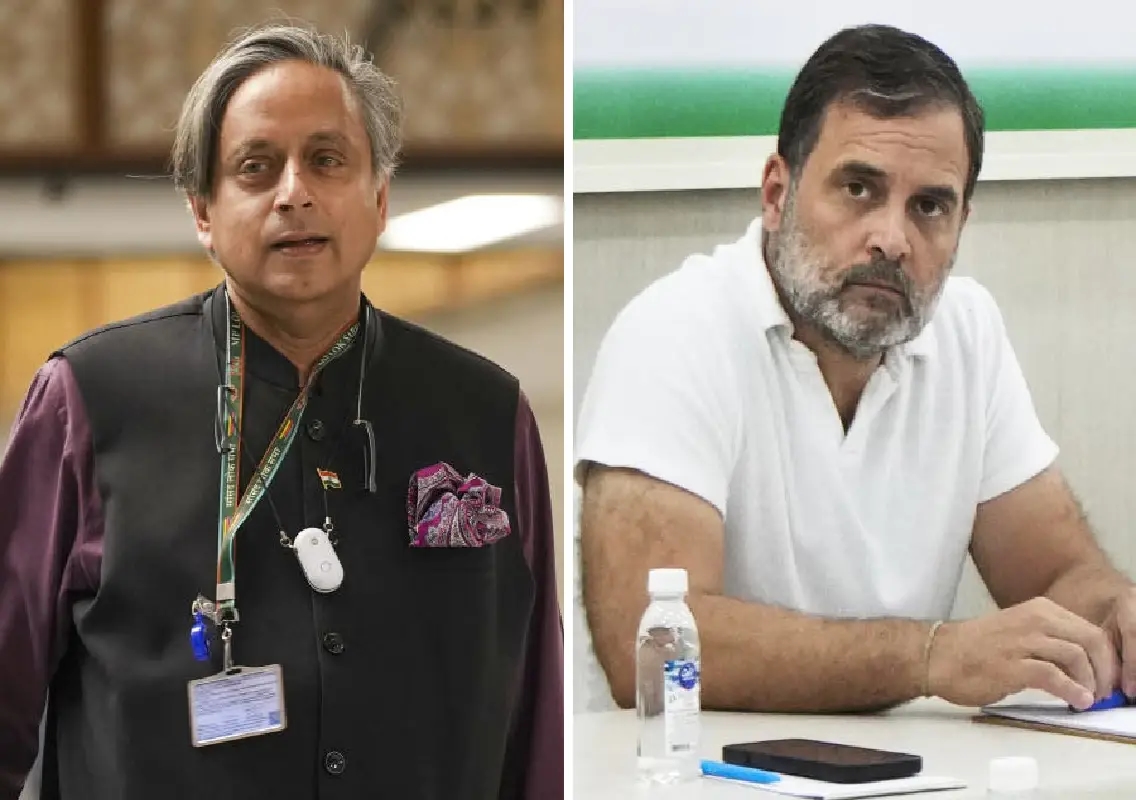


New Delhi: A detailed social media analysis comparing ideological differences between senior Congress leader Shashi Tharoor and the Rahul Gandhi-led party leadership has sparked renewed debate within political circles, after Tharoor publicly acknowledged and responded to the commentary on X (formerly Twitter).
The discussion began when an X user, Civitas Sameer, posted a thread analysing what he described as an “ideological showdown” within the Congress. The thread framed the perceived differences between the party’s current leadership and Tharoor as a clash between two contrasting ideological tendencies that the Congress, according to the user, has failed to reconcile in recent years.
Tharoor, the four-time Member of Parliament from Thiruvananthapuram, responded briefly but pointedly to the analysis, thanking the user for what he termed a “thoughtful analysis” and agreeing that the framing reflected “a certain perception of the current reality” within the party. The exchange quickly went viral, drawing attention amid ongoing speculation over Tharoor’s position within the Congress.
Ideological contrasts within the Congress
The X user’s analysis suggested that the Congress has undergone a “devastating post-2010 shift” towards what was described as a rural grievance-driven mass politics model. This approach, the thread argued, was adopted in response to the electoral dominance of the Bharatiya Janata Party (BJP), but without the organisational depth or cultural embedding required to succeed in rural India.
In contrast, the analysis positioned Shashi Tharoor as broadly aligned with a 1990s-era Congress ideology that was urban-facing, institutionally oriented and reform-compatible. According to the user, this tendency emerged during India’s period of economic transition and elite-led governance, and prioritised policy formulation, administrative competence and strong institutions over mass mobilisation.
The thread cited leaders such as former Prime Minister P V Narasimha Rao, former Prime Minister Manmohan Singh in his role as Union Finance Minister, former Karnataka Chief Minister S M Krishna, and former Planning Commission Deputy Chairman Montek Singh Ahluwalia as figures who operated within this framework.
Tharoor’s response draws attention
Responding to the analysis, Tharoor wrote, “Thank you for this thoughtful analysis. There has always been more than one tendency in the party; your framing is fair, and reflective of a certain perception of the current reality.” The X user replied with a brief “Damn!”, further fuelling online discussion.
The response from Tharoor comes at a time when he has been the subject of speculation after skipping several consecutive major party meetings, leading to renewed debate about his standing within the Congress and his ideological alignment.
Claims of sidelining urban technocrats
The analysis went on to argue that leaders identified as urban, technocratic and institutionally focused have repeatedly been sidelined by the Congress in recent years. It claimed that many such leaders have gained greater recognition and respect from right-wing political spaces than from within the party itself.
Observers have drawn parallels with high-profile exits from the Congress, including Jyotiraditya Scindia, who joined the BJP in 2020, triggering the fall of the Congress government in Madhya Pradesh. Since then, Scindia has held key Union Cabinet positions, including Aviation and later Communications in the third Narendra Modi government.
The analysis also alluded to leaders such as Sachin Pilot, often cited by critics as part of a younger generation that has faced internal marginalisation within the party structure.
Critique of Congress’s rural strategy
A significant portion of the X thread criticised what it described as the Congress’s attempt to adopt rural mass politics without the necessary organisational foundation. The user argued that rural politics in India requires sustained cadre-based engagement, cultural alignment and long-term organisational work, attributes the BJP has developed through the Rashtriya Swayamsevak Sangh (RSS).
The analysis described it as ironic that the Congress’s rural turn is being led by Rahul Gandhi, whom it characterised as an elite political figure lacking lived rural organisational depth. According to the thread, symbolic rural outreach without grassroots infrastructure undermines credibility and electoral effectiveness.
The post further claimed that the Congress currently occupies an ideological vacuum, having abandoned its earlier urban reformist identity without successfully transforming into a credible rural mass party. As a result, the party’s identity, the user argued, has become primarily oppositional rather than aspirational.
Debate over Tharoor’s political positioning
Addressing criticism that Tharoor has shifted ideologically to the right, the analysis rejected such claims, stating that he remains consistent in his beliefs. It described Tharoor as a “proud Hindu from day one” and suggested that recent controversies over his remarks, including those perceived as favourable to Prime Minister Narendra Modi, have been misinterpreted.
The thread concluded by arguing that, like earlier urban technocratic leaders, Tharoor is being sidelined within the Congress due to the party’s unresolved ideological contradictions.
Conclusion
Tharoor’s brief but measured response has added momentum to an ongoing conversation about the Congress’s ideological direction, internal cohesion and leadership strategy. While the party continues to grapple with electoral challenges, the exchange highlights deeper questions about whether the Congress can successfully integrate diverse ideological traditions or risks further internal fragmentation in the years ahead.