


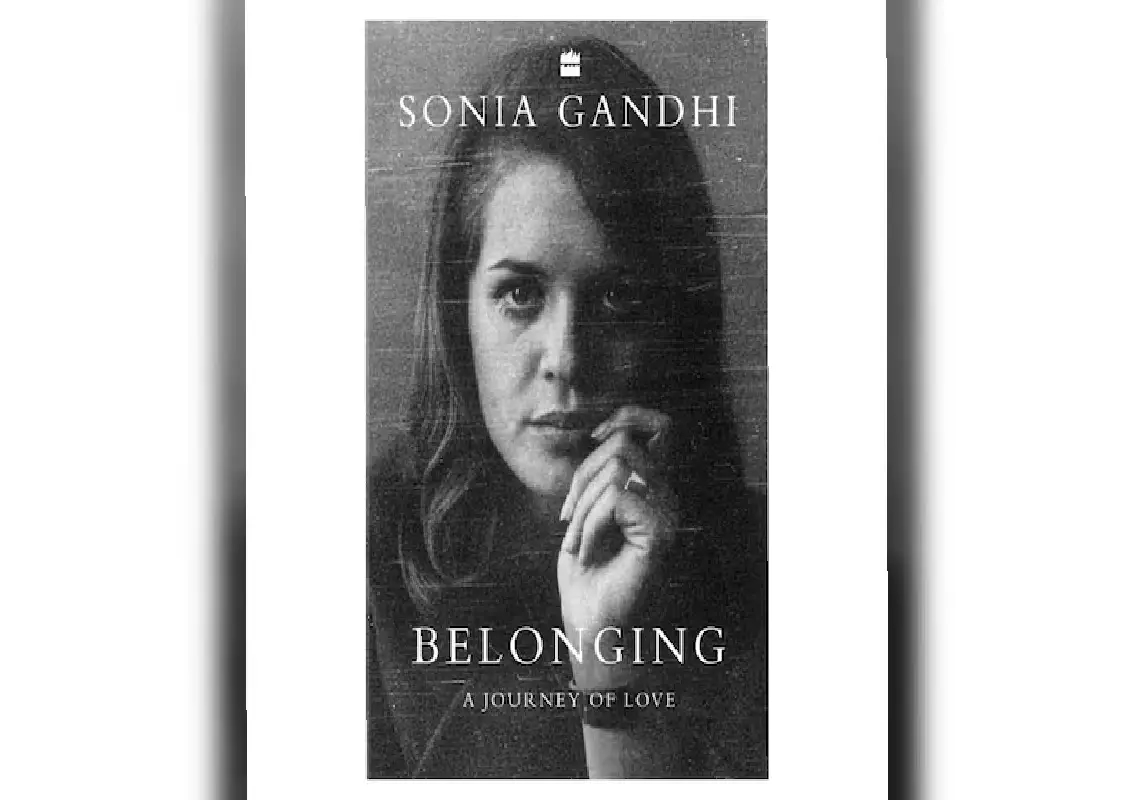


New Delhi: Congress Parliamentary Party chairperson Sonia Gandhi’s memoir, Belonging: A Journey of Love, was officially released on November 10, offering a personal account of some of the most defining moments in her life and India’s political history.
Published by HarperCollins India, the 544-page book revisits major events, including the assassination of her husband and former prime minister Rajiv Gandhi, the 1975 Emergency, Operation Blue Star, the demolition of the Babri Masjid in 1992 and her decision to decline the prime minister’s post after the Congress-led United Progressive Alliance (UPA) came to power in 2004.
The memoir also discusses her cancer treatment, relationships within the Nehru-Gandhi family, her interactions with political leaders and the allegations that she exercised influence over the government during former prime minister Manmohan Singh’s tenure.
Several passages have attracted attention for the political and personal insights they offer into events that shaped Sonia Gandhi’s public life.
Sonia Gandhi describes Emergency as a mistake
One of the significant reflections in the memoir concerns the Emergency imposed by then prime minister Indira Gandhi in June 1975.
Sonia Gandhi describes the decision as a mistake and suggests that her mother-in-law eventually came to recognise the consequences of the move. She also believes that keeping Sanjay Gandhi, Indira Gandhi’s younger son, under control could have prevented much of the damage associated with the Emergency.
In an interview with The Guardian ahead of the memoir’s release, Sonia Gandhi said she believed Indira Gandhi was fundamentally a democrat, despite the decision to impose the Emergency.
“I always feel that Mrs (Indira) Gandhi was a democrat at heart. I know that many would laugh at this, but I believe she was never comfortable in the course of the emergency. I think it was sitting heavy on her,” she said.
The memoir also recalls the differing positions taken by Rajiv and Sanjay Gandhi during the period. According to Sonia’s account, Rajiv opposed the decision and advised his mother to wait for the next election. Sanjay, however, supported the Emergency, arguing during a family dinner that the Opposition would destroy his mother and insisting that they had to be stopped.
Her account offers a glimpse into the family discussions surrounding one of the most controversial periods in independent India’s history.
Babri Masjid demolition was a political turning point
Sonia Gandhi also revisits the demolition of the Babri Masjid in Ayodhya on December 6, 1992, describing it as a turning point in India’s political journey.
In the memoir, she argues that the demolition and the communal violence that followed demonstrated the growing political influence of the BJP-RSS combine.
“There had been for several years clear indications that the BJP-RSS and their affiliates were single-mindedly advancing their divisive agenda,” she writes.
She further says the demolition marked a stage when these organisations were no longer operating behind the scenes and the BJP was moving closer to its ambition of gaining greater political power.
Recalling the day of the demolition in her interview with The Guardian, Sonia said she broke down in tears while watching the events unfold on television.
She writes that the incident made her realise that preserving the secular vision associated with Mahatma Gandhi, Jawaharlal Nehru and other leaders of India’s founding generation would require a prolonged struggle.
These observations have since become a point of political contention, particularly because of her criticism of the BJP and the ideological organisations associated with it.
Why she chose Manmohan Singh as prime minister in 2004
Another important section of the memoir explains Sonia Gandhi’s decision to decline the prime minister’s post after the Congress-led UPA won the 2004 general election.
Although the Congress had offered her the opportunity to lead the government, she chose Manmohan Singh for the position. In the book, she describes him as a leader with unquestionable integrity and a deep understanding of governance.
She says Singh was not aligned with any particular faction within the Congress and was therefore well placed to lead a coalition government that also depended on the support of the Communist parties.
“He was not allied to any camp in the party. Over a period of time, the Congress had been painted as being left of centre, and our government would now be supported by the Communist parties as well. I thought Dr Manmohan Singh would assuage the doubts of many about our ability to manage and continue the policies that had been begun years ago,” she writes.
The passage also provides her explanation of the political considerations behind the choice, which shaped the leadership arrangement during the first UPA government.
Cancer treatment and medical challenges
The memoir contains personal details about Sonia Gandhi’s health, including her breast cancer diagnosis in 2010 and the subsequent discovery of a pancreatic growth a year later.
She recalls that before the breast cancer diagnosis, she had experienced occasional asthma attacks, allergies and stomach problems but had not faced any major health concerns.
The diagnosis left her shaken, particularly because of the uncertainty surrounding the illness and its possible consequences for her family.
“Still, I felt shaken and worried; there was no time to lose, my children and I were told, and my mind began to race to a possible scary outcome,” she writes.
Sonia opted for surgery at the European Institute of Oncology outside Milan, Italy. She travelled for the procedure accompanied by a senior officer, her children Rahul and Priyanka Gandhi, Priyanka’s husband Robert Vadra and her sisters.
The operation was performed under the guidance of renowned surgeon Dr Umberto Veronesi. The account offers a personal perspective on the medical challenges she faced while remaining a prominent figure in national politics.
Sonia recalls finding grenades after Operation Blue Star
Another episode discussed in the book concerns the aftermath of Operation Blue Star in June 1984.
The military operation, ordered by the Indira Gandhi government to remove armed militants from the Golden Temple complex in Amritsar, remains one of the most sensitive and consequential episodes in India’s political history.
Sonia recalls the frightening discovery of grenades in a room of the family residence following the operation. The incident reflected the security concerns surrounding the Gandhi family during a period of heightened tensions.
She also describes the emotional impact of the operation on Indira Gandhi. According to the memoir, when the then prime minister was shown photographs of the damage inside the Golden Temple after the military action, “tears rolled down her face”.
The recollection provides an insight into the personal response of Indira Gandhi to the consequences of the operation, which had far-reaching political and social repercussions.
Indira Gandhi’s temper and Sonia’s early years in the family
Sonia Gandhi also writes about the challenges she faced while adjusting to life in the Nehru-Gandhi household after marrying Rajiv Gandhi.
She recalls that Indira Gandhi could occasionally lose her temper, with her outbursts leaving even members of the household staff intimidated.
In one incident, a staff member who failed to remind Indira Gandhi about an appointment was made to stand in a corner. In another, Sonia recalls seeing a senior Congress leader being ordered to face a wall.
Describing her reaction during her early years in the family, she writes: “But until I got to know her well, I’d quake in my seat.”
The recollections present a more personal account of her relationship with her mother-in-law, beyond their public association with the Congress and Indian politics.
Sonia rejects allegations of controlling Manmohan Singh’s government
The memoir also addresses allegations that Sonia Gandhi exercised unofficial authority over the UPA government during Manmohan Singh’s tenure as prime minister.
Critics had accused her of functioning as a “back-seat driver”, suggesting that she influenced government decisions despite not holding the prime minister’s office.
Sonia rejects the characterisation. She describes an understanding under which Singh was responsible for running the government while she concentrated on leading the Congress party.
She maintains that she did not interfere in administrative matters or access official government files, insisting that she respected the distinction between her responsibilities as party president and Singh’s role as prime minister.
The passage revisits a long-running political debate about the relationship between the Congress leadership and the UPA government.
Pranab Mukherjee’s reported prime ministerial ambition
Sonia also recounts a conversation with former President Pranab Mukherjee in 2010, which she interpreted as an indication of his interest in becoming prime minister.
According to her account, Mukherjee told her that “it was time for a change at the top”. She understood the remark as a possible reference to his own long-standing ambition to lead the government.
Sonia writes that she gently changed the subject during the conversation. She also says Mukherjee did not subsequently make her feel that he resented her response.
The recollection offers an insight into the political relationships and leadership considerations within the Congress during the UPA years.
Limited interaction with Narendra Modi
The memoir also discusses Sonia Gandhi’s interactions with Prime Minister Narendra Modi.
She writes that she has had “practically no real contact” with Modi during his 12 years in office. According to her account, their interactions have largely been limited to formal greetings at official functions.
She recalls that when they have been in the same room, including in the Speaker’s chamber, Modi has tended to look away and avoid eye contact.
However, she acknowledges that he once briefly enquired about her health following a hospital stay.
The passage describes her personal experience of their limited interactions rather than detailing any substantive political discussions between the two leaders.
Personal loss and relationship with Maneka Gandhi
Among the most intimate recollections in the memoir is Sonia Gandhi’s account of losing her first child in 1969. The baby was born prematurely and died shortly after birth.
She recalls the painful experience and says she insisted that the baby’s remains be buried, a deeply personal episode that she has now chosen to share publicly.
The book also discusses the deterioration of her relationship with her sister-in-law Maneka Gandhi, who married Sanjay Gandhi in 1974 at the age of 18.
Sonia writes that their relationship was initially warm but became increasingly strained over time. She recalls arguments and says Maneka sometimes used harsh language, even in front of Indira Gandhi.
The tensions intensified after Sanjay Gandhi died in an aircraft crash in June 1980. Maneka was then 23 and had a three-month-old son, Varun Gandhi. Sonia says Indira Gandhi considered her too young for a leadership role amid Maneka’s political ambitions.
The relationship deteriorated further in 1982 when Maneka began moving her belongings out of the family residence while Indira Gandhi was in London.
According to Sonia’s account, Maneka later regarded her and Rajiv as enemies and leaked stories about them to journalists.
Through these recollections, Belonging: A Journey of Love combines personal memories with reflections on political events, family relationships and leadership decisions. Its release has brought renewed attention to Sonia Gandhi’s account of some of the most debated chapters in India’s modern history.