







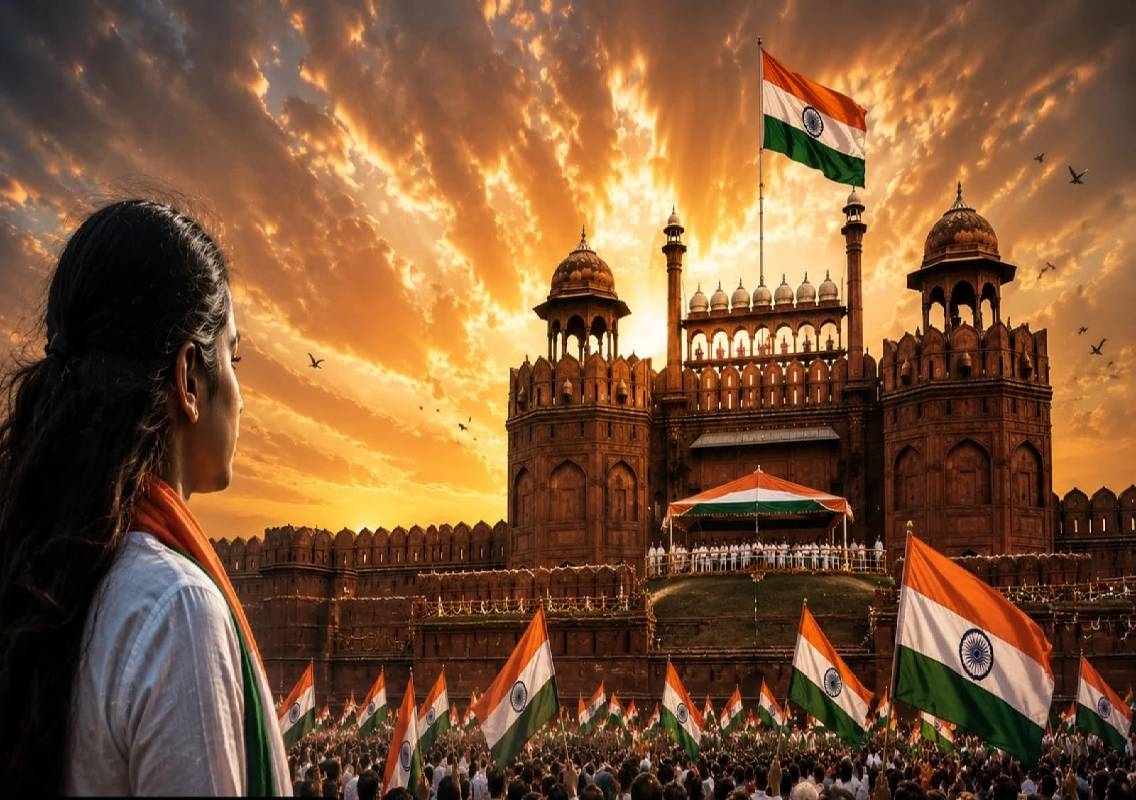


New Delhi: India’s 80th Independence Day marked a historic change in the country’s traditional Red Fort ceremony, with Vande Mataram being performed from the ramparts for the first time. The move comes as India commemorates 150 years of the national song, adding a new element to the Independence Day proceedings.
The ceremonial sequence was changed this year so that Prime Minister Narendra Modi would be welcomed at the Red Fort with the National Song before the national flag was unfurled and the National Anthem played. Defence Secretary Rajesh Kumar Singh had announced the new sequence ahead of the celebrations.
Vande Mataram gets a new place in Red Fort ceremony
According to the ceremonial plan, the Prime Minister arrives at the ramparts, after which Vande Mataram is played while everyone remains standing. The Prime Minister then unfurls the Tricolour, followed by the playing of Jana Gana Mana, India’s National Anthem.
The change gives Vande Mataram a formal place in the country’s most prominent Independence Day ceremony.
The decision is also linked to the 150th anniversary of the song. Vande Mataram was composed by Bankim Chandra Chattopadhyay in 1875, making 2025-26 a significant period of commemoration for the song.
Why 2026 is significant for Vande Mataram
Vande Mataram has a long association with India’s freedom movement.
The song was written by Bankim Chandra Chattopadhyay and later published as part of his novel Anandamath. It became closely associated with the nationalist movement, particularly during the Swadeshi movement following the 1905 Partition of Bengal.
The song’s imagery celebrates the motherland through references to its natural beauty, including rivers, greenery, breeze and abundance.
Over time, however, some of its later verses also became the subject of debate because of their references to Hindu religious imagery. This eventually influenced the distinction between Vande Mataram as the National Song and Jana Gana Mana as the National Anthem.
Vande Mataram and Jana Gana Mana have different status
India’s two most prominent national songs have different constitutional and ceremonial roles.
Jana Gana Mana was adopted as the National Anthem, while Vande Mataram was accorded the status of National Song.
The first two stanzas of Vande Mataram have traditionally been used for official and ceremonial purposes. The distinction was intended to recognise the song’s enormous role in India’s freedom struggle while also addressing concerns surrounding some of its later religious imagery.
The latest Red Fort decision does not change the song’s status to that of a National Anthem. Instead, it gives the National Song a new place in the official Independence Day ceremony.
A song closely linked to the freedom struggle
Vande Mataram became one of the most powerful symbols of resistance to British rule.
During the Swadeshi movement, the song was used at public gatherings and protests and became a rallying cry for India’s independence movement.
Its historical importance was also recognised by the Indian National Congress, which adopted it at its 1896 session. Rabindranath Tagore is associated with one of its early public renditions.
The song therefore predates independent India by several decades and was already deeply embedded in the nationalist movement before 1947.
150 years of Vande Mataram
The Red Fort ceremony is part of a wider national commemoration of 150 years of Vande Mataram.
The government has organised programmes and musical renditions to mark the anniversary, including versions in different Indian musical traditions. The anniversary has also featured prominently in national events and discussions.
The incorporation of Vande Mataram into the Independence Day ceremony represents the culmination of that anniversary year.
Full version of the song also gets attention
The 150th anniversary celebrations have also renewed attention on the complete six-stanza version of Vande Mataram.
For decades, the opening two stanzas have generally been used in formal settings because they focus on descriptions of the motherland. The later stanzas contain more explicit religious imagery, which has historically made their use in official settings more contentious.
The debate over which portions should be performed has therefore been closely connected with questions surrounding India’s plural and multi-religious character.
Why the Red Fort matters
The significance of the decision is also tied to the location.
The Red Fort has been at the centre of India’s Independence Day celebrations since 1947. Every year, the Prime Minister unfurls the national flag from its ramparts and addresses the nation.
Adding Vande Mataram to the ceremony therefore places a song from the freedom struggle at the heart of the annual celebration of India’s independence.
It also creates a symbolic connection between the nationalist movement of the colonial era and the Republic’s modern Independence Day celebrations.
Not the same as making the song compulsory
The inclusion of Vande Mataram in the Red Fort ceremony should not be confused with making the song compulsory for citizens.
The decision concerns the official sequence of the Independence Day ceremony.
Questions about compulsory singing of Vande Mataram have previously generated legal and political debate, particularly in relation to freedom of expression and freedom of religion. The latest move instead concerns its ceremonial use at the Red Fort.
A historic ceremonial change
For decades, the Independence Day ceremony at the Red Fort followed a familiar sequence centred on the Prime Minister’s arrival, the unfurling of the national flag and the National Anthem.
The introduction of Vande Mataram at the beginning of that sequence represents a significant ceremonial change.
It also comes at a moment when the government is placing renewed emphasis on the historical role of the song and its contribution to India’s freedom movement.
Conclusion
The performance of Vande Mataram from the Red Fort on August 15, 2026 marks a significant moment in India’s Independence Day tradition. The National Song, which has been associated with the freedom movement for more than a century, now has a formal place in the opening sequence of the Red Fort ceremony.
The move coincides with the 150th anniversary of Vande Mataram and adds another layer to the symbolism of India’s 80th Independence Day. While Jana Gana Mana remains the National Anthem and Vande Mataram remains the National Song, their placement within the ceremony has now taken on a new form.