







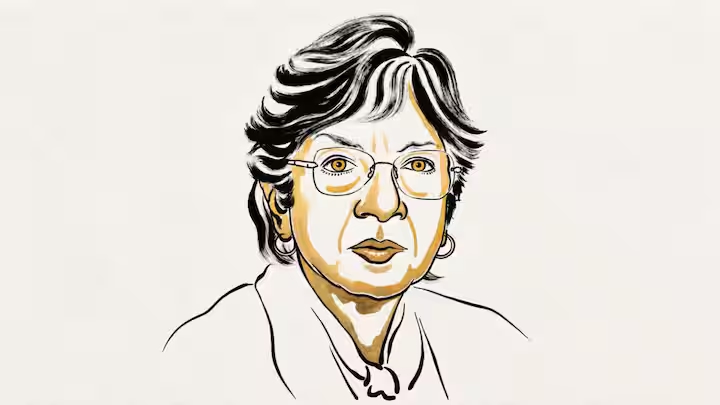


Oslo: South African jurist of Indian Tamil origin Navanethem “Navi” Pillay has been awarded the 2026 Nobel Peace Prize for her efforts to promote peace and international law, recognising a career dedicated to human rights, accountability and the strengthening of international justice.
The Norwegian Nobel Committee announced the award on Friday, October 9, highlighting Pillay’s commitment to universal legal principles and her work to advance international law. The prize carries an award amount of 12 million Swedish kronor and will be presented at the Nobel ceremony in Oslo on December 10.
Pillay, a former United Nations High Commissioner for Human Rights, has held several prominent positions in international judicial institutions. Her work includes serving as a judge at the International Criminal Tribunal for Rwanda and the International Criminal Court, where she contributed to landmark efforts to prosecute serious international crimes.
Her selection also brings attention to the role of international legal institutions in addressing human rights violations, war crimes and genocide at a time when the authority and effectiveness of such institutions remain subjects of global debate.
Who is Navi Pillay?
Born on September 23, 1941, in Durban, South Africa, Pillay grew up under apartheid, a system of racial segregation and discrimination that restricted the rights and opportunities of the country’s non-white population.
Her parents were of Indian Tamil origin, and she was raised in a family of eight children. Her father worked as a bus driver and took on additional jobs to support the household, while her mother cared for the children.
Despite financial difficulties and the discrimination faced by the family, her parents placed considerable importance on education. They believed their sons and daughters should have equal opportunities to study.
Pillay’s early experiences of racial inequality helped shape her commitment to justice and human rights. She went on to build a legal career that took her from practising law in apartheid-era South Africa to some of the world’s most prominent judicial and human rights institutions.
Landmark work on genocide and sexual violence
One of the most significant chapters of Pillay’s career was her work at the International Criminal Tribunal for Rwanda, which was established to prosecute people responsible for serious crimes committed during the 1994 genocide.
As a judge at the tribunal, she contributed to legal developments that recognised rape and sexual violence as acts that could constitute genocide under particular circumstances.
The tribunal’s landmark Akayesu judgment in 1998 established an important precedent by recognising that sexual violence could form part of the crime of genocide when committed with the requisite intent to destroy a protected group, in whole or in part.
The ruling was widely regarded as a major development in international criminal law, strengthening the recognition of sexual violence as a weapon used during mass atrocities.
Pillay’s work at the tribunal formed part of broader international efforts to ensure that those responsible for genocide and other grave crimes could be held accountable under the law.
From international courts to the UN human rights chief
Pillay subsequently served as a judge at the International Criminal Court, which prosecutes individuals accused of genocide, crimes against humanity, war crimes and, under specified conditions, the crime of aggression.
She later became the United Nations High Commissioner for Human Rights, serving from 2008 to 2014.
In that position, she was responsible for leading the UN’s human rights office and advocating for the protection of fundamental rights across countries and regions.
Her work involved addressing violations, promoting international human rights standards and pressing governments to meet their obligations under international law.
Pillay’s career has therefore spanned both judicial proceedings and international human rights advocacy, with a focus on legal accountability and the protection of people affected by conflict and discrimination.
Role in the Israel-Palestine human rights inquiry
In recent years, Pillay has chaired a United Nations commission of inquiry investigating alleged human rights violations in Israel and the Palestinian territories.
The commission’s work has included examining events in Gaza and allegations of serious international crimes. A report by the commission concluded that Israel had committed genocide in Gaza, a finding that Israel has rejected.
The report and the commission’s conclusions have drawn international attention and controversy, reflecting wider disagreements over accountability, the interpretation of international law and the responsibilities of states during armed conflict.
Pillay’s involvement in the inquiry has continued her work on international justice, while also placing her at the centre of contentious debates over the application of human rights law to the Israeli-Palestinian conflict.
Who won the Nobel Peace Prize in 2025 and 2024?
Pillay follows two recipients whose work focused on democracy and nuclear disarmament.
The 2025 Nobel Peace Prize was awarded to Venezuelan opposition leader María Corina Machado for her efforts to promote democratic rights and a peaceful transition from dictatorship to democracy in Venezuela.
In 2024, the prize went to Nihon Hidankyo, a Japanese grassroots movement representing survivors of the atomic bombings of Hiroshima and Nagasaki. The organisation was recognised for its efforts to achieve a world free of nuclear weapons and for using survivors’ testimonies to demonstrate why nuclear weapons must never be used again.
The two awards highlighted different dimensions of peacebuilding: the protection of democratic rights and the prevention of nuclear catastrophe. Pillay’s recognition places renewed emphasis on international law, judicial accountability and human rights.
A long history of recognising peace efforts
The Nobel Peace Prize was first awarded in 1901 and has since recognised individuals and organisations for work connected with peace, international cooperation and the prevention of conflict.
The inaugural prize was shared by Henry Dunant, founder of the International Committee of the Red Cross, and Frédéric Passy, a French peace activist who promoted international arbitration and peaceful dispute resolution.
Over the decades, recipients have included human rights campaigners, political leaders, humanitarian organisations and advocates of disarmament.
The Nobel Foundation announced in September 2026 that the prize amount would increase by one million Swedish kronor, taking the award to 12 million kronor per category. The 2026 Peace Prize will be presented on December 10, the anniversary of the death of Alfred Nobel, whose will established the awards.
Recognition of a career devoted to justice
Pillay’s Nobel Peace Prize recognises a career that has connected domestic struggles against racial discrimination with international efforts to prosecute grave crimes and protect human rights.
From her upbringing under apartheid to her work at international tribunals and the United Nations, her professional life has centred on the principle that legal protections should apply regardless of a person’s identity or circumstances.
Her work on genocide jurisprudence helped establish important precedents in international criminal law, while her tenure as UN human rights chief brought her into the centre of global debates over state responsibility and fundamental freedoms.
The award places Pillay among the individuals recognised for advancing peace through legal institutions and international accountability. It also highlights the continuing importance of international law in efforts to address atrocities, protect vulnerable communities and resolve disputes through established legal frameworks.