


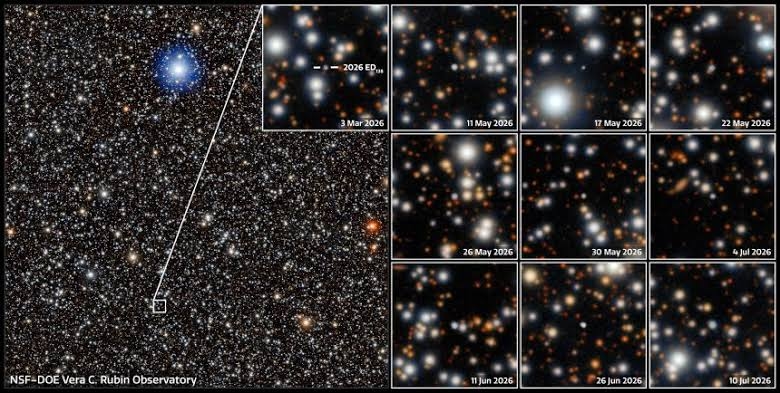


Santiago: The discovery of a distant icy object beyond Pluto has reignited debate about how astronomers classify planets and dwarf planets in our Solar System. Provisionally designated 2026 ED138, the object was identified in observations from Chile’s Vera C. Rubin Observatory and is now considered a strong dwarf planet candidate. However, the discovery does not change Pluto’s official classification or the International Astronomical Union’s definition of a planet.
Scientists estimate that 2026 ED138 could be between 600 and 1,500 kilometres in diameter. It is currently about 46 times farther from the Sun than Earth is, placing it beyond Neptune and Pluto in the distant outer Solar System. Further observations, particularly at infrared wavelengths, are needed to determine its size more accurately and establish whether it qualifies as a dwarf planet.
The discovery has drawn attention because ED138 could become the sixth dwarf planet recognised by the IAU if its status is confirmed. The five currently recognised dwarf planets are Pluto, Ceres, Eris, Haumea and Makemake.
Mario Jurić, the Rubin Observatory’s Solar System lead scientist, described the discovery as the beginning of a potentially much larger wave of findings. The observatory’s ability to repeatedly survey the sky and identify objects moving against distant stars is expected to help astronomers find more bodies in regions that earlier surveys struggled to examine.
What is 2026 ED138?
The object was identified by Matthew Holman, a researcher affiliated with the Center for Astrophysics | Harvard and Smithsonian and a member of the Rubin Observatory operations team. He found it while analysing observations collected by the observatory earlier in 2026.
Holman used a search programme designed to compare billions of detections of moving objects and identify observations that correspond to the same body. After spotting ED138, researchers examined additional observations to verify its movement and determine its orbit.
The team found further observations in Rubin’s catalogues and images, including data dating back to March 4, 2026. In total, the observatory recorded the object 30 times over 20 nights between March and July. Archival images from the Dark Energy Camera also helped researchers trace its orbit back to 2016.
ED138 is classified as a trans-Neptunian object because it orbits the Sun beyond Neptune. Its estimated diameter places it among the largest candidates for dwarf planet status discovered in this distant region.
However, the size estimate remains preliminary. An object’s brightness depends not only on its physical dimensions but also on how much sunlight its surface reflects. Scientists therefore need additional observations to narrow the estimate and establish the object’s physical characteristics.
The discovery is important because large icy bodies in the outer Solar System can provide clues about how the planets formed and how gravitational interactions shaped their present-day orbits.
Why did Pluto stop being a planet?
Pluto was discovered in 1930 by American astronomer Clyde Tombaugh and was long taught as the ninth planet in the Solar System.
Its status came under renewed scrutiny as increasingly powerful telescopes revealed more objects beyond Neptune. Many of these icy bodies occupy a region known as the Kuiper Belt, which contains remnants from the early stages of the Solar System’s formation.
A major turning point came in 2005, when astronomers announced the discovery of Eris, a distant object initially considered comparable in size to Pluto. The finding raised a fundamental question: if Pluto qualified as a planet, should Eris and other similar objects receive the same classification?
As more distant bodies were discovered, astronomers faced the possibility that the Solar System’s official list of planets could expand substantially.
The International Astronomical Union, which is responsible for official astronomical nomenclature and classification, took up the issue. At its General Assembly in August 2006, the organisation adopted a formal definition of a planet and created a separate category for dwarf planets.
Pluto did not meet all the requirements for full planetary status and was reclassified as a dwarf planet. The official number of planets in the Solar System consequently fell from nine to eight.
What makes a planet a planet?
Under the IAU’s 2006 definition, a planet in the Solar System must meet three conditions:
- It must orbit the Sun.
- It must have enough mass for its own gravity to make it nearly round.
- It must have cleared the neighbourhood around its orbit of other objects of comparable size.
Pluto meets the first two conditions but does not meet the third.
Clearing an orbital neighbourhood does not mean removing every asteroid or small object from a planet’s path. Rather, it means that a planet must be gravitationally dominant in its region of the Solar System.
Pluto shares its distant orbital region with a population of other icy bodies. It is therefore classified as a dwarf planet rather than a full planet.
A dwarf planet also orbits the Sun and is nearly round, but it has not cleared its orbital neighbourhood and is not a satellite of another body.
The distinction is based on the IAU’s classification system, rather than simply on an object’s size or whether it has an interesting surface.
The discovery of ED138 does not challenge these criteria. Instead, it gives scientists another object to study under the existing framework. If further observations confirm that it is sufficiently large and round, it could join the recognised dwarf planets without changing Pluto’s status.
Pluto remains scientifically important
Although Pluto lost its status as a full planet, its scientific importance has not diminished.
NASA’s New Horizons spacecraft flew past Pluto in July 2015, providing the first close-up views of the distant world. The observations revealed mountains, broad plains, glaciers and a thin atmosphere, demonstrating that Pluto is a complex world rather than simply a small, frozen object.
Pluto also has five known moons, including Charon, which is unusually large relative to Pluto itself.
The New Horizons mission transformed scientists’ understanding of Pluto and offered new insights into the icy bodies found in the outer Solar System.
Pluto’s reclassification was a decision about terminology and scientific classification, not a judgement about whether the object is worthy of study. Its geology, atmosphere, moons and orbital characteristics continue to provide valuable information about the Solar System’s evolution.
The discovery of ED138 reinforces the importance of examining distant icy worlds, many of which remain poorly understood because of their distance and faintness.
Why was 2026 ED138 discovered only now?
ED138 was found in a crowded region of the sky close to the plane of the Milky Way. This area contains millions of background stars, making it difficult for many telescopes and surveys to distinguish faint, slowly moving objects from the surrounding light.
The Rubin Observatory is designed to monitor large areas of the sky repeatedly, combining a powerful camera with data-processing systems that can identify changes and movements across successive observations.
That approach helped researchers identify ED138 in data collected earlier in the year. They were then able to search archival images for earlier appearances of the same object, a process known as precovery.
The observatory’s survey capabilities are expected to reveal additional asteroids and distant objects over time. In April 2026, its team submitted observations of more than 11,000 new asteroids, including hundreds of trans-Neptunian objects, to the International Astronomical Union’s Minor Planet Center.
The ED138 discovery demonstrates how repeated observations and improved computational tools can uncover objects that have remained hidden in existing astronomical data.
Could ED138 become the sixth recognised dwarf planet?
The possibility depends on follow-up observations.
Researchers currently estimate the object’s diameter at between 600 and 1,500 kilometres, based on its brightness, distance and assumptions about its surface reflectivity. Icy bodies of this size are expected to be massive enough for gravity to pull them into a nearly spherical shape, but the team has not yet confirmed ED138’s precise dimensions.
Infrared observations could help scientists estimate its size more accurately by measuring heat emitted by the object. Other observations may provide additional information about its surface and physical properties.
If ED138 is confirmed as a dwarf planet, it would join Pluto, Ceres, Eris, Haumea and Makemake in the IAU’s recognised category.
Until then, it remains a candidate rather than an officially recognised dwarf planet. Its provisional designation also reflects its status as a recently identified object whose physical characteristics and classification are still being investigated.
The search for Planet Nine continues
The discovery is also relevant to the broader effort to understand the outer Solar System, including the search for the hypothetical Planet Nine.
Planet Nine is a proposed planet that some researchers believe could exist far beyond Neptune. The hypothesis has been discussed in connection with unusual orbital patterns observed among certain distant Solar System objects. However, Planet Nine has not been directly discovered, and its existence remains unconfirmed.
ED138 is not Planet Nine. It is a much smaller candidate object whose discovery adds to the growing inventory of bodies in the distant Solar System.
Studying objects such as ED138 can help astronomers understand the distribution, composition and orbital behaviour of trans-Neptunian bodies. Those observations may contribute to broader investigations into how the giant planets migrated and how the Solar System evolved.
The discovery therefore provides another opportunity to study the region beyond Neptune, but it does not establish the existence of an additional major planet.
A new discovery, not a new planetary definition
The discovery of 2026 ED138 has revived public interest in Pluto’s demotion and the question of what qualifies as a planet. Yet the scientific distinction remains unchanged: the IAU’s definition, adopted in 2006, continues to separate the eight planets from dwarf planets and other smaller Solar System bodies.
ED138 could eventually become the sixth officially recognised dwarf planet, but additional observations are required before that determination can be made.
For now, the discovery is significant because it demonstrates how much remains to be learned about the distant Solar System. As the Vera C. Rubin Observatory continues its surveys, astronomers expect to identify more objects that could help explain the formation and evolution of our cosmic neighbourhood.
Pluto’s classification remains unchanged, but the search for distant worlds continues to expand our understanding of what lies beyond the familiar planets.