







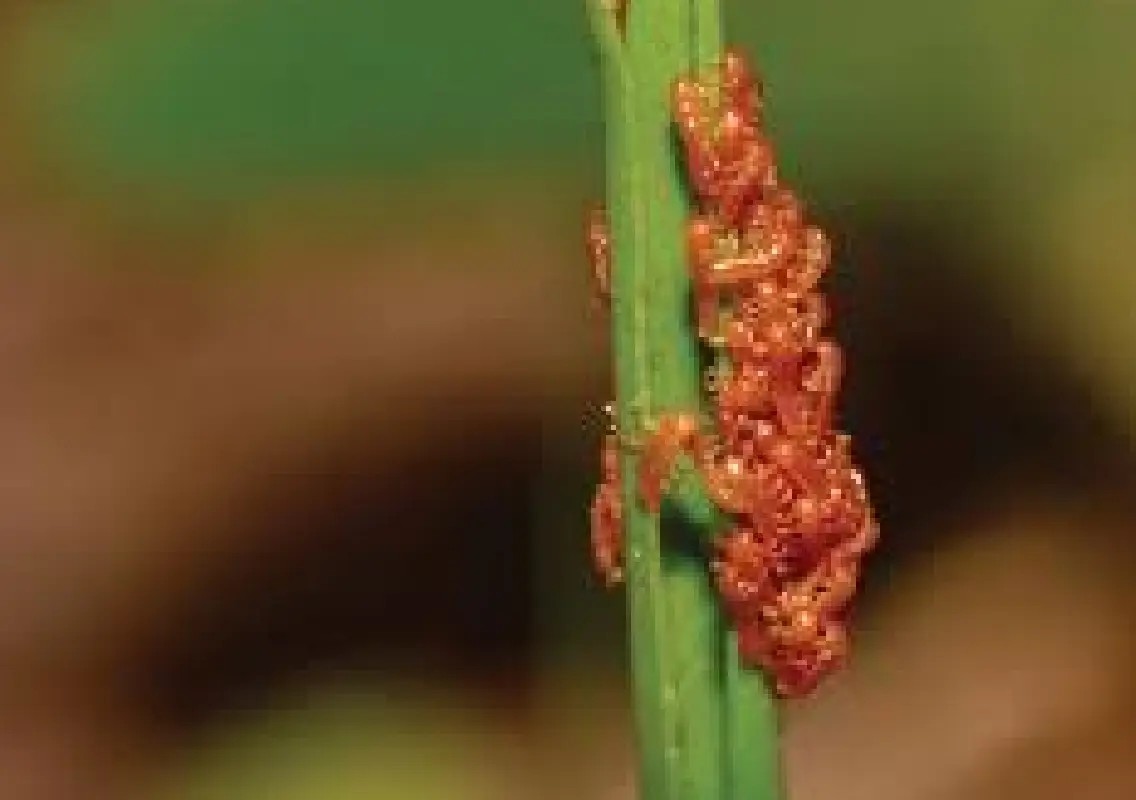


In a remarkable discovery that highlights nature’s extraordinary survival strategies, scientists have found that blister beetle larvae can produce flower-like scents to deceive bees and gain access to their nests.
Researchers say this is the first known case of an animal mimicking the scent of a flower, adding a fascinating new chapter to the complex relationship between insects and pollinators.
A clever trap for unsuspecting bees
The discovery centres on the European black oil beetle (Meloe proscarabaeus). After hatching, the larvae climb grass stalks and gather in clusters that resemble flowers.
What makes the deception even more remarkable is that the larvae release a bouquet of floral-smelling chemicals. Attracted by the scent, bees mistake the cluster for a nectar-rich flower and land on it.
The larvae then attach themselves to the bee and hitch a ride back to its nest.
Hidden danger inside the nest
Once inside the nest, the larvae reveal their true purpose. They begin feeding on bee eggs as well as the pollen and nectar stored by the bee for its offspring.
Scientists describe the strategy as an exceptionally sophisticated form of parasitism that combines visual and chemical deception.
Scientists uncover floral perfume
The discovery was made by chemical ecologist Ryan Alam from the Max Planck Institute for Chemical Ecology in Germany.
Using gas chromatography-mass spectrometry, researchers analysed the chemicals released by the larvae and identified 17 compounds commonly associated with flowers.
Among them were linalool oxide and lilac aldehyde, substances known to attract pollinators.
The findings suggest that the larvae actively produce these floral scents rather than merely acquiring them from their surroundings.
A new chapter in evolutionary science
Experts have praised the discovery as an important breakthrough in understanding mimicry and evolution.
Scientists believe similar scent-based deception strategies may exist elsewhere in nature and could lead to further discoveries about how insects interact with one another.
Although the research is currently available as a preprint and has not yet undergone peer review, researchers say the evidence supporting the findings is highly convincing.