







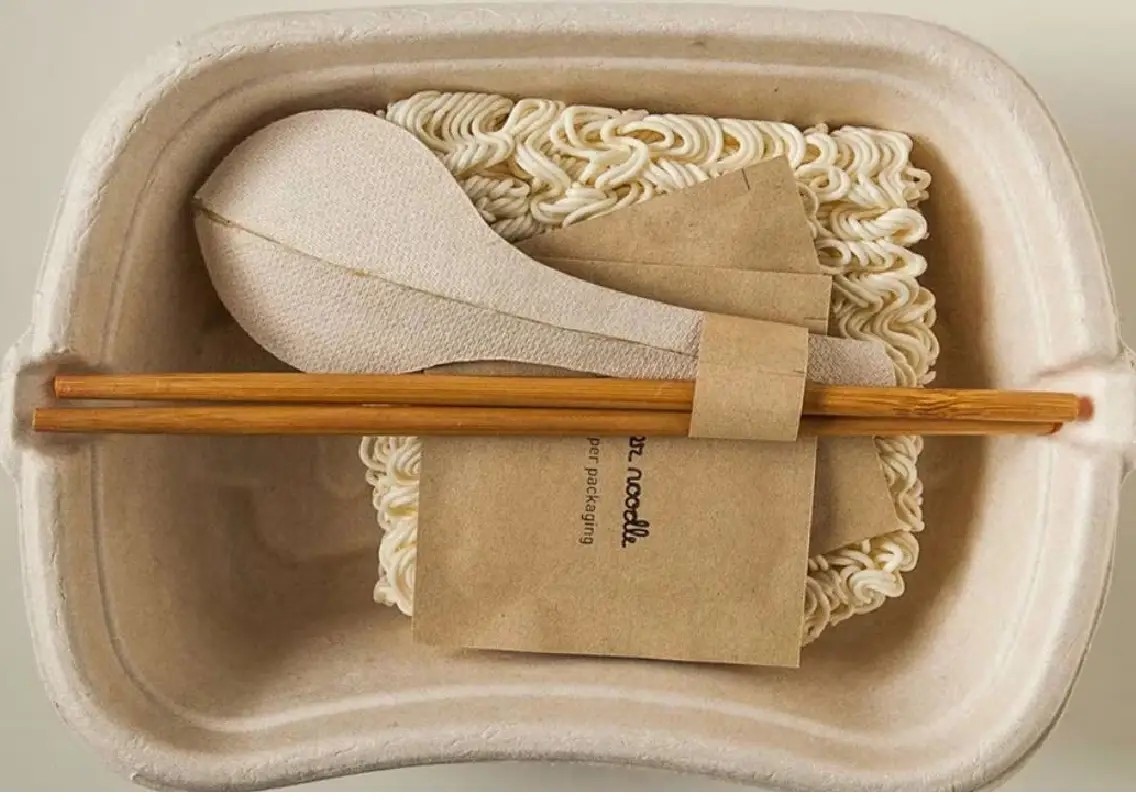


Researchers at Kagawa University in Japan have found an innovative way to reduce food waste by transforming discarded udon noodles into biodegradable paper-like sheets using microorganisms.
The project focuses on repurposing unsold and discarded Sanuki udon, a speciality of Kagawa Prefecture, into sustainable cellulose-based sheets that resemble traditional Japanese washi paper.
Turning food waste into useful products
The initiative was developed by Professor Naotaka Tanaka from the university’s Faculty of Agriculture. Drawing on years of research into microorganisms and cellulose-producing bacteria, Tanaka devised a process that converts unwanted noodles into durable eco-friendly material.
The production process begins by mixing discarded noodles with water. Enzymes are then added to break down the starch into glucose. Acetic acid bacteria cultivated in the mixture gradually form a cellulose membrane, which is later dried to create paper-like sheets.
Researchers say a single serving of udon can produce between five and ten A4-sized sheets.
Strong, biodegradable and sustainable
According to the team, the resulting material is more resistant to water and tearing than ordinary paper. It also naturally decomposes in soil through microbial activity, making it environmentally friendly.
Professor Tanaka said the idea emerged from a desire to address the large quantity of noodles discarded in the region while creating practical solutions for local communities.
Supporting local communities
The university shared the technology with a local social welfare organisation, which now produces around 100 sheets each month. The collaboration has created a circular economy involving restaurants, researchers and welfare workers.
Partner restaurants provide noodles that would otherwise be thrown away, while the university helps businesses monitor food waste levels and improve demand forecasting.
The biodegradable sheets are already being used for artwork and promotional materials. Researchers are also exploring future applications, including environmentally friendly fishing bait and other products that naturally break down after disposal.
Professor Tanaka hopes the initiative can become a model for reducing food waste and promoting sustainable innovation in communities around the world.