







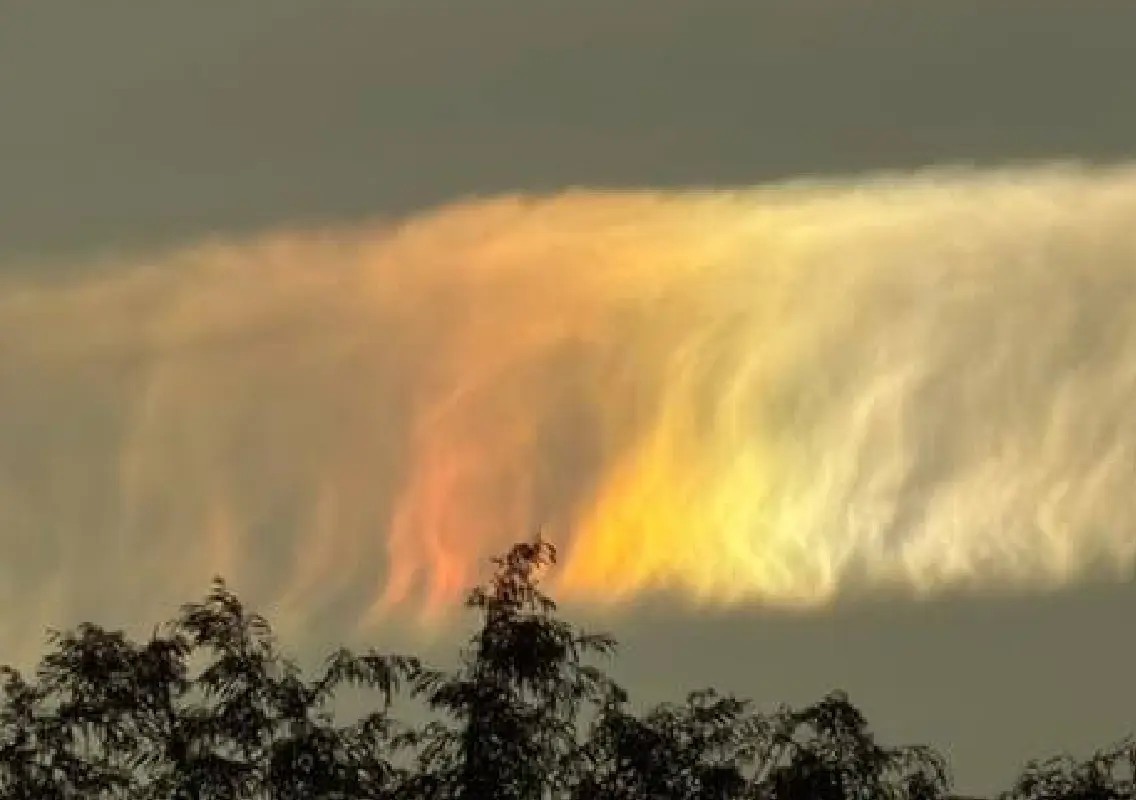


Melbourne : Parts of Victoria were treated to a striking natural display when iridescent clouds appeared in the sky, producing shimmering rainbow-like colours that caught the attention of residents and photographers. The atmospheric phenomenon, while not particularly unusual in Australia, is rarely captured so clearly on camera.
The colourful clouds were observed in several parts of the state, turning ordinary cloud formations into vibrant displays of pastel and rainbow shades.
The phenomenon is known as cloud iridescence and occurs when sunlight interacts with tiny water droplets or ice crystals within a cloud. The light is diffracted as it passes around the small particles, producing colours that can resemble those of a rainbow.
A rainbow effect in the clouds
Unlike a conventional rainbow, which forms when sunlight is refracted, reflected and dispersed by raindrops, cloud iridescence is primarily caused by diffraction.
The process can produce delicate bands of colour across portions of a cloud. Depending on the conditions, observers may see shades of pink, green, blue, yellow and violet blending together.
The colours are often soft and appear to glow against the surrounding sky. They can also change quickly as the position of the Sun or the structure of the cloud changes.
The effect is therefore both temporary and highly dependent on atmospheric conditions.
Why the colours appear
Clouds are made up of countless tiny water droplets or ice particles. When these particles are sufficiently small and relatively uniform in size, sunlight passing around them can interfere in ways that separate the light into different colours.
This process is called diffraction.
The resulting colours can resemble an oil slick or the shimmering surface of a soap bubble, although the physical processes involved are different.
Iridescence is generally most visible when the Sun is relatively close to the cloud from the observer’s perspective and when the cloud contains appropriately sized particles.
Because the conditions need to be favourable, a colourful cloud display may disappear within minutes.
Australia often sees the phenomenon
Cloud iridescence is not considered an exceptionally rare phenomenon in Australia. However, it is much less common for the effect to be photographed at its most vivid.
The fleeting nature of the display means that many people may notice unusual colours in a cloud without having enough time to capture them clearly.
The latest sightings in Victoria provided photographers and residents with an opportunity to document the phenomenon as it unfolded.
The photographs also offered a reminder that atmospheric optics can produce spectacular effects without the presence of severe weather or an approaching storm.
Different from a rainbow
Although iridescent clouds are sometimes described as “rainbow clouds”, they are not the same as traditional rainbows.
A rainbow is normally seen when an observer has the Sun behind them and water droplets in front of them. Sunlight enters the droplets, is refracted and reflected inside them, and emerges separated into its component colours.
Cloud iridescence, by contrast, results from diffraction around tiny particles within the cloud.
The difference explains why the colourful patterns can appear directly within or around a cloud rather than forming the familiar curved arc associated with a rainbow.
The role of cloud structure
The structure and composition of a cloud play an important role in determining whether iridescence becomes visible.
Clouds containing very small particles that are relatively similar in size provide particularly favourable conditions for diffraction.
The colours can appear strongest in thinner parts of a cloud, where sunlight can interact with the particles in a suitable way.
As the particles change size, move within the cloud or become more widely distributed, the colours can fade.
This helps explain why cloud iridescence can seem to appear suddenly and disappear just as quickly.
A fleeting spectacle for observers
For people watching the Victoria skies, the event was an example of how ordinary atmospheric conditions can occasionally produce extraordinary visual effects.
The colours may be subtle when viewed from a distance, but under the right conditions they can become remarkably vivid.
Photographs can also enhance the appearance of the colours, particularly when cameras capture details that are difficult for the human eye to distinguish against a bright sky.
The latest images have helped bring attention to a phenomenon that can otherwise pass unnoticed.
Atmospheric optics fascinate scientists and skywatchers
Iridescent clouds belong to a broader family of atmospheric optical phenomena that includes halos, sun dogs, glories and coronas.
These effects occur when sunlight interacts with water droplets, ice crystals or other particles in the atmosphere.
They provide useful demonstrations of fundamental optical principles while also creating some of the most striking sights in the sky.
For scientists, such displays can help illustrate how light behaves when it encounters particles of different sizes and structures.
For the public, they offer an opportunity to appreciate the complexity of the atmosphere.
Colours can change rapidly
One of the most fascinating features of cloud iridescence is its constantly changing appearance.
As the Sun moves, the observer changes position or the cloud evolves, the colours and their intensity can shift.
A cloud that appears predominantly pink from one location may show green or blue hues moments later.
The phenomenon can therefore be difficult to predict and photograph.
This fleeting quality is also part of what makes particularly vivid photographs of iridescent clouds noteworthy.
Nature’s colourful display
The appearance of rainbow-like clouds over Victoria provided a spectacular reminder that the atmosphere can produce extraordinary sights without warning.
Cloud iridescence may not be as widely recognised as a conventional rainbow, but its delicate colours can be equally captivating.
The phenomenon occurs through a combination of sunlight, cloud particles and the physics of diffraction, transforming an otherwise ordinary cloud into a shimmering display.
While such clouds may appear again under suitable conditions, each display is temporary and unique.
For those who happened to look towards the Victorian skies at the right moment, the result was a rare opportunity to witness — and photograph — one of nature’s most beautiful optical effects.