







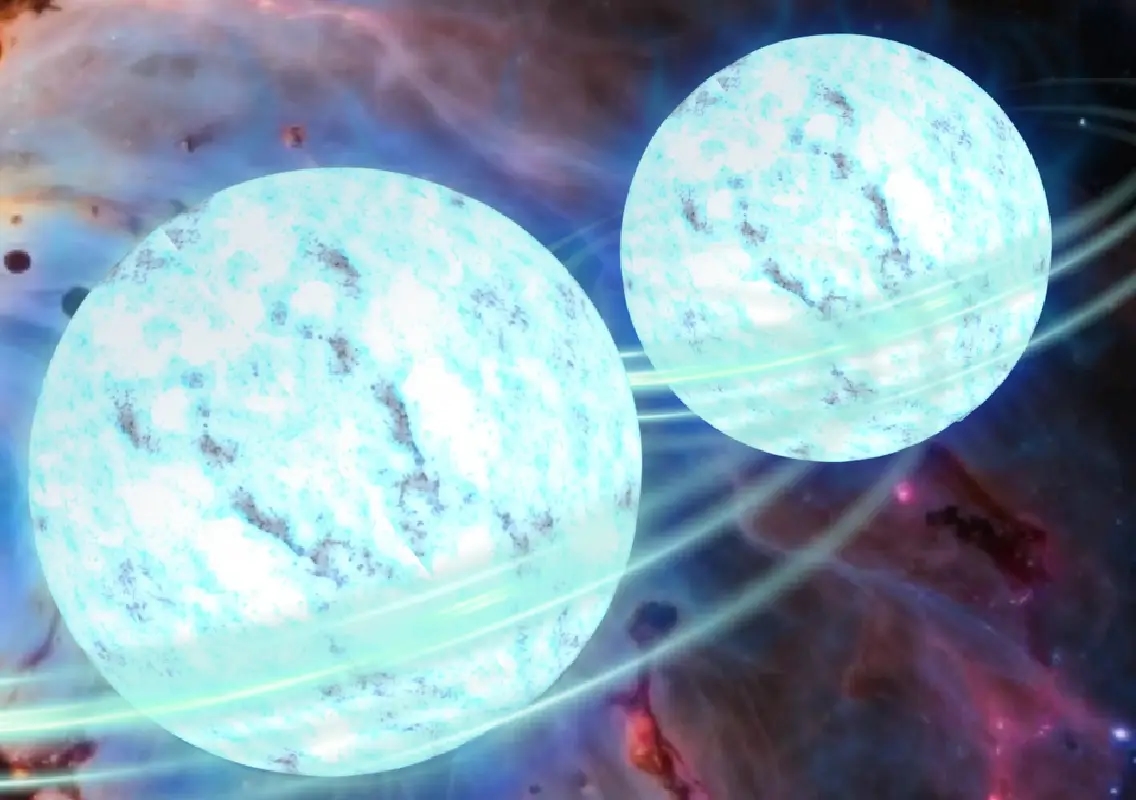


A new simulation using a NASA supercomputer has revealed that neutron stars begin interacting violently even before they collide, as their powerful magnetic fields entangle and generate extreme electromagnetic chaos.
Neutron stars are among the most extreme objects in the universe, formed when massive stars explode in supernovae. Despite being only about 20 kilometres wide, they can pack more mass than the Sun, making them unimaginably dense. Their magnetic fields are the strongest known, trillions of times more powerful than Earth’s.
Magnetic mayhem before the merger
Using NASA’s Pleiades supercomputer, researchers simulated the final 7.7 milliseconds before two neutron stars merge. The study, led by scientists at NASA Goddard Space Flight Center, focused on how the stars’ magnetospheres interact during their final orbits.
The simulations showed that the magnetic fields behave like a constantly rewiring circuit — field lines connect, snap apart and reconnect repeatedly, while charged particles surge through plasma at near light speed. This violent process produces rapidly fluctuating electromagnetic signals.
Why this matters for astronomy
Neutron star mergers are already known to generate gravitational waves, gamma-ray bursts and kilonovae — cosmic explosions that forge heavy elements like gold and platinum. Until now, most studies focused on what happens after the collision.
This research highlights that important signals may be emitted before impact. Scientists found that while extremely high-energy gamma rays are trapped near the stars, lower-energy gamma rays and X-rays could escape and be detected by future telescopes.
“These signals vary greatly depending on viewing angle and magnetic alignment,” researchers said, meaning an observer’s position in space strongly affects what is seen.
Looking to future observatories
The findings could help guide next-generation observatories, including the space-based gravitational wave mission Laser Interferometer Space Antenna (LISA), planned for launch in the 2030s. Together with ground-based detectors like LIGO, astronomers may soon detect neutron star mergers before they happen.
The study was published in The Astrophysical Journal in November 2025.