


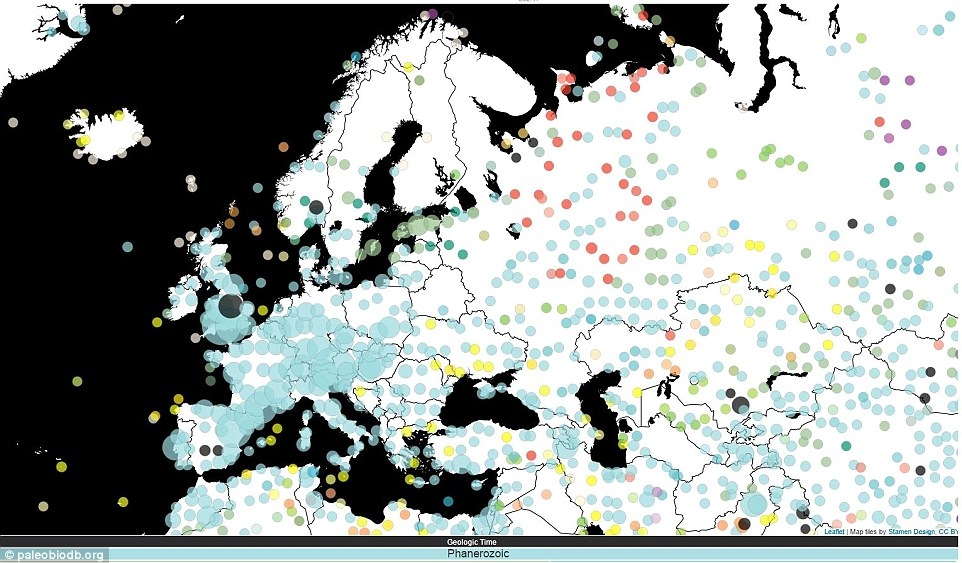


Munich/Vienna: Scientists have developed a global map identifying regions where fossils of previously undiscovered prehistoric species could still be found. Based on an analysis of 540 million years of marine fossil records, the research aims to help paleontologists identify overlooked areas and focus future fossil searches on locations with the potential to reveal new information about ancient life.
The study was conducted by paleontologists Thomas A Neubauer of the Bavarian State Collections of Natural History in Germany and Mathias Harzhauser of the Natural History Museum in Vienna. Their research examines where fossils of ancient marine animals have already been discovered and highlights geographical areas where significant gaps remain in the fossil record.
The findings challenge the assumption that the oldest geological deposits necessarily offer the best opportunities for discovering unknown prehistoric species. Instead, the researchers suggest that comparatively younger rocks from the Cenozoic Era could provide promising opportunities for new discoveries.
The map is intended to serve as a guide for future research rather than a guarantee that new species will be found at the identified locations.
Mapping 540 million years of marine life
Fossils provide scientists with important evidence about organisms that lived millions of years ago. They help researchers understand how ancient animals evolved, how ecosystems changed and how life responded to major environmental transformations throughout Earth’s history.
However, the fossil record is incomplete. Only a fraction of organisms that existed in prehistoric times were preserved under conditions suitable for fossilisation. Of those preserved, many have yet to be discovered or scientifically documented.
This creates significant gaps in scientists’ understanding of ancient biodiversity. While certain regions have been extensively explored and have produced large numbers of fossils, other parts of the world remain comparatively under-researched.
To identify areas that could offer opportunities for further discoveries, Neubauer and Harzhauser examined fossil records of animals that inhabited shallow marine environments over the past 540 million years.
Their analysis focused on understanding the geographical distribution of known marine fossils and identifying locations where the available evidence remains limited.
By combining information about existing discoveries with geological data, the researchers developed a picture of where future fossil exploration could be particularly useful.
Paleobiology Database helps identify fossil gaps
An important resource for the research was the Paleobiology Database, which brings together published fossil records from different parts of the world.
The database allowed the researchers to examine where marine fossils had previously been reported and compare those discoveries with the distribution of geological formations.
The scientists mapped known fossil locations and identified geographical areas where evidence of ancient marine life was missing or limited. They also examined geological information to determine whether potentially fossil-bearing rocks were exposed and accessible for study today.
This distinction is important because an area with few recorded fossil discoveries may not necessarily have a poor fossil record. It could simply be a region that has received less scientific attention.
Similarly, the presence of suitable geological deposits does not automatically mean that undiscovered fossils will be found there. Researchers still need to examine the rocks, carry out fieldwork and assess any specimens recovered.
The resulting map therefore combines existing fossil knowledge with geological information to help scientists decide where additional research may be worthwhile.
Younger rocks could offer better opportunities
One of the notable findings challenges the idea that scientists should concentrate primarily on the oldest geological deposits when searching for undiscovered prehistoric animals.
The Paleozoic and Mesozoic eras span hundreds of millions of years and include some of the most significant periods in the history of life on Earth. The Mesozoic, in particular, is widely associated with the age of dinosaurs and has produced many important fossil discoveries.
However, the researchers found that several shallow marine deposits from these older geological periods have already been investigated extensively.
As a result, some of the most promising opportunities for identifying previously undocumented species may lie in comparatively younger deposits.
The study highlights the potential of the Cenozoic Era, which began approximately 66 million years ago and continues to the present day. Although younger than the geological periods associated with many famous prehistoric animals, Cenozoic marine deposits may contain important gaps in the fossil record.
This suggests that scientists do not necessarily need to focus exclusively on the oldest rocks to uncover new information about prehistoric biodiversity.
Relatively recent geological deposits could also contain fossils of species that have not yet been identified or adequately studied.
Why the fossil record remains incomplete
The fossil record is shaped by several factors, including the conditions under which organisms lived and died, the availability of suitable environments for preservation and the extent of subsequent geological changes.
Not every organism becomes a fossil. Even when preservation occurs, geological processes can alter or destroy the remains over millions of years.
Scientific exploration also plays an important role in determining what becomes part of the documented fossil record. Regions that have been studied extensively tend to have more recorded discoveries, while areas with limited research may contain evidence that has not yet been collected or examined.
The researchers’ approach takes these differences into account by distinguishing between places with established fossil discoveries and areas where further investigation could improve scientific understanding.
This could help paleontologists avoid concentrating too heavily on locations that have already been explored in detail.
Museum collections could reveal overlooked discoveries
The research may also have implications beyond new fossil excavation projects. Existing museum collections could contain specimens that have not received detailed scientific examination.
Museums around the world preserve fossils collected during earlier expeditions and research projects. Some specimens may have remained in storage for years without being studied using newer scientific methods or being compared with more recent discoveries.
Re-examining these collections could help researchers identify previously overlooked information and improve the understanding of ancient species.
The global map could therefore help scientists decide which collections and geographical regions deserve greater attention. Instead of relying only on new field expeditions, researchers may be able to make progress by revisiting material that has already been collected.
Neubauer emphasised the importance of exploring less-studied regions, pointing out that many parts of the world still offer opportunities for significant discoveries.
He also indicated that expanding the fossil record is a gradual process and that directing research towards promising locations could make the effort more systematic.
A guide for future fossil research
The scientists hope their findings will help guide future paleontological projects and excavation work. By identifying geographical gaps and examining the availability of suitable rock deposits, the map could help researchers prioritise locations for further investigation.
It may also support decisions about which existing museum collections should be examined first.
The study does not establish that every highlighted region contains undiscovered species, nor does it guarantee that future excavations will produce new fossils. Instead, it offers a research framework for identifying places where additional exploration could provide valuable evidence.
By combining hundreds of millions of years of marine fossil records with geographical and geological information, the researchers have created a tool that could help scientists investigate the missing chapters of Earth’s prehistoric history.
The findings underline that important discoveries may not always come from the most famous fossil sites or the oldest rocks. Some of the answers to questions about ancient life could still be waiting in comparatively younger deposits and regions that have received little scientific attention.