







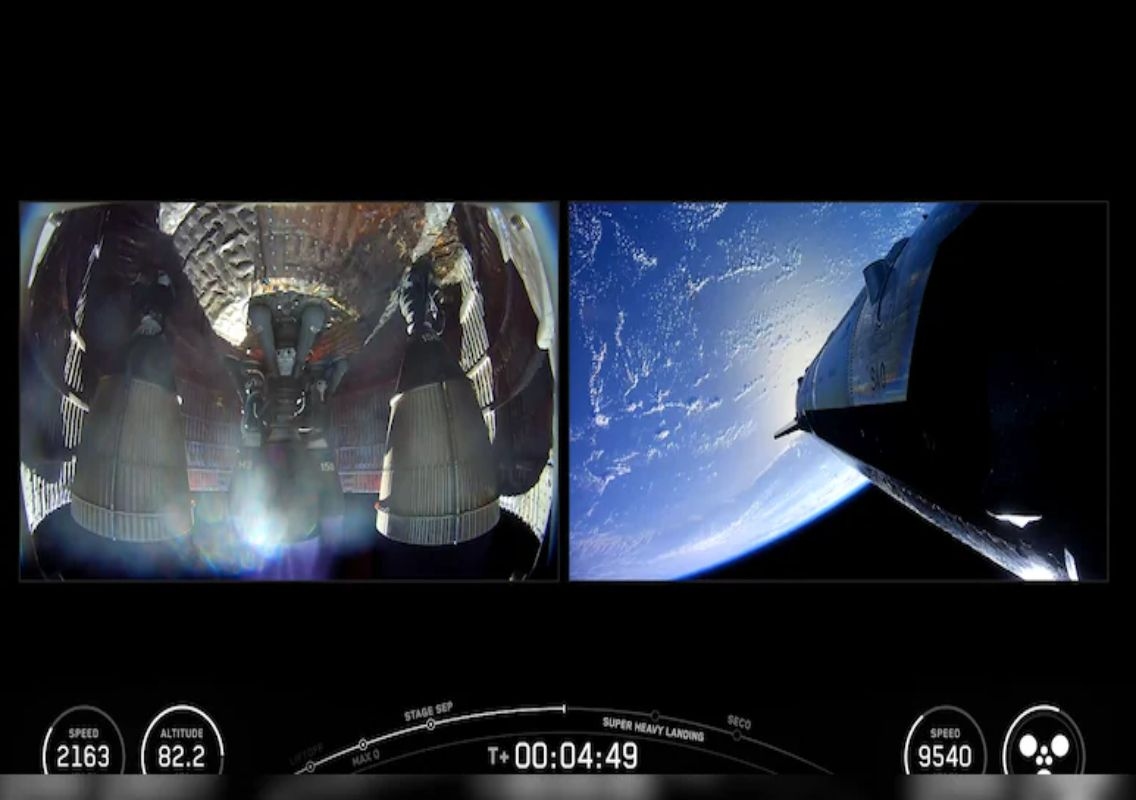


SpaceX has successfully completed its first Starship test flight since its IPO, marking a significant milestone in Elon Musk’s long-term plans to dominate space transportation, satellite communications, and even artificial intelligence infrastructure.
The mission achieved most of its primary objectives, including deploying upgraded Starlink satellites and executing a controlled splashdown, despite minor technical glitches.
🚀 Launch and flight highlights
Starship lifted off from SpaceX’s Starbase facility in South Texas at 5:51 p.m. local time, mounted atop its powerful Super Heavy booster.
Key milestones:
- Successful liftoff and stage separation
- Deployment of 20 upgraded Starlink satellites
- Satellites successfully connected and transmitted data
- Controlled atmospheric reentry
- Splashdown in the Indian Ocean
The mission marked a clear improvement over previous tests, which saw loss of control and engine failures.
⚠️ Minor glitch, but overall success
While the mission was largely successful, there was a hiccup during the booster’s return phase.
- The Super Heavy booster failed to relight all engines
- Resulted in a faster-than-expected splashdown in the Gulf of Mexico
Despite this, the outcome was still considered a major technical improvement compared to earlier attempts.
SpaceX also skipped its ambitious midair booster “catch” maneuver—previously demonstrated in 2024—which is key to rapid reusability.
🌊 “Softest splashdown yet”
After completing its objectives in space, Starship reentered Earth’s atmosphere and performed a controlled descent, ending in a splashdown in the Indian Ocean.
According to SpaceX’s communications team, it was:
“The softest splashdown we have ever had.”
Shortly after landing, the vehicle ignited, which is expected in such test scenarios and part of the iterative “fly-fail-fix” development model.
📡 Why Starship matters
Starship is central to SpaceX’s future ambitions:
- Scaling the Starlink satellite network globally
- Supporting lunar missions under NASA contracts
- Enabling human missions to the Moon and Mars
- Potentially hosting data centers in space
SpaceX has already invested over $15 billion into Starship’s development, underscoring its importance.
💼 Investor pressure after IPO
Despite the technical progress, investor sentiment has been volatile.
- Shares dropped 3% on Friday
- Down about 25% over the past month
- Trading below the $135 IPO price
The fluctuations reflect concerns over delays and the inherent risks of SpaceX’s aggressive “fly, fail, fix” approach to innovation.
🌕 NASA missions and future challenges
SpaceX holds nearly $4 billion in contracts with NASA to use Starship for lunar landings as early as 2028.
However, major hurdles remain:
- In-orbit refueling technology
- Multiple consecutive successful launches
- Human safety certification
- Completing a full orbital mission
These challenges highlight the gap between successful tests and operational readiness.
🔮 What’s next?
Elon Musk has stated that Starship could become fully reusable—like a commercial airplane—within a year, a breakthrough that would dramatically reduce the cost of space travel.
SpaceX has already begun shifting focus away from its Falcon rockets for future satellite launches beyond 2028, signaling strong confidence in Starship’s eventual success.
Conclusion
The latest Starship test marks a crucial step forward for SpaceX. While not flawless, the mission demonstrated meaningful progress in reliability, satellite deployment, and controlled reentry.
As SpaceX pushes toward fully reusable rockets and interplanetary missions, each test brings it closer to transforming space travel—and potentially reshaping industries far beyond Earth.