







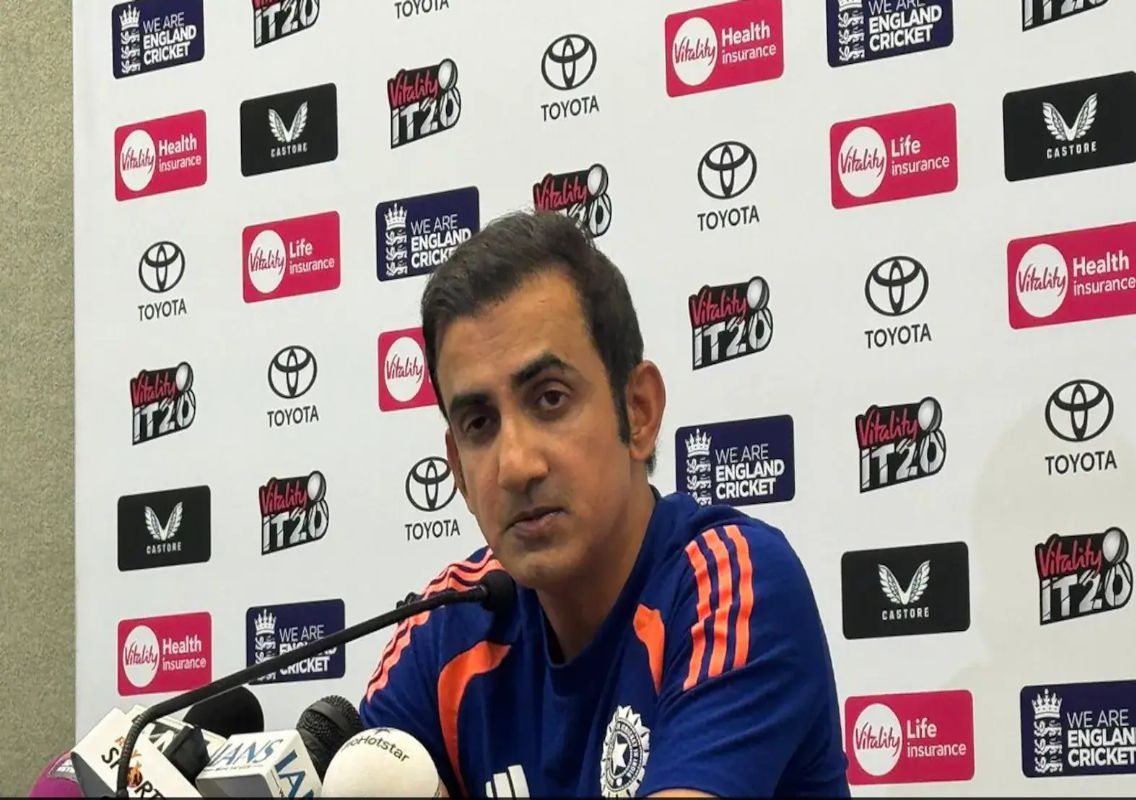


Nottingham: India head coach Gautam Gambhir has addressed the growing controversy surrounding Sanju Samson’s exclusion from the playing XI, stating that the decision was based on team combination and current form rather than any long-term judgement. His remarks came after India’s crushing 125-run defeat to England in the third T20I, which intensified scrutiny over team selections and strategy.
India’s batting collapse while chasing 202 — getting bowled out for just 76 — marked one of their worst performances in T20 internationals. In the aftermath, questions were raised about the decision to bench Samson, one of India’s key performers in their T20 World Cup 2026 triumph, in favour of 15-year-old Vaibhav Sooryavanshi.
Clarity given, but details remain private
Speaking at the post-match press conference, Gambhir emphasised that there was complete clarity between him and Samson regarding the decision. However, he made it clear that the specifics of their discussion would remain confidential.
“The first thing is that regarding the clarity Sanju Samson needed, he has been given that from my side. That’s a conversation strictly between the player and the head coach. That conversation is not going to come outside,” Gambhir said.
He reiterated that Samson’s contributions to Indian cricket have been significant and assured that the door remains open for his return. “What he has done for India has been phenomenal, and sometimes you just have to look at the form of a certain player. There is no hard and fast rule that he cannot make a comeback in this series,” he added.
Selection based on team combination
Gambhir defended the inclusion of Vaibhav Sooryavanshi, stating that the decision was driven by the management’s belief in a specific opening combination alongside Abhishek Sharma. According to him, international cricket demands a results-oriented approach where team balance takes precedence over individual reputations.
“International cricket is about results. Whatever we feel is the best combination to give us that result, we play that combination and that playing XI,” he explained. He also stressed that every player must consistently earn their place in the team.
The move to include Sooryavanshi reflects the team management’s focus on youth and experimentation, especially in a format like T20 where adaptability and aggressive intent are key. However, the young batter has yet to make a major impact, adding to the ongoing debate.
Team struggles extend beyond selection
While much of the criticism has centred on Samson’s omission, Gambhir pointed out that the team’s struggles cannot be attributed to a single decision or player. India have endured a difficult run, including a series defeat to Ireland and a poor showing against England, losing four matches in succession.
“Regarding adaptability, obviously we haven’t adapted well. That’s the reality, be it Ireland or England. If we had adapted well or played better cricket, we probably would not have lost four games in a row,” Gambhir admitted.
The coach acknowledged that the entire squad has underperformed, highlighting issues with both batting execution and adapting to conditions in the United Kingdom.
Balancing form and experience
The situation has reignited discussions about balancing experience with emerging talent in India’s T20 setup. While Samson’s recent form may not have been consistent, his experience and past performances make him a valuable asset. On the other hand, Sooryavanshi represents the future, with his fearless approach and potential making him an exciting prospect.
Experts believe that such decisions must strike a balance between immediate results and long-term planning. The challenge for the team management lies in ensuring that experimentation does not come at the cost of stability.
Conclusion
Gautam Gambhir’s explanation has provided some insight into the reasoning behind Sanju Samson’s exclusion, but it has done little to quell the debate among fans and former players. As India look to recover from a string of poor performances, the focus will be on whether the chosen combinations deliver results. Ultimately, consistent performances and clear communication will be key to restoring confidence and stability within the team.