







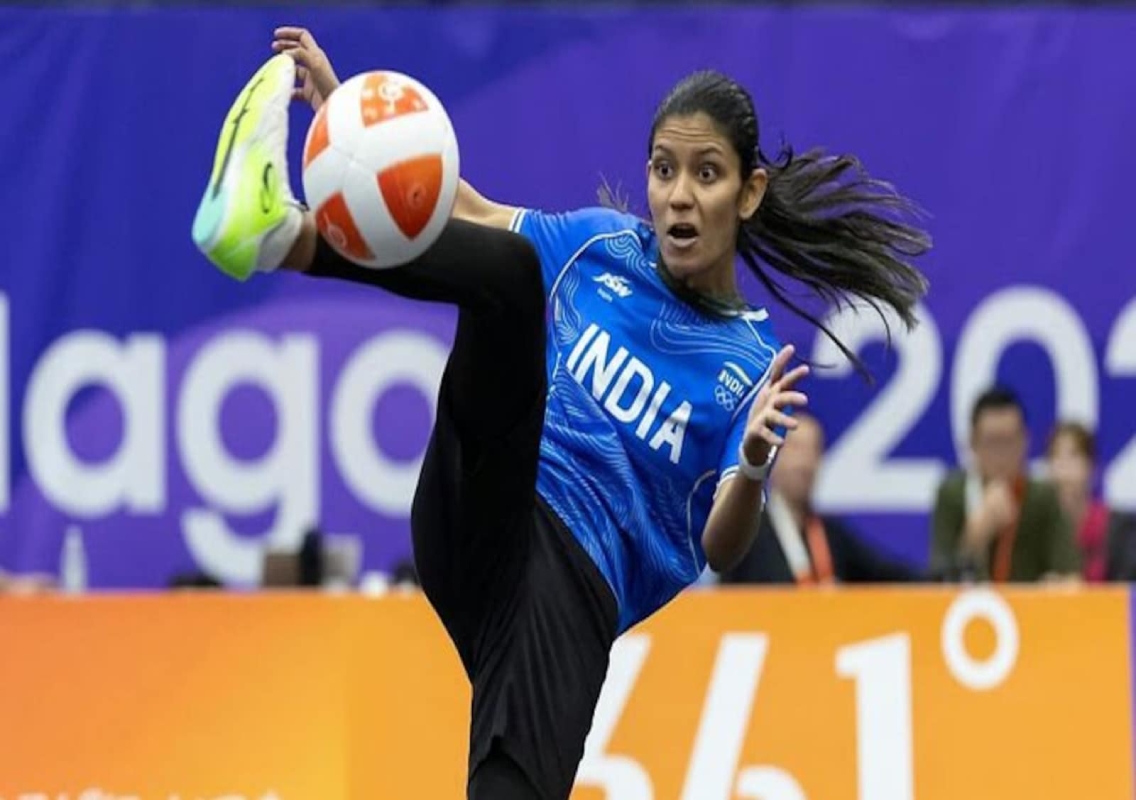


Nagoya: India’s Quimcy Dsouza endured a heartbreaking end to her Asian Games 2026 campaign on Sunday as she narrowly missed out on a women’s singles bronze medal before suffering another defeat in the mixed doubles bronze-medal match minutes later.
The 24-year-old Mumbai player pushed Japan’s world No. 7 Yuina Sakamoto to the limit in the women’s singles bronze-medal contest at the Nagoya City Higashi Sports Center. However, she went down 0-2, with both sets decided by the narrowest possible margin at 11-12 and 11-12.
There was little between the two players throughout the contest. Dsouza had a set point in the opening game and also moved to a 10-8 lead in the second, putting herself in a strong position to force a deciding set. She even saved a match point before a foul handed Sakamoto the victory.
The defeat was particularly difficult for Dsouza because there was almost no recovery time before she had to return to the court for the mixed doubles bronze-medal match.
Dsouza falls short by a point in singles
The singles bronze-medal match highlighted just how close Dsouza came to securing a historic podium finish for India in teqball.
Sakamoto, playing in front of a home crowd, won both sets 12-11. The scoreline, however, did not fully reflect the competitiveness of the contest, with Dsouza remaining within touching distance throughout.
The Indian had opportunities to change the outcome. She held a set point in the opening game and then established an 10-8 advantage in the second. After saving a match point, Dsouza served a winner but subsequently committed a foul, allowing Sakamoto to close out the match.
The women’s singles event was played in a best-of-three format, with the first player to win two sets taking the match.
For Dsouza, the result brought an end to a campaign that had already created significant interest because teqball is making its Asian Games debut at the Aichi-Nagoya Games.
Little time to recover before mixed doubles
There was barely any time for Dsouza to recover from the physically demanding singles contest.
She returned to the court alongside Mohamed Anas Beg for India’s mixed doubles bronze-medal match against Vietnam’s Hoang Minh Tan Nguyen and Gia Ngih Trinh.
The Indian pair lost 0-2, with Vietnam taking the two sets 12-9 and 12-6. Dsouza’s physical condition became a major factor as the contest progressed.
The effects of playing two intense matches in little more than an hour began to show during the second set. With the Indian pair trailing 5-9, Dsouza appeared to be struggling with discomfort in her lower back.
She received treatment and took a 10-minute medical timeout before returning to the court with a strapped waist. However, she was unable to regain enough momentum to change the course of the match.
The Vietnamese pair eventually completed the victory 12-9, 12-6, leaving India without a medal in either teqball event involving Dsouza on the day.
India’s teqball campaign still makes an impression
Although the two defeats represented a difficult end to Dsouza’s campaign, India’s performance in teqball at the Asian Games has provided valuable exposure for a relatively new sport in the country.
Teqball combines elements of football and table tennis. Players compete around a specially curved table and use different parts of the body, apart from the hands and arms, to return a football over the net.
Each side can make a maximum of three touches before sending the ball back to the opponent. The sport requires a combination of ball control, balance, timing, flexibility and quick reactions.
The scoring system also adds to the intensity. The first player or pair to reach 12 points wins a set. In the first two sets, a one-point margin is enough, while a deciding third set requires a two-point advantage.
Teqball’s inclusion in the 2026 Asian Games is significant because this is the sport’s debut at the continental multi-sport event. Its appearance has given athletes from countries such as India an opportunity to compete on a major international stage.
Dsouza’s campaign ends with two near misses
Dsouza had entered the final day with the possibility of creating history for India. After reaching the women’s singles medal rounds, she was also in contention for a podium finish in mixed doubles.
Instead, two defeats came within a short span of one another.
The singles result was particularly close, with both sets decided by a single point. The mixed doubles defeat was more pronounced, but Dsouza’s physical condition became a significant factor after the exhausting singles battle.
Her performance nevertheless demonstrated India’s ability to compete with established teqball nations at the sport’s first Asian Games appearance.
Earlier in the tournament, Dsouza had reached the women’s singles semi-final, where she lost 1-2 to Indonesia’s Ima Sumaya. She won the opening set 12-7 before Sumaya fought back to take the next two sets 12-9 and 12-7.
That result had earned Dsouza a place in the bronze-medal match against Sakamoto.
A promising start for India’s teqball journey
India’s campaign may have ended without a medal, but the performances have given the country’s teqball movement an important platform.
The sport remains relatively new in India compared with established disciplines such as badminton, table tennis and football. Its debut at the Asian Games has nevertheless brought greater attention to the game and its athletes.
For Dsouza, the experience also represents an important milestone. She competed at her first Asian Games and came within a point of taking a singles set against one of the world’s leading players.
The final result will understandably be disappointing after two medal opportunities ended in defeat. Yet the narrow margins in the singles contest and the difficult circumstances surrounding the mixed doubles match underline how competitive India’s campaign was.
With teqball now having a place on the Asian Games programme, India’s participation in Nagoya could help create greater awareness and opportunities for the sport and its players in the years ahead.