







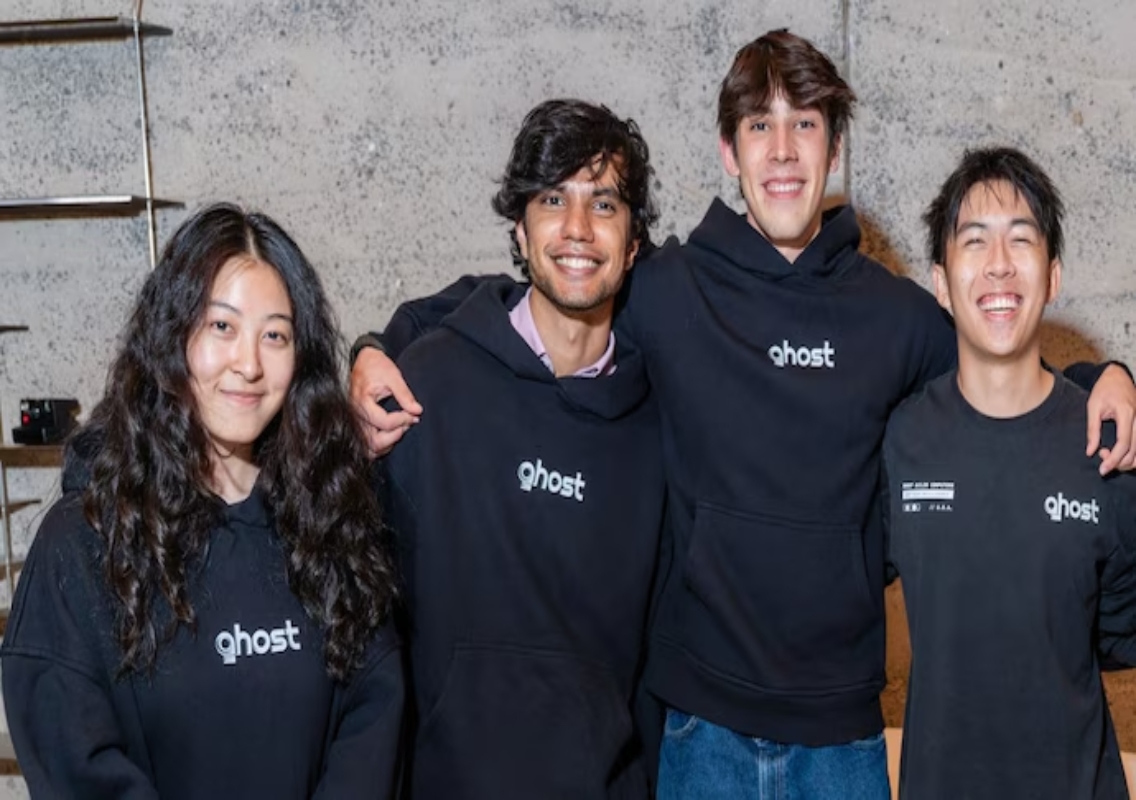


New Delhi: Silicon Valley’s artificial intelligence startup landscape is getting a fresh entrant in the form of Ghost, a San Francisco-based company founded by a remarkably young team led by 19-year-old Zain Javaid. The startup is developing Core, a $3,499 personal computer designed specifically to run AI agents continuously in the background.
Ghost has already raised $11 million as it works towards its vision of personal computing centred around AI agents rather than conventional applications. The company wants its AI systems to understand a user’s context, work across different apps and services, remember information and perform tasks on the user’s behalf.
The company’s approach is different from that of a conventional desktop computer. Instead of placing a screen and traditional applications at the centre of the experience, Ghost is building a device where artificial intelligence is expected to do much of the work in the background.
Who is Zain Javaid?
Javaid, who is 19, is the founder and CEO of Ghost. His route into artificial intelligence began with an interest in mathematics, data and quantitative finance rather than hardware or consumer technology.
He previously worked as a quant at Millennium, where he used mathematics and data to help guide investment decisions. However, Javaid eventually became interested in artificial intelligence after ChatGPT emerged in 2022.
That experience led him towards the idea of personal AI that could understand a person’s digital life and actually carry out tasks instead of simply responding to questions.
At Ghost, Javaid is responsible for the company’s broader vision. His work involves thinking about the hardware, operating system and AI layer required to build a computer around autonomous AI agents.
Ghost’s Gen-Z founding team
Javaid is joined by three other young co-founders, giving Ghost one of the younger founding teams in the emerging AI hardware space.
Gautam Sharda, 23, serves as a co-founder and technical lead. Before joining Ghost, he worked as a software engineer at Google, including on Cloud SDK build and release infrastructure and systems associated with Gemini Code Assist’s retrieval-augmented generation and evaluation.
Sharda had also previously co-founded a startup focused on AI agents for computer use. His discussions with Javaid around local AI models and consumer privacy eventually helped bring him into the Ghost project. He is now working across hardware and software, including AI-agent architecture and inference optimisation.
Yifei Chen, 24, is Ghost’s founding designer. She is responsible for the product experience, brand system and design-engineering foundation. Before Ghost, Chen worked as a designer at OKX and had experience with SCAD FLUX and the Savannah College of Art and Design.
Chen holds a master’s degree in User Experience Design from SCAD and a bachelor’s degree in Computer Science and Human-Computer Interaction from Carnegie Mellon University.
The fourth co-founder, Nicholas Chua, 19, focuses on growth. He studied Industrial Engineering and Operations Research at the University of California, Berkeley and previously worked in growth at Wispr Flow. He also spent time at TikTok, where he worked on governance agents.
Together, the founders are attempting to redefine the personal computer around AI rather than simply adding AI features to existing machines.
What is Ghost Core?
Ghost’s first product is called Core, a $3,499 personal computer designed specifically for running AI agents.
Unlike a conventional desktop computer, Core does not have a screen. Instead, the device is designed to keep AI agents running continuously, allowing them to understand a user’s data, perform tasks and act on the user’s behalf.
Ghost says Core is not simply an AI model running on an ordinary computer. The device has dedicated hardware, its own software layer, browser and file system, along with AI models that are already installed. Users can interact with the computer through a phone or application while Core handles the underlying AI processing.
One of the more notable aspects of the product is its focus on local processing. According to Ghost, its AI models, personal memory and user data can run locally rather than relying entirely on cloud services.
That approach could appeal to users who want more control over personal information while still using AI agents for everyday tasks.
A different idea of the personal computer
The concept behind Core reflects a broader shift in the technology industry towards AI agents that can perform actions rather than simply generate responses.
Traditional computers require users to open applications, enter information and manually complete individual steps. Ghost’s model is based on the idea that users should instead be able to tell an AI system what they want and allow agents to handle multiple steps in the background.
This could eventually change how people interact with software, particularly if AI agents become capable of securely navigating websites, managing files, communicating with services and completing routine digital tasks.
However, the concept also faces challenges. A personal computer that can access a user’s data and act on their behalf needs strong privacy, security and reliability safeguards. The success of such products will depend not only on AI capabilities but also on how confidently users can hand over tasks to autonomous systems.
Ghost’s $11 million funding and future plans
Ghost has emerged from stealth with an $11 million funding round as it works to bring Core to consumers. The company’s young founding team is now competing in a rapidly developing market where several technology companies are exploring AI-native hardware and personal agents.
Core’s $3,499 price places it firmly in the premium computing segment. Ghost is therefore betting that consumers will be willing to pay for a specialised machine whose primary purpose is not conventional computing but persistent personal AI.
The bigger ambition, however, appears to extend beyond a single device. Ghost wants to build personal AI that can understand context, retain useful information and complete tasks across digital services.
If that approach succeeds, the personal computer could gradually shift from being a tool that users operate to a system that actively works for them.
For now, Ghost remains an early-stage bet on that future. But with a 19-year-old CEO, a young founding team, $11 million in funding and a $3,499 AI computer already unveiled, the startup is positioning itself as one of the more unusual attempts to rethink what a personal computer could become in the age of AI.