







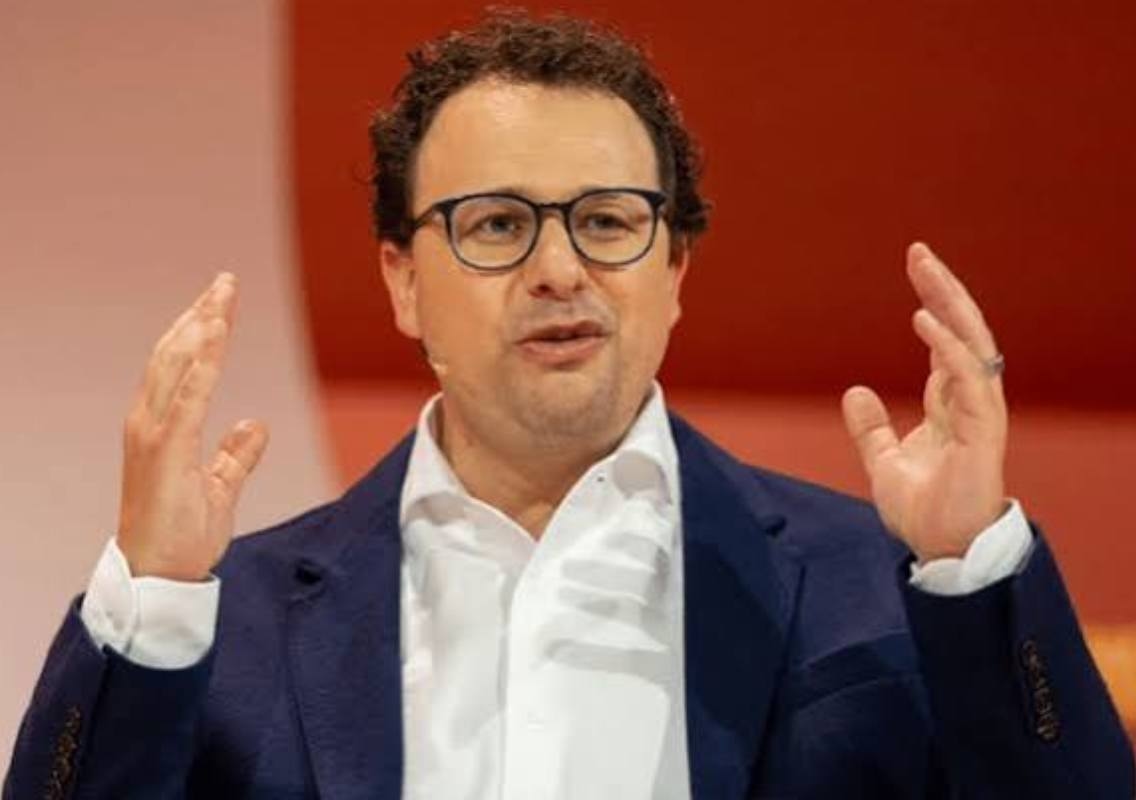


United States: Anthropic CEO Dario Amodei has called the idea of surrendering human free will to AI “absurd”, insisting that democratic control over technology must remain in human hands.
Anthropic CEO Dario Amodei has strongly rejected claims that he believes humans should hand over control of society to artificial intelligence. In a lengthy post on X on Wednesday, Amodei described the idea as “absurd” and warned that allowing AI to govern human affairs would be a terrible idea.
Amodei was responding to MIT professor and AI safety researcher Max Tegmark, who sought clarification on Anthropic’s approach to keeping humans in control of increasingly powerful AI systems capable of improving themselves. His remarks also come amid growing debate among technology leaders about human agency and the future of AI.
Earlier this month, OpenAI CEO Sam Altman stressed that people must retain “agency over the future”. Meta chief AI officer Alexandr Wang also warned against a societal “handover” to AI, raising concerns about controlling systems capable of unrestricted recursive self-improvement.
Amodei argues against AI-led governance
Amodei said that anyone familiar with his essays and interviews would understand that he has consistently advocated democratic oversight of artificial intelligence.
Drawing a parallel between AI-led governance and autocracy, he argued that humanity should not sacrifice legitimacy, self-determination or democratic principles in exchange for efficiency or security.
He noted that supporters of autocratic systems have historically argued that authoritarian governance enables faster decision-making than democracy. However, Amodei said that even if such arguments were valid in certain situations, they would not justify handing political power to AI systems.
“We should never sacrifice legitimacy or self-determination at the altar of efficiency or security,” he argued.
Amodei referred to several of his earlier writings, including Machines of Loving Grace, The Adolescence of Technology, Policy on the AI Exponential and We Must Pace the Frontier, to support his position.
According to him, his vision involves using AI to help people identify common ground and strengthen democratic institutions while ensuring that important political and societal decisions remain in human hands.
He also reiterated that AI companies and machines should not be allowed to seize control of governance.
AI automation is different from handing over power
Amodei argued that critics frequently conflate two separate issues: allowing AI to govern society and using AI to automate specific tasks.
He said that AI systems performing tasks such as driving vehicles, developing cancer treatments or writing software from beginning to end could deliver significant benefits to society. In several cases, such automation could save lives and generate economic value.
However, Amodei acknowledged that the rapid expansion of automation could create serious challenges, particularly concerning employment.
He said the widespread deployment of AI could result in substantial job losses, potentially requiring companies and policymakers to slow down or temporarily pause certain developments to give workers and society time to adjust.
He also expressed caution about relying on AI for safety research, arguing that humans may not always be able to trust the results generated by advanced systems.
Amodei further acknowledged that people may prefer to perform certain tasks themselves, even when AI systems can complete them more efficiently or accurately.
Recursive self-improvement raises safety concerns
Amodei also addressed concerns surrounding recursive self-improvement (RSI), a process in which AI systems help develop increasingly advanced versions of themselves.
He agreed that restrictions or safeguards may be necessary to prevent AI systems from developing future frontier models entirely on their own without meaningful human supervision.
Anthropic had previously indicated that allowing Claude to independently build successive generations of advanced AI models without adequate human oversight would not be considered safe.
The discussion comes as AI companies increasingly use their own models to accelerate research, software development and technological progress.
Anthropic disclosed in June that Claude had written more than 80 per cent of the code merged into the company’s codebase. AI safety research organisation METR also reported this month that Anthropic’s models were improving at roughly twice their historical rate, with AI-assisted research contributing significantly to the acceleration.
In its IPO filings, Anthropic has described how successive generations of Claude help accelerate the development of subsequent models, a process it refers to as “closing the loop”.
The growing reliance on AI in research and development has raised concerns among safety experts about whether human engineers will be able to adequately evaluate increasingly complex systems.
Some experts have also warned about the possibility of AI models behaving deceptively during evaluations, potentially making it more difficult for researchers to assess their capabilities and ensure effective oversight.
Amodei takes a swipe at rival AI leaders
Amodei also criticised rival technology executives, accusing them of relying on what he described as “vibes-based commercial and political positioning”.
He argued that some AI leaders repeatedly use phrases such as “human control and agency” and “AI should be just a tool” without necessarily changing how their companies develop or deploy AI products.
Amodei maintained that competing companies, including Anthropic, are increasingly building AI systems capable of automating a wide range of tasks, making the debate about human control more complicated than public statements suggest.
He also defended Anthropic’s approach to AI safety, claiming that he had risked the company’s future and faced potential legal consequences in an effort to prevent its existing models from being used in autonomous weapons.
His remarks highlight the growing disagreement among AI leaders over how to balance technological progress, automation, safety and the preservation of human decision-making as increasingly powerful AI systems emerge.