




Stockholm: Belgian-born physicist Francis Halzen has won the 2026 Nobel Prize in Physics for his decisive contributions to the IceCube Neutrino Observatory and the discovery of high-energy neutrinos of astrophysical origin.
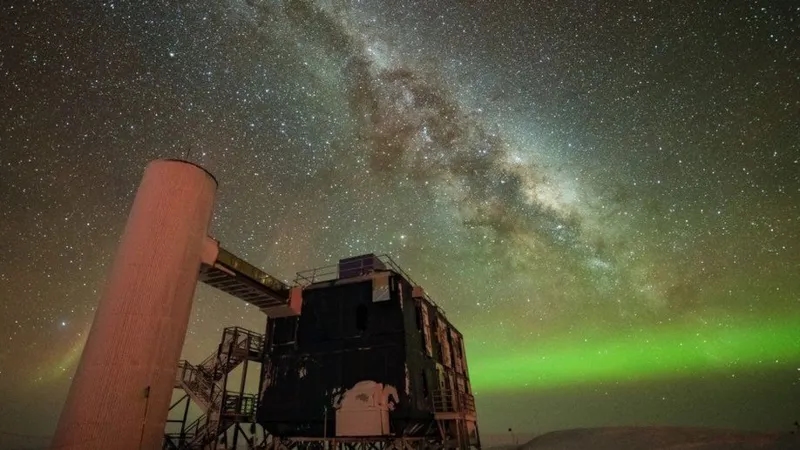
Halzen, a professor at the University of Wisconsin–Madison, pioneered the idea of using the vast Antarctic ice sheet as a detector for elusive subatomic particles known as neutrinos. His vision eventually became IceCube, a giant observatory buried deep beneath the ice at the geographic South Pole.
The Royal Swedish Academy of Sciences recognised Halzen for turning an ambitious idea first proposed in 1988 into an instrument capable of detecting high-energy neutrinos arriving from the distant Universe.
Neutrinos are sometimes described as “ghost particles” because they interact so weakly with matter that enormous numbers can pass through the Earth and human bodies without leaving any detectable trace. Their elusive nature, however, is precisely what makes them valuable to astronomers.
Unlike light, neutrinos can travel through dense regions of space without being easily absorbed or deflected. Their arrival can therefore provide scientists with information about violent cosmic environments that conventional telescopes cannot fully observe.
Halzen’s Antarctic vision
Halzen first proposed using Antarctic ice to detect high-energy neutrinos in 1988.
The idea was ambitious because neutrino interactions are exceptionally rare. To capture enough of them, scientists needed an enormous detection volume. Instead of constructing a conventional telescope, Halzen proposed turning a natural resource — the exceptionally clear ice beneath the South Pole — into a giant particle detector.
The IceCube project eventually instrumented about a cubic kilometre of Antarctic ice with thousands of optical sensors. The observatory was completed in 2011 and has since become a major facility for studying high-energy neutrinos.
Halzen said he was surprised by how well the original idea ultimately worked.
“I have to emphasise how lucky I was,” he said, recalling the early days of the project. He said that while scientists recognised that using ice might be a good idea, very few initially believed it would work as effectively as it eventually did.
The Nobel recognition therefore comes after decades of scientific development, engineering challenges and international collaboration.
What are neutrinos?
Neutrinos are electrically neutral elementary particles with extremely small masses.
They are produced in enormous numbers by processes including nuclear reactions in stars and some of the most energetic events in the Universe.
The Sun, for example, constantly produces neutrinos. Billions of these particles can pass through an area as small as a fingernail every second.
Most travel through matter without interacting with it.
That property makes neutrinos extremely difficult to detect, but it also gives them an important scientific advantage. Because they rarely interact with matter, they can travel enormous distances while retaining information about the environments in which they were produced.
High-energy neutrinos originating outside the Solar System are particularly valuable because they can act as messengers from extreme astrophysical environments.
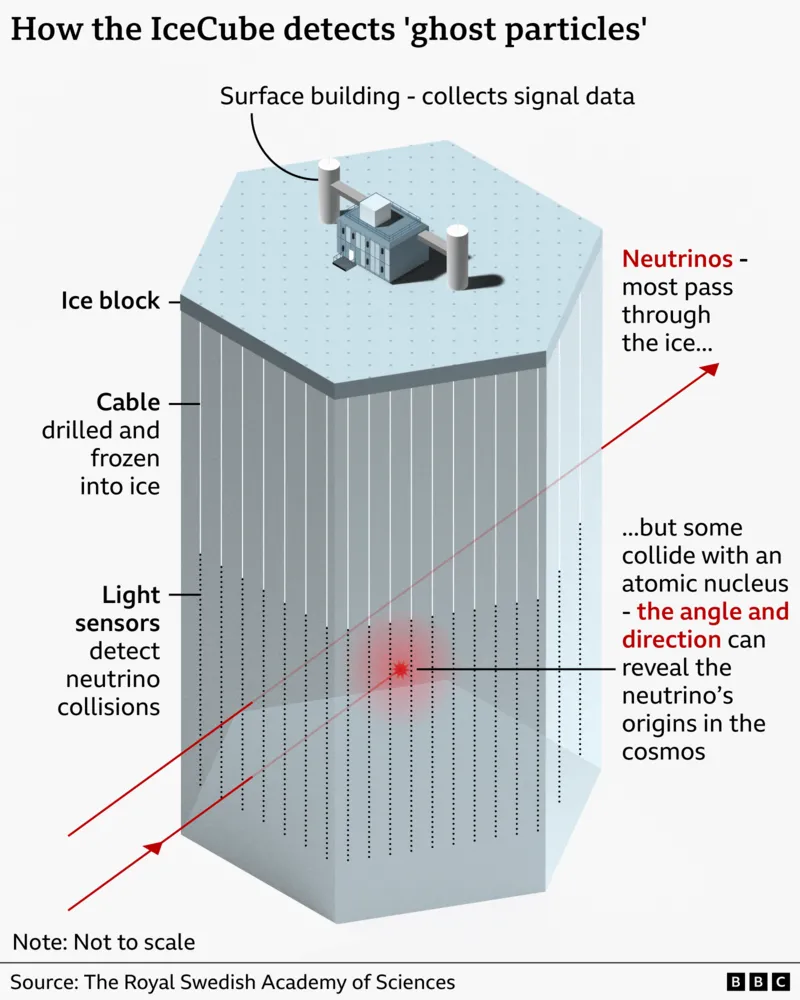
How IceCube detects ‘ghost particles’
IceCube does not observe neutrinos in the same way that an optical telescope observes stars.
Instead, the observatory looks for the extremely rare occasions when a neutrino interacts with matter inside the Antarctic ice.
When a high-energy neutrino strikes an atomic nucleus, it can produce fast-moving charged particles. As those particles travel through the ice, they generate a faint blue flash known as Cherenkov light.
IceCube contains thousands of sensitive optical sensors embedded deep in the ice to detect these flashes.
The timing and pattern of the light allow researchers to reconstruct the direction and energy of the original neutrino. Scientists can then use that information to investigate where the particle came from and what kind of cosmic event produced it.
IceCube contains 5,160 optical sensors distributed through its instrumented volume, making it the world’s largest neutrino detector.
The enormous size of the detector is essential because neutrino interactions are so uncommon. A smaller instrument would simply miss most of the particles passing through it.
Why neutrinos open a new window on space
Astronomy has traditionally relied heavily on electromagnetic radiation, including visible light, radio waves, X-rays and gamma rays.
Neutrino astronomy provides a different way of studying the Universe.
Because neutrinos carry no electric charge, magnetic fields do not bend their paths. Their trajectories can therefore point researchers back towards the regions where they were produced.
Their weak interaction with matter also allows them to escape environments that may be opaque to light.
This makes neutrinos particularly useful for studying extreme cosmic accelerators, including active galaxies and the regions surrounding massive black holes.
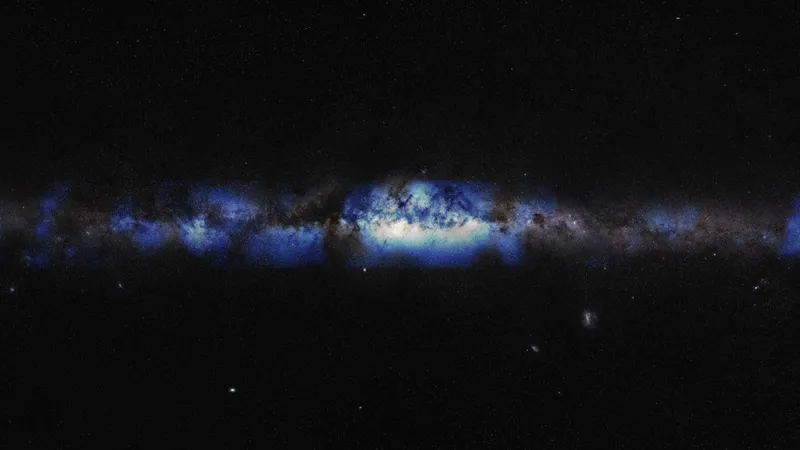
IceCube’s observations have helped establish that high-energy neutrinos originate both within and beyond the Milky Way. NASA has highlighted a 2017 detection in which IceCube observed a high-energy neutrino from the direction of an active galactic nucleus that was simultaneously producing a gamma-ray flare.
The discovery provided important evidence linking astrophysical neutrinos to specific cosmic sources.
IceCube changed neutrino astronomy
The construction of IceCube transformed the study of high-energy neutrinos from a largely experimental pursuit into a new branch of astronomy.
The project brought together scientists and engineers from institutions around the world. More than 400 researchers from 14 countries have contributed to the collaboration.
The observatory has produced observations that cannot easily be replicated with conventional telescopes.
Instead of simply seeing the light emitted by an astronomical object, scientists can use neutrinos to investigate the processes that accelerate particles to extraordinarily high energies.
That information can help researchers understand how some of the most violent environments in the Universe operate.
The significance of Halzen’s contribution therefore extends beyond the construction of a single scientific instrument. IceCube demonstrated that neutrinos could be used as astronomical messengers on a large scale.
A difficult idea becomes a working observatory
The journey from Halzen’s 1988 proposal to a functioning observatory took decades.
Scientists had to determine whether Antarctic ice was sufficiently clear, design sensors capable of operating under extreme conditions and develop methods to drill and deploy thousands of detectors more than 2 km beneath the surface.
The resulting observatory operates in one of the most remote and inhospitable environments on Earth.
The National Science Foundation said Halzen and other scientists developed a plan to place thousands of digital detectors deep inside the clear ice at the South Pole, where the enormous volume of ice could serve as the target for neutrino interactions.
The scale of the experiment was crucial. Rather than trying to capture neutrinos with a small laboratory instrument, IceCube effectively turned a cubic kilometre of natural material into a particle detector.
IceCube continues to evolve
The Nobel Prize recognises Halzen’s contributions to IceCube and its discoveries, but the observatory’s scientific work is continuing.
The IceCube Upgrade was installed during 2025–26, with the aim of lowering the detector’s energy threshold and improving calibration and the reconstruction of neutrino directions. The collaboration expects to begin obtaining science data from the upgraded system later in 2026.
Scientists are also considering IceCube-Gen2, a proposed expansion that would substantially increase the detector’s effective volume.
The proposed next-generation facility would allow researchers to study even higher-energy astrophysical neutrinos and potentially discover more cosmic sources.
The aim is to move beyond the first detections and build a much more detailed map of the high-energy neutrino sky.
Halzen’s work opens a new era of astronomy
The Nobel Committee’s recognition of Halzen reflects the broader significance of IceCube.
The observatory has shown that the Universe can be studied through particles other than photons, providing scientists with a new form of astronomical information.
Institute of Physics Director of Science Louis Barson said IceCube had enabled astronomers to investigate phenomena that conventional telescopes cannot see and that discoveries from the observatory were helping scientists understand some of the most energetic and mysterious processes in the Universe.
Physicist Subir Sarkar of the University of Oxford similarly described Halzen’s contribution as a new way of observing the Universe, comparing the work to seeing the cosmos through different eyes.
That is perhaps the central significance of the IceCube experiment.
For decades, astronomers have expanded their view of the Universe by detecting different forms of light. Halzen’s work added neutrinos to that expanding collection of cosmic messengers.
The particles are difficult to detect precisely because they barely interact with matter. But once scientists developed a detector large enough to capture their rare interactions, that same property became an advantage.
From a South Pole experiment to a new cosmic window
Francis Halzen’s Nobel Prize marks the culmination of a scientific idea that began with an unconventional question: could the enormous volume of Antarctic ice be turned into a telescope for particles that almost never interact with matter?
IceCube demonstrated that the answer is yes.
The observatory has detected high-energy neutrinos from astrophysical sources and helped establish neutrino astronomy as a new way of exploring the Universe.
For Halzen, the achievement represents decades of persistence and collaboration. For physics and astronomy, it represents something broader — another way to investigate the most extreme environments in the cosmos.
The “ghost particles” that pass unnoticed through the Earth are now being used to trace some of the most powerful events in the Universe, opening a new window on the cosmos.