







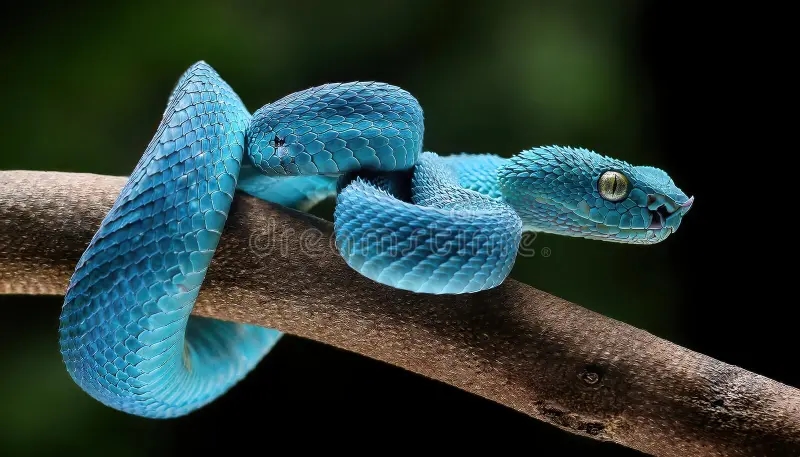


Drawing inspiration from nature, scientists in China have developed a new artificial vision system that mimics the heat-sensing ability of snakes, potentially transforming night-time imaging and surveillance technologies.
Researchers at the Beijing Institute of Technology have unveiled what is informally being called “snake vision” — an imaging technology inspired by pit vipers, snakes that can detect infrared radiation emitted by warm bodies. The findings were detailed in a peer-reviewed study published in Light: Science & Applications.
Inspired by pit vipers’ heat vision
Pit vipers possess specialised organs that allow them to sense heat rather than visible light, enabling them to hunt in complete darkness. The Chinese researchers replicated this biological advantage using principles of biomimicry, an approach where technological design borrows from natural systems.
Unlike conventional night-vision cameras, which rely on infrared LEDs to illuminate dark scenes, snake vision detects naturally emitted infrared radiation — similar to how thermal imaging works.
How it improves on existing night vision
Consumer-grade night-vision cameras often produce grainy or blurry images because they depend on artificial infrared illumination and low-cost sensors. Thermal cameras, while more effective in darkness, are expensive, bulky and typically deliver lower resolution images.
The new system bridges this gap by modifying a standard CMOS sensor — similar to those found in smartphones — to detect infrared radiation without sacrificing image clarity. This allows cameras to capture detailed, high-resolution images in total darkness without using any visible or infrared light source.
The science behind snake vision
Every object emits infrared radiation as heat, but this radiation falls outside the range that ordinary camera sensors can detect. Traditional thermal cameras use specialised materials and cooling systems to capture it, driving up costs.
The Beijing Institute of Technology team overcame this by inserting a quantum-dot layer into the CMOS sensor. This layer converts invisible infrared radiation into visible-light photons that the sensor can process. In effect, it acts as a translator, allowing the camera to “see” heat with the sharpness of modern digital photography.
Potential real-world applications
Researchers say the technology could make high-quality thermal imaging more accessible and affordable. Possible applications include security surveillance, search-and-rescue operations, industrial inspection, firefighting, and even future smartphone cameras.
By combining the strengths of thermal imaging and conventional photography, snake vision could redefine how machines perceive the world in low-light or no-light conditions.
Biomimicry shaping future technology
Scientists note that snake vision is part of a broader trend where nature-inspired engineering is driving innovation — much like birds influenced aviation and marine life shaped ship design.
As imaging technology continues to evolve, experts believe such bio-inspired systems may soon find their way into everyday devices, revealing a hidden world of heat and motion previously invisible to the human eye.